This is the last post for our Peruvian Odyssey. If you’ve just stumbled upon it, you might enjoy starting at the beginning and working your way through the whole story!
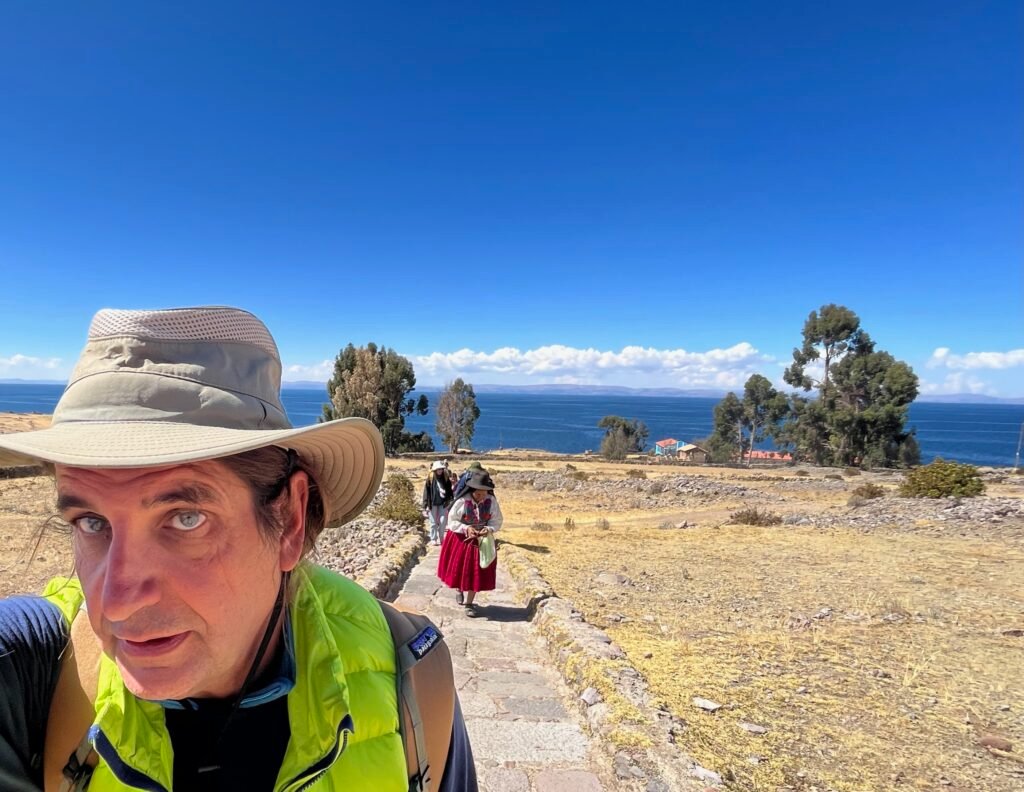
Yesterday was quite a day and it’s so hard to imagine leaving the antiquity and culture on Taquile Island, where there are no vehicles and solar power just arrived a year ago. We dropped into Lima, with a population of 12,000,000 and every possible convenience of modern civilization. We were then transported to Miraflores arriving at the Casa Andina Premium Hotel late.
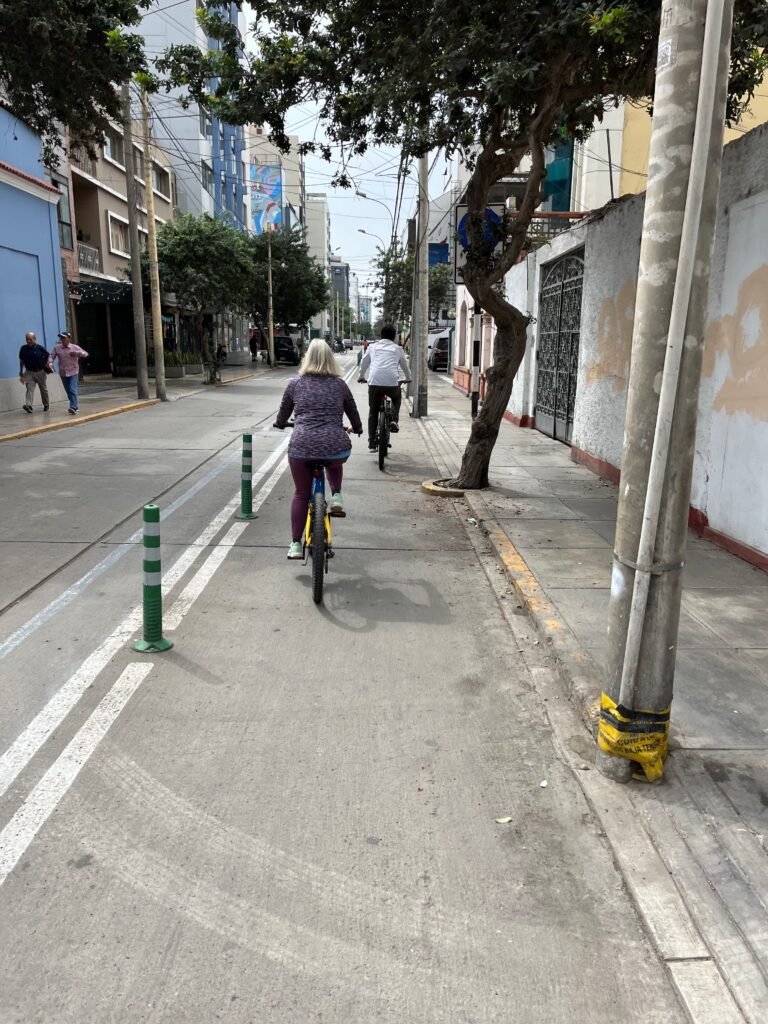
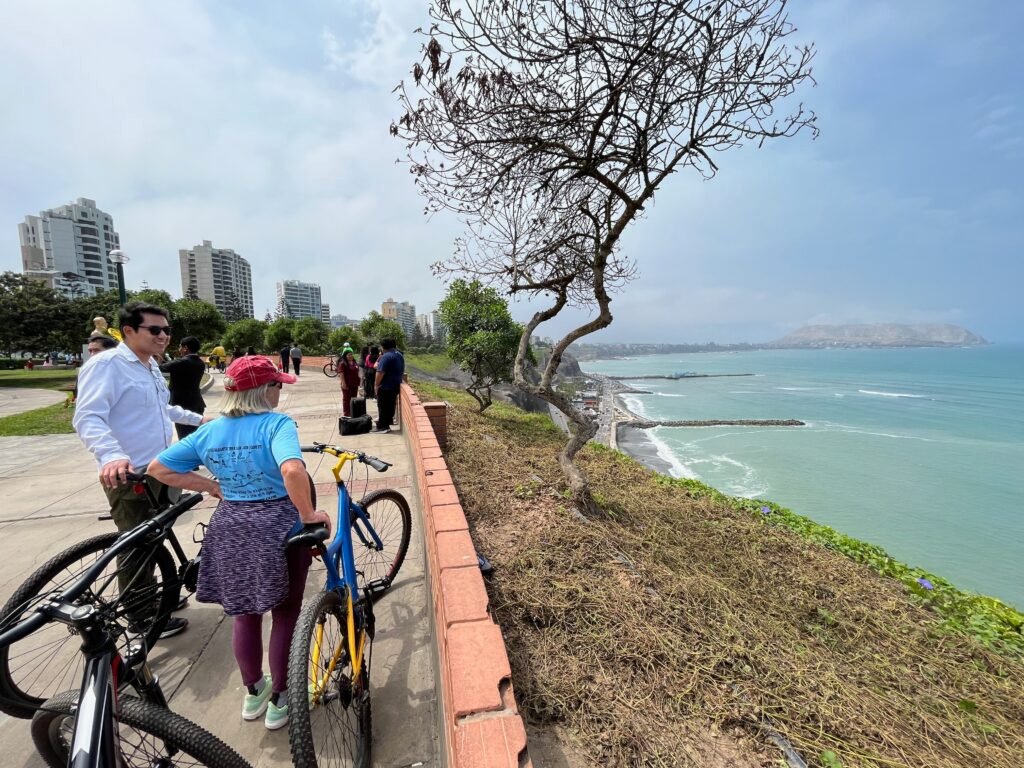
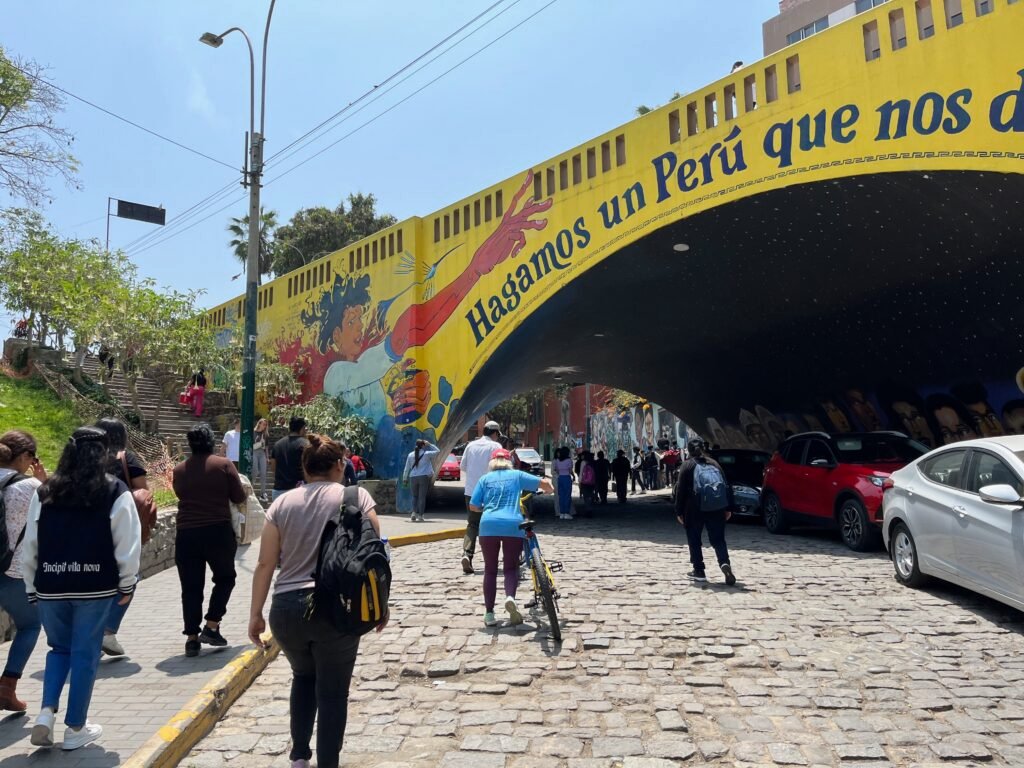
Today is our last full day and we are to take a guided bike ride to and along the coast and through the art district of Miraflores. Our guide, Alberto, showed up right on time and we walked a few blocks to a bike rental shop and picked up a couple of bikes.
As it turns out, Sunday is a pretty wonderful day to bike in Lima. The culture in Peru does a pretty good job of taking the same day off from work and it made for a stress-free ride through the city to the coast. Once on the coast, however, we found that all those people taking the day off were also really enjoying the coast!
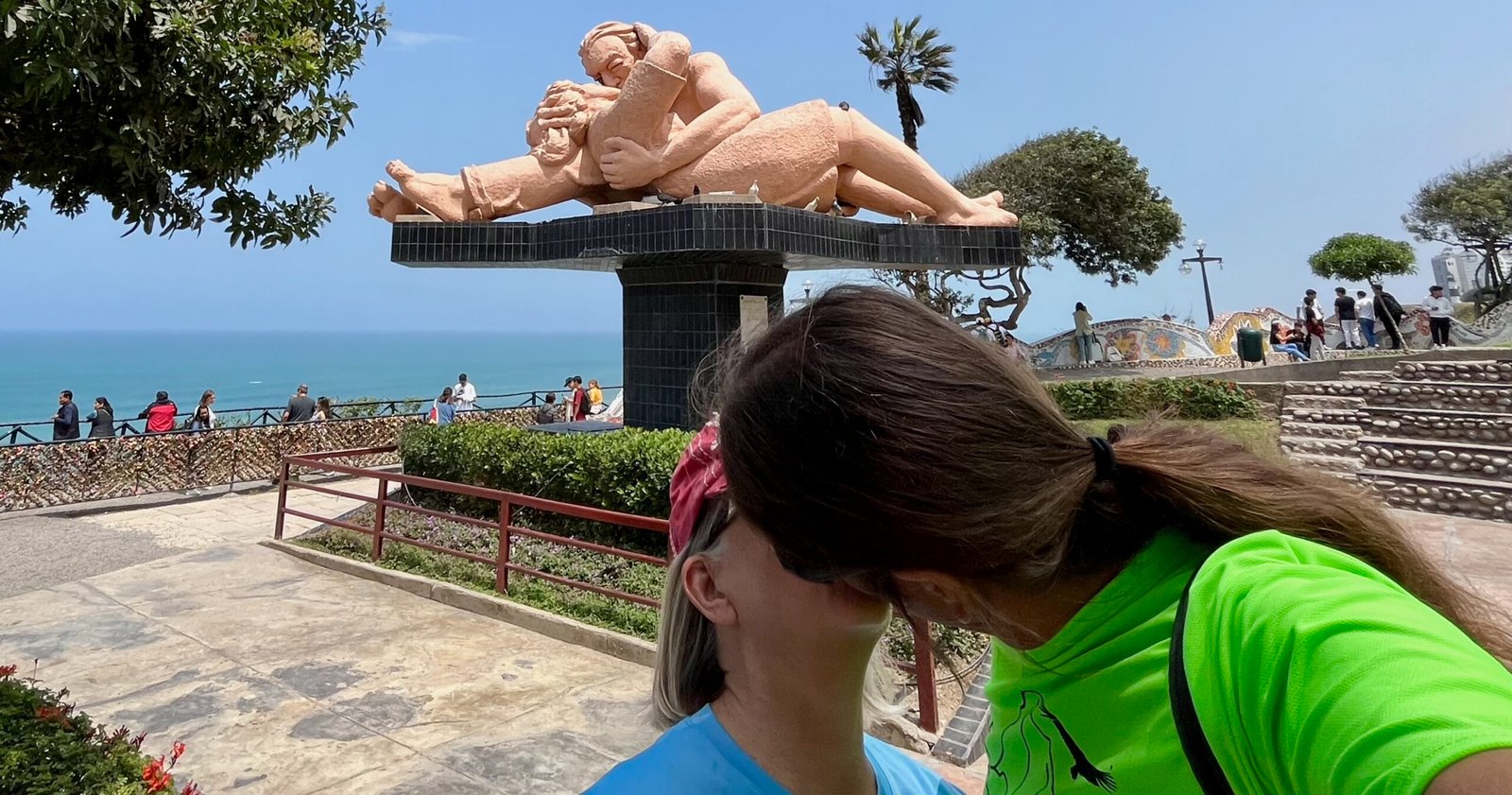
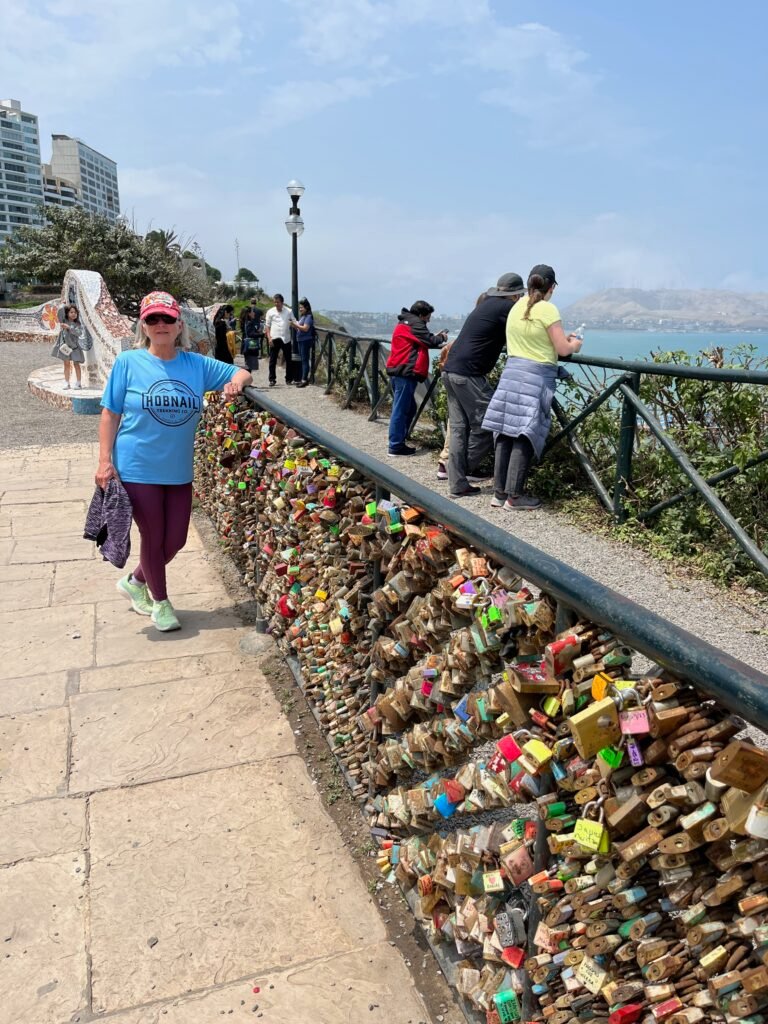
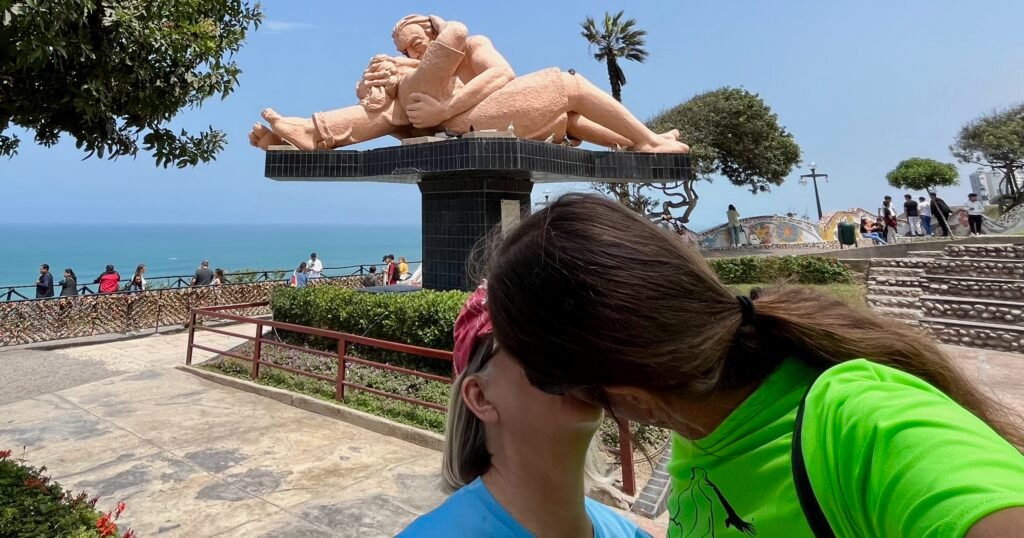
It was a fun ride. Our guide, Alberto, filled us in on some of the history as we rode along. The “kissing park” is pretty popular and many have placed locks of love on the fencing!
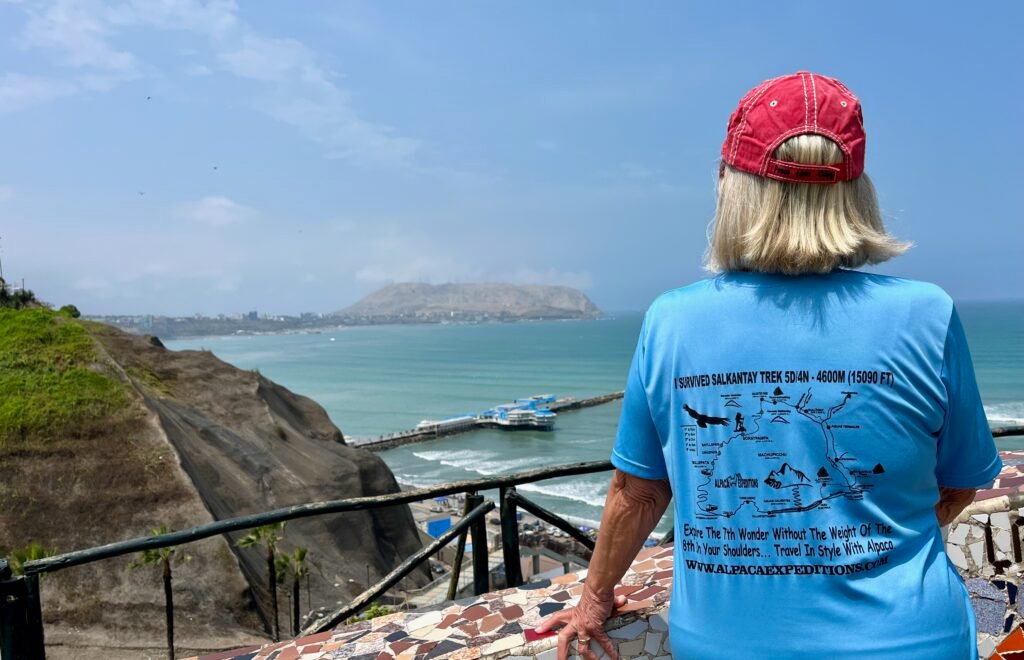
It was quite the casual ride after our Salkantay Trek!
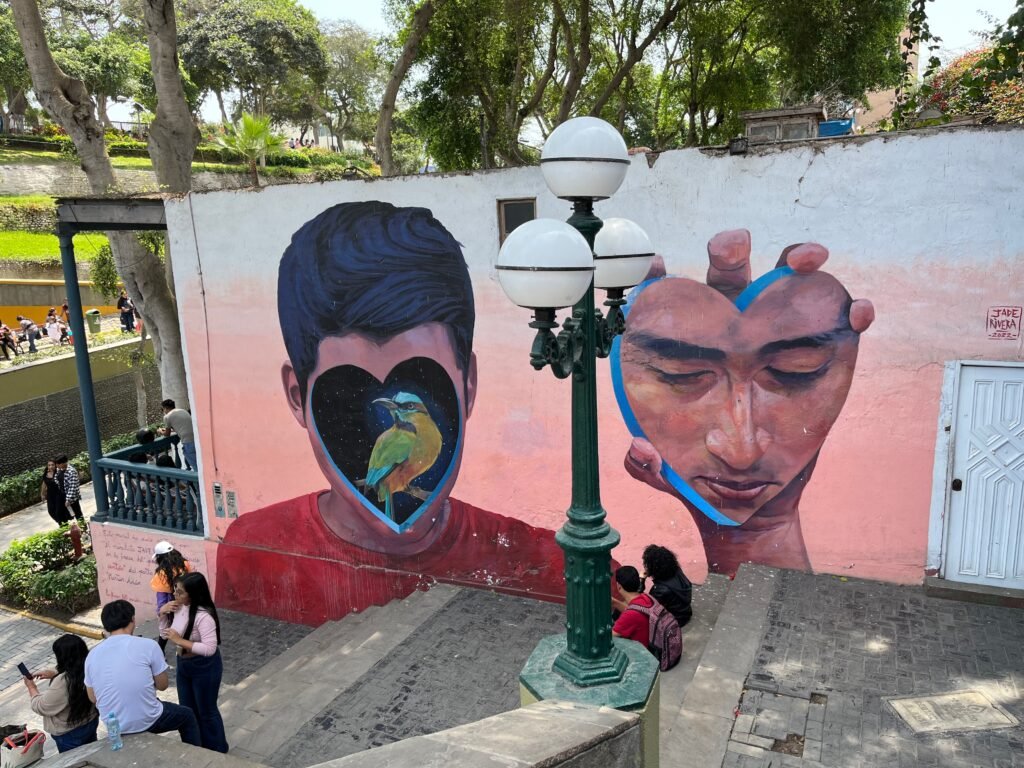
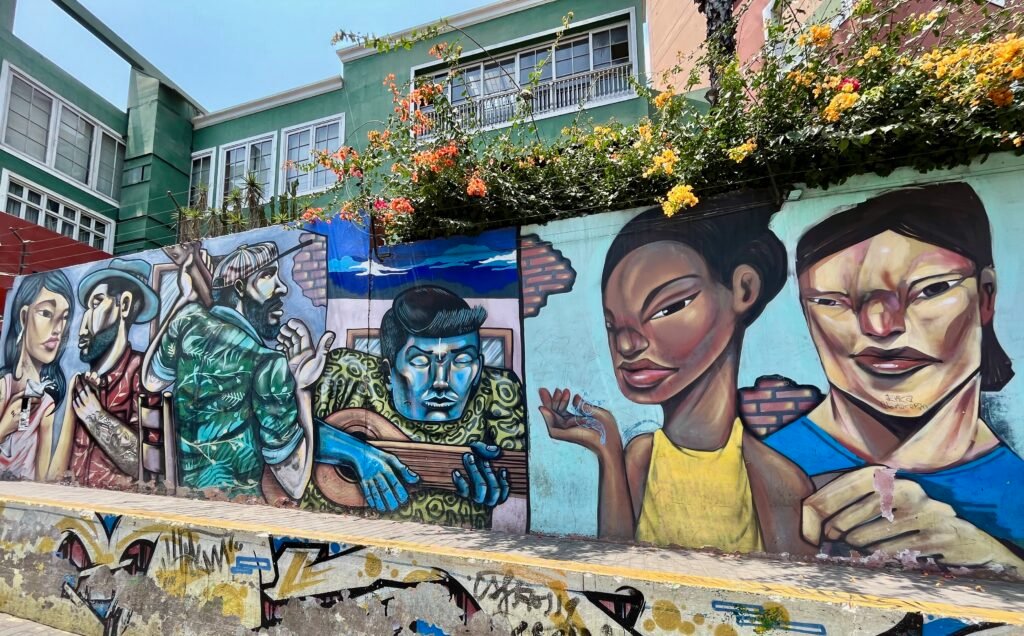
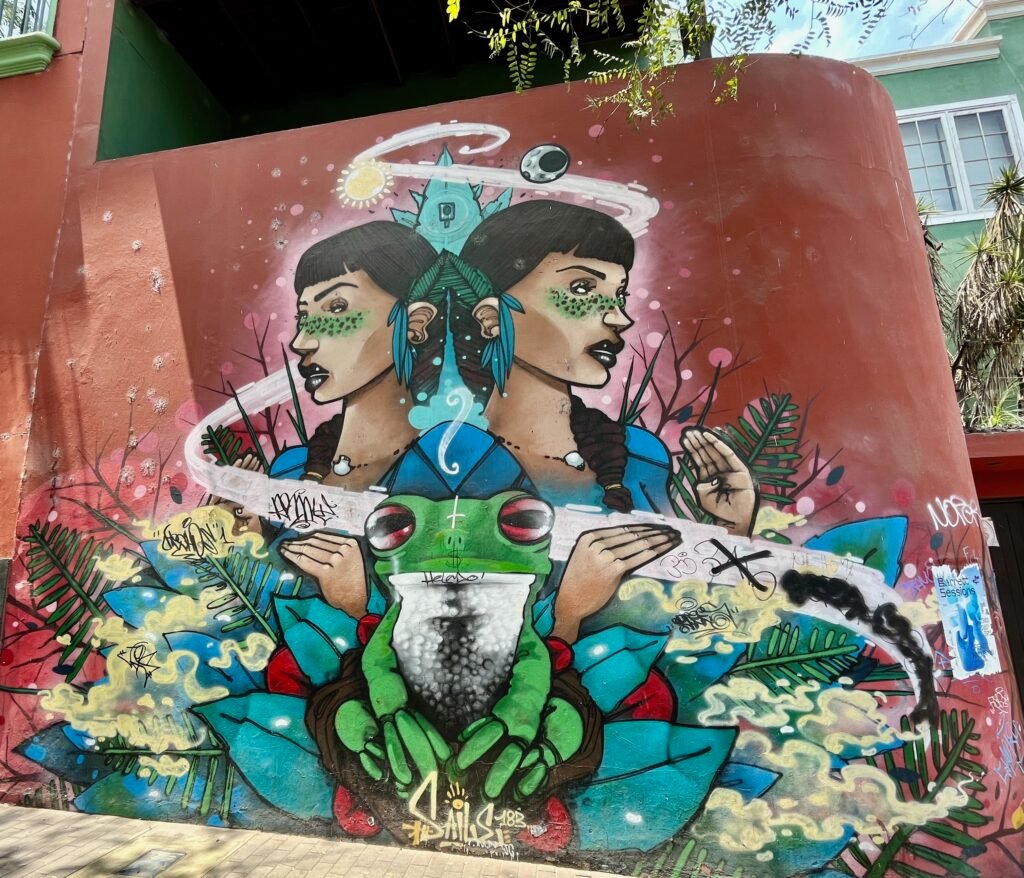
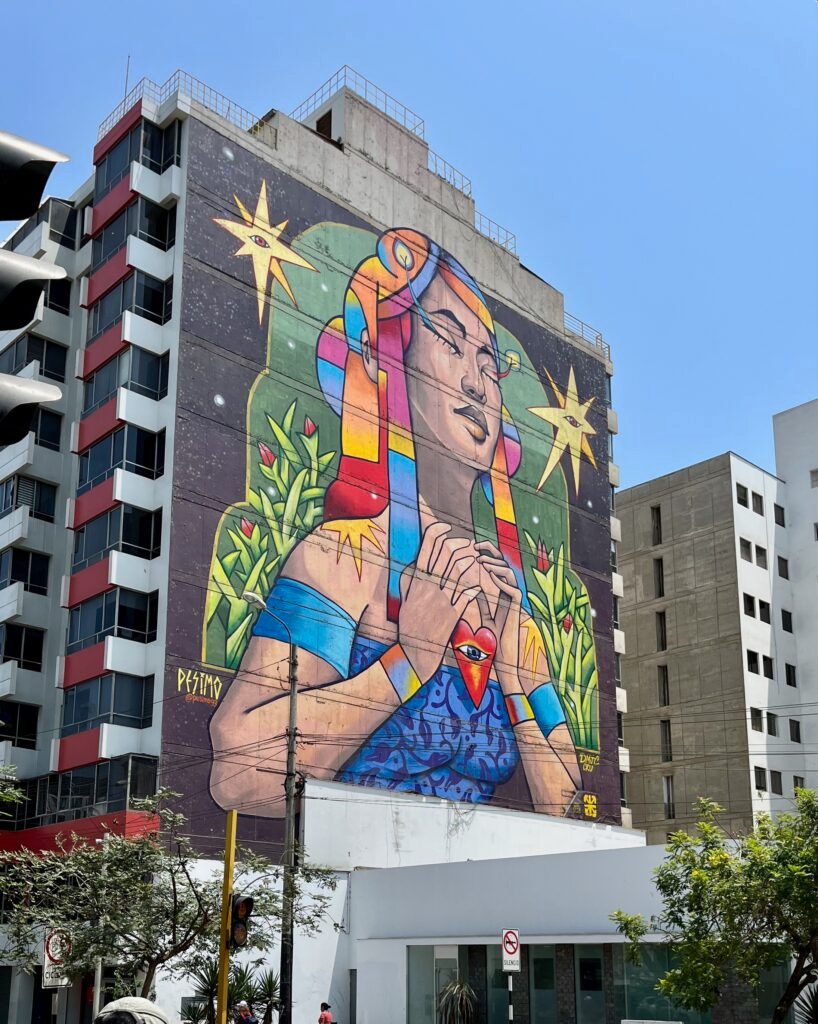
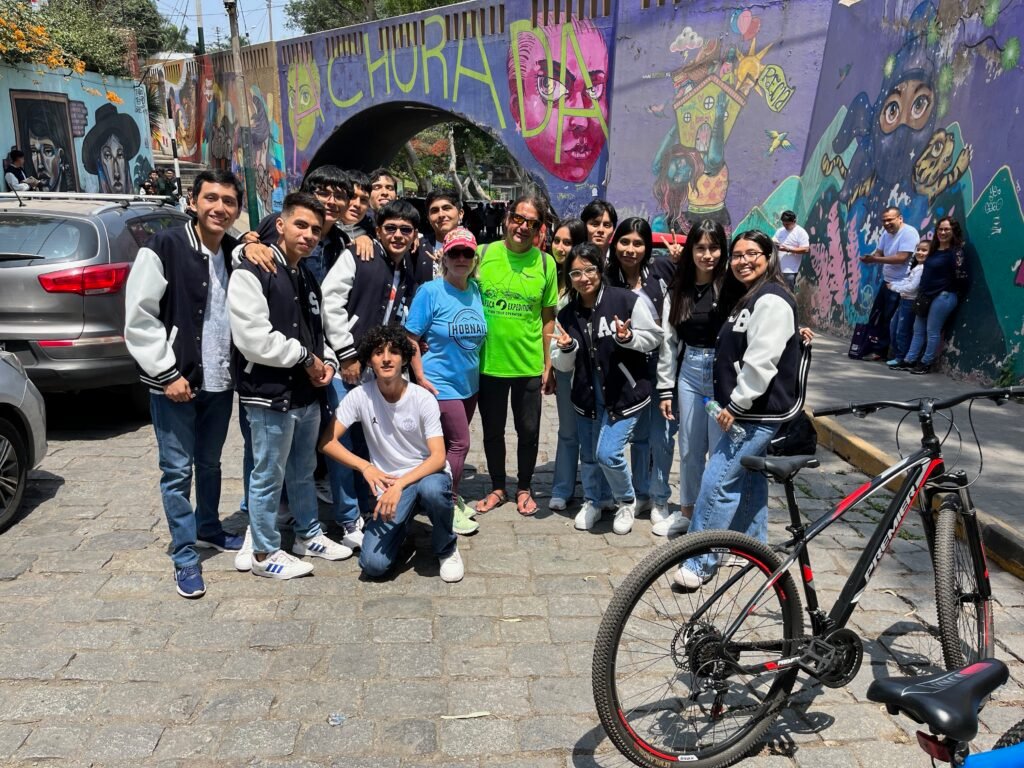
The Miraflores district is known for its art and we enjoyed the displays all around. At some point we were “discovered” by a local high school group. Tourists! We briefly became famous as they all gathered to take pictures with us.
There is a large sculpture in the Parque del Amor, the love park. Named El Beso (The Kiss), it is a very popular place. The mayor used to hold a competition for the couple with the longest kiss!
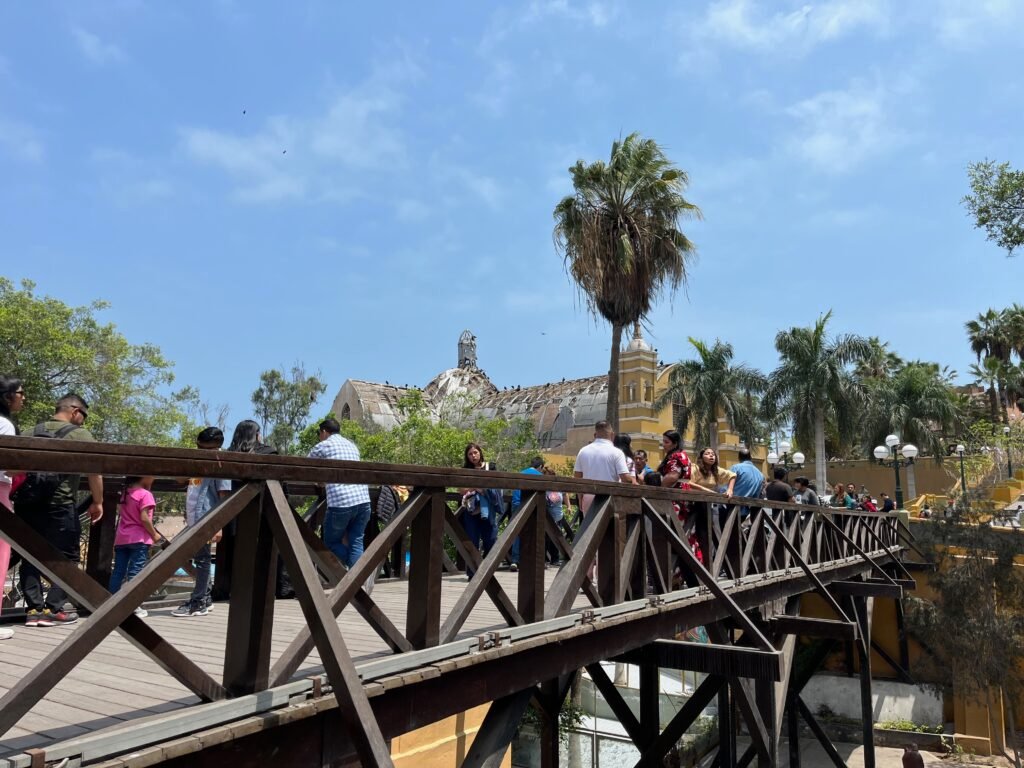
This is called the Bridge of Sighs but I think the one in Venice, Italy is the one that Robin Trower titled his second album after!
But here, the goal is to make a wish and then walk completely across the bridge while holding your breath. Let out a sigh at the end and your wish will come true!
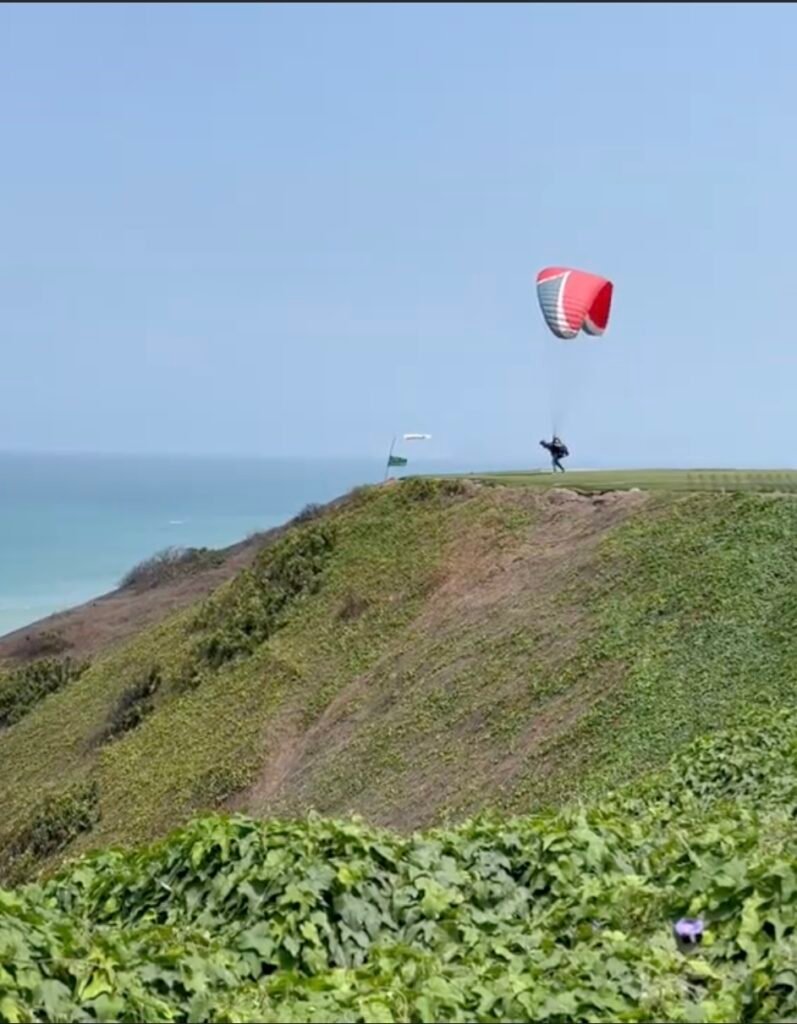
It was fascinating to watch the paragliders on the coast. I was really surprised they were allowed so close to the city with all the power lines and tall buildings!
The picture takes you to a two minute clip of a pretty cool ride. Where will he end up?
A fun 10-mile ride followed by a fabulous meal at Alfresco’s and the day was done! And then it was up sometime after 4am in order to catch our morning flight toward home.
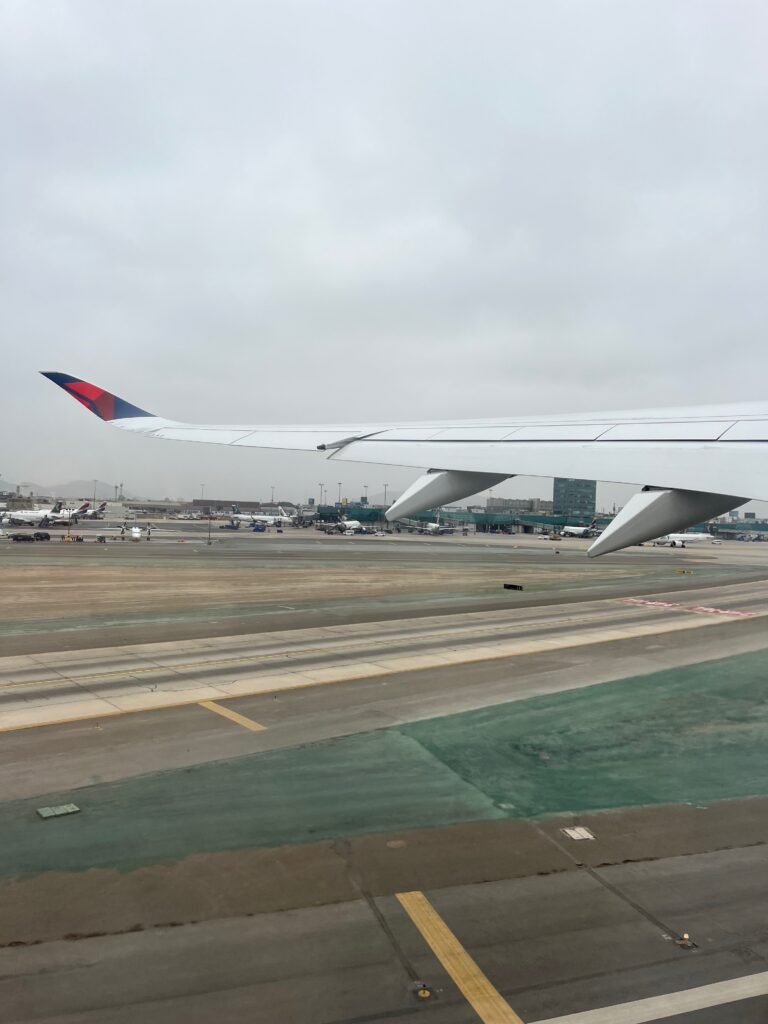
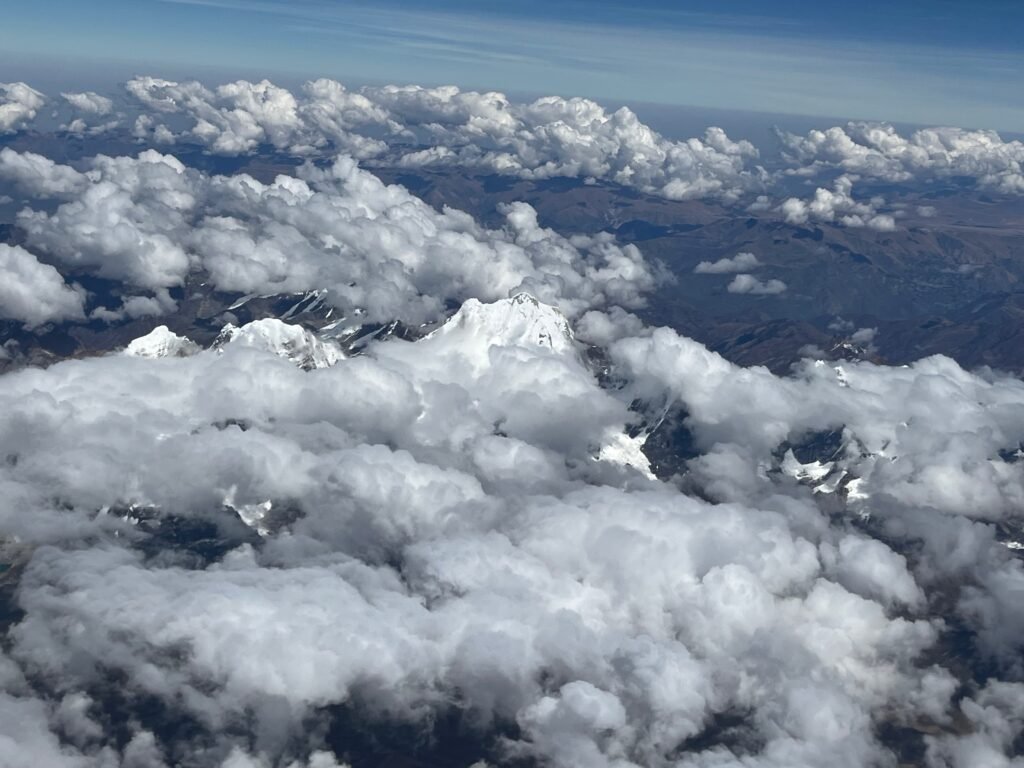
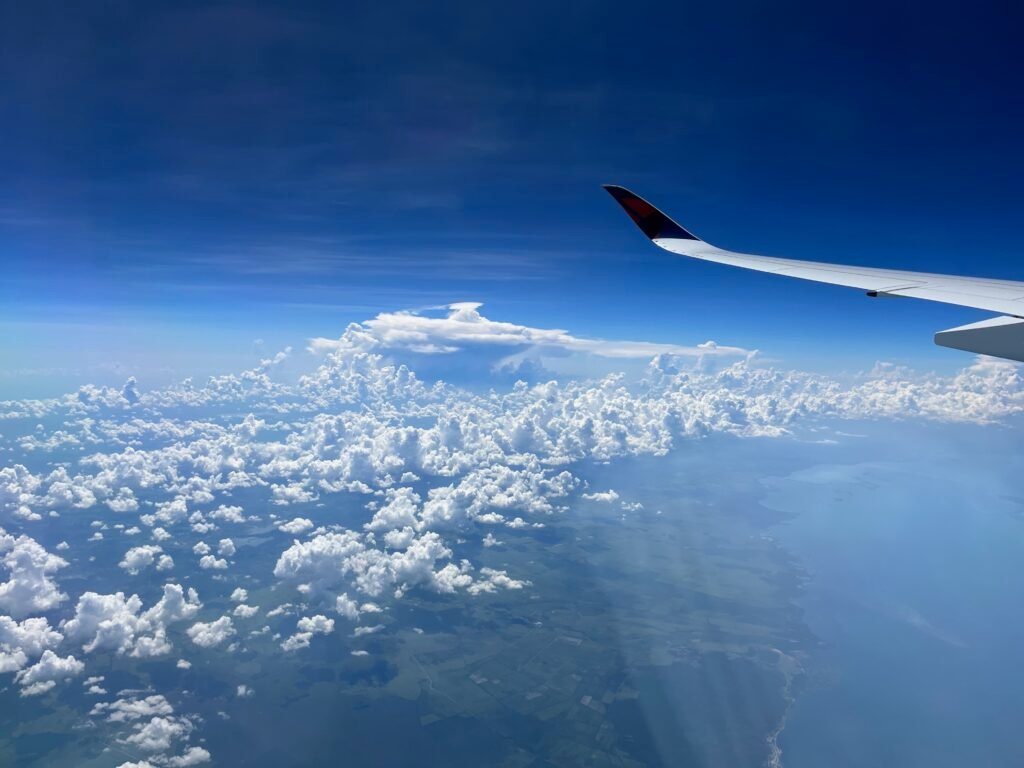
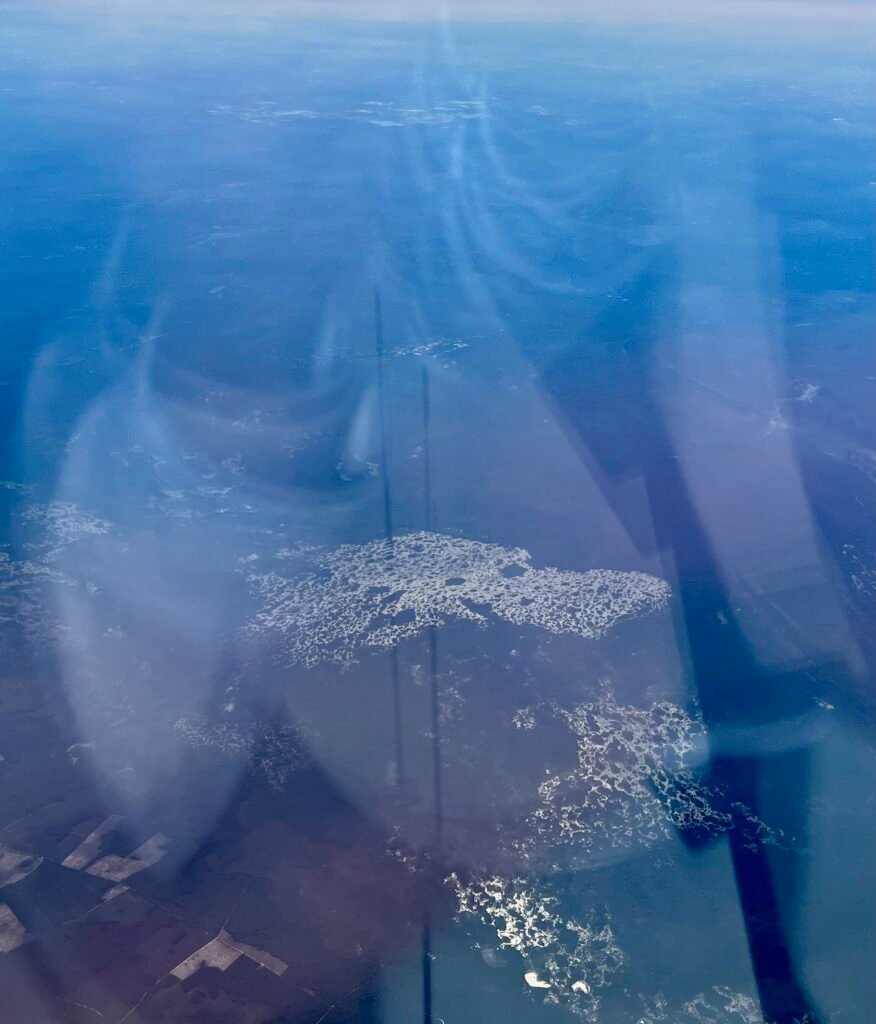
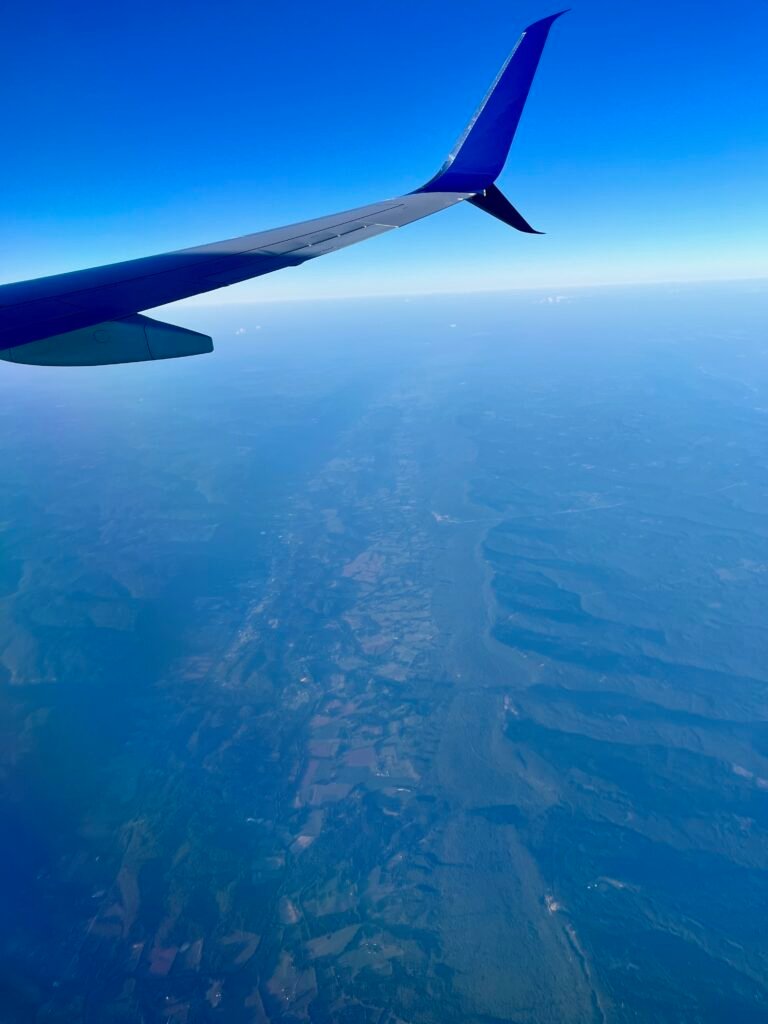
I love getting the window seat (and Patricia graciously offers me hers most of the time)! It was fun crossing the Andes on our way to Atlanta and I was able to spot places we had visited in the Florida Keys. I even saw the Okefenokee Swamp from above, a place I have visited a few times.
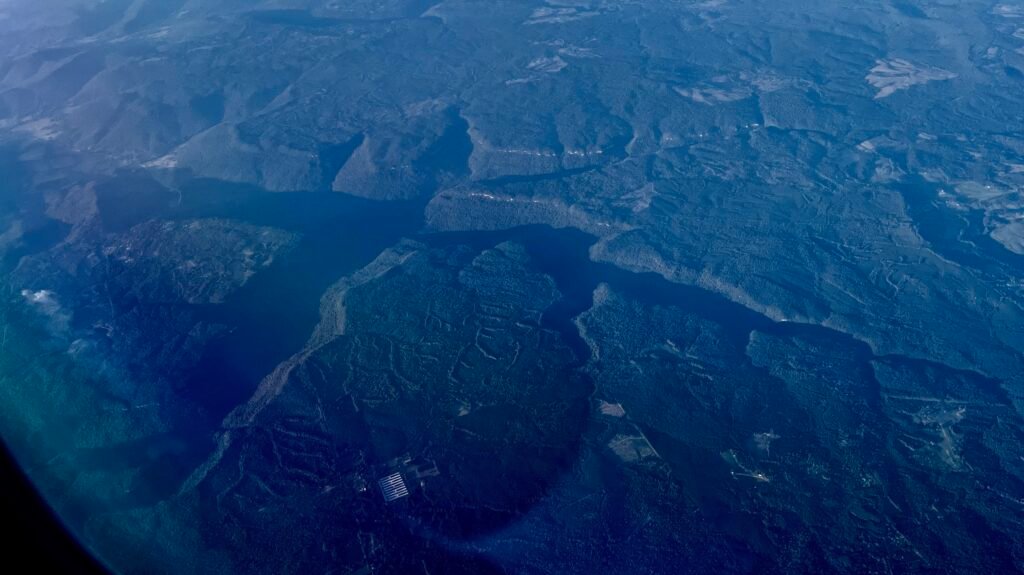
After Atlanta, The Sequatchie Valley and the crow’s foot gorges of Savage Gulf in Tennessee were very familiar. While we live “on the mountain” in Monteagle, it certainly feels like a hill after the Andes!
Bilbo Baggins, from The Lord of the Rings, compiled his memoirs into There and Back Again. Kind of a Hero’s Journey, where one leaves on a quest and brings something back with him.
While not a hero, I certainly have brought plenty back with me! And I’ve savored the memories over the last few weeks as I’ve ever so slowly compiled this blog. And I’ve learned it’s pretty much impossible to convey an odyssey to anyone back home. You start showing picture, their eyes glaze over after the first 300 or so, and you feel pretty silly. In the end, I wrote this blog for myself (and Patricia!) as a way to relive the experiences from time to time. And even at that, there were so, so many things not captured here! But that’s okay, the joy and the memories are still there. And of course we’re glad you’ve followed along.
Another shout out to Hobnail Trekking and Alpaca Expeditions for nearly perfect execution and truly meaningful and immersive experiences!
And of course to Trail Ninja! The adventure of a lifetime and with my soul mate at my side.
I wish to leave you with two thoughts that seem to recur to me time and time again as I’ve struggled how to explain the odyssey:
It’s like taking one of your best adventure vacation weeks and cramming it all into one day…and then doing that for 14 days in a row1
If I knew that tomorrow was going to be my last day, I think I’d be ok with it. This trip filled a yearning that maybe I didn’t even know needed to be filled.
Yeah, I said that wrong. What I should have said was la casa de la abuela. But more on that later.
The next couple of days turned out to be unexpectedly epic. Today started at 7am with a nice breakfast buffet at the hotel. After a quick taxi ride to Puerto Puno we reconnected with our young guide Ricardo and boarded the tour boat for the trip to Amantini Island on Lake Titcaca, the largest lake in South America and considered the highest navigable lake in the world.
There are many places in Peru where the Spanish could not pronounce the local words properly. Lake Titicaca has that unfortunate distinction. In the Quechua and Aymara languages, “Titi” means puma or cat, while “qaqa” may mean gray or strong, respectively. Gray because it is overcast most of the time.
It was a chilly and beautiful day with a blue sky, unlike the typical “gray puma” namesake the lake has.
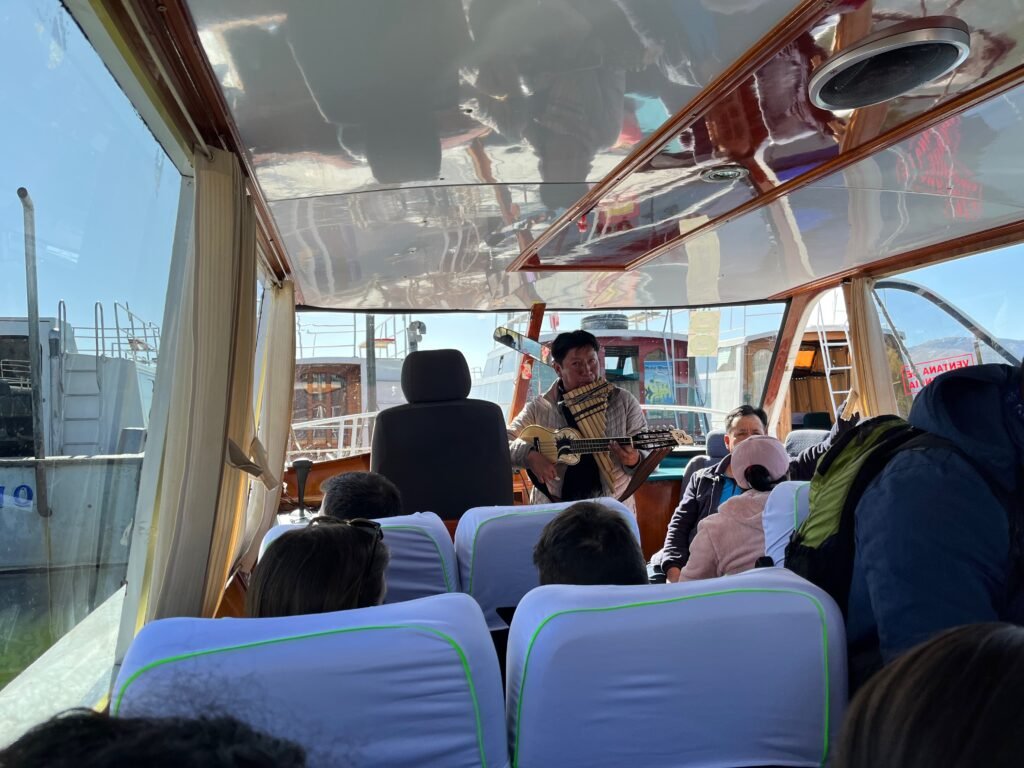
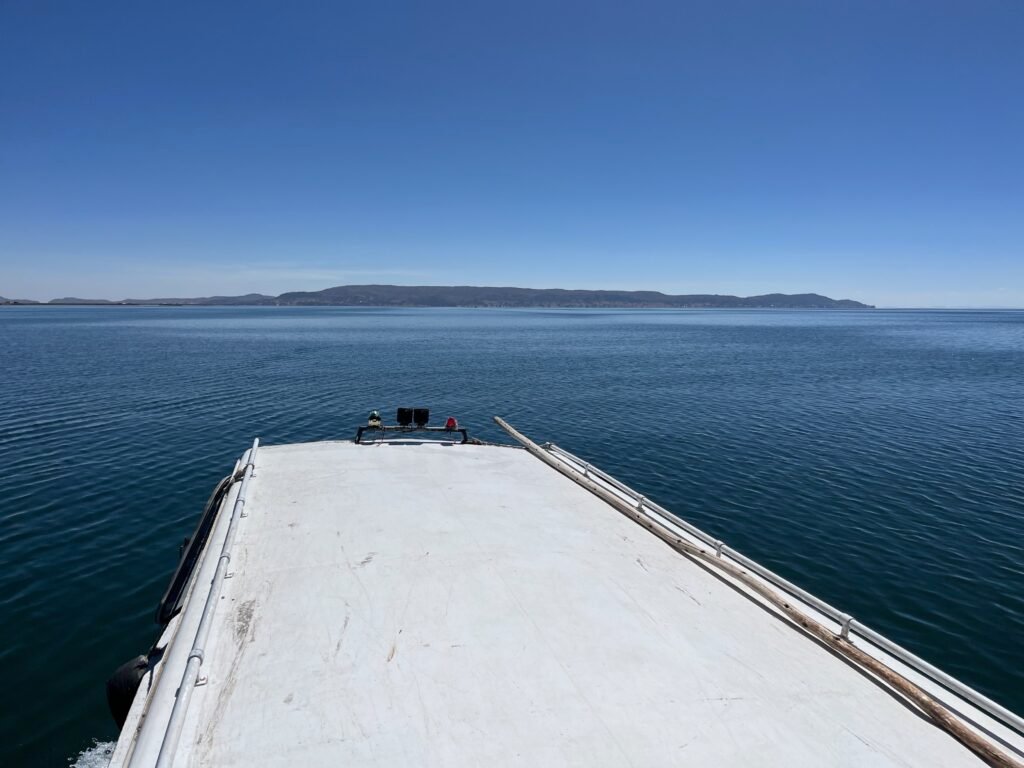
Our tour boat held about 25 people and was comfortable. There were several guides, with Ricardo hosting about seven of us. There was some onboard entertainment and wonderful views from the top of the boat as we motored along.
It took a couple of hours to go the 15 miles or so to get to our first stop.
The Floating Islands of Lake Titicaca
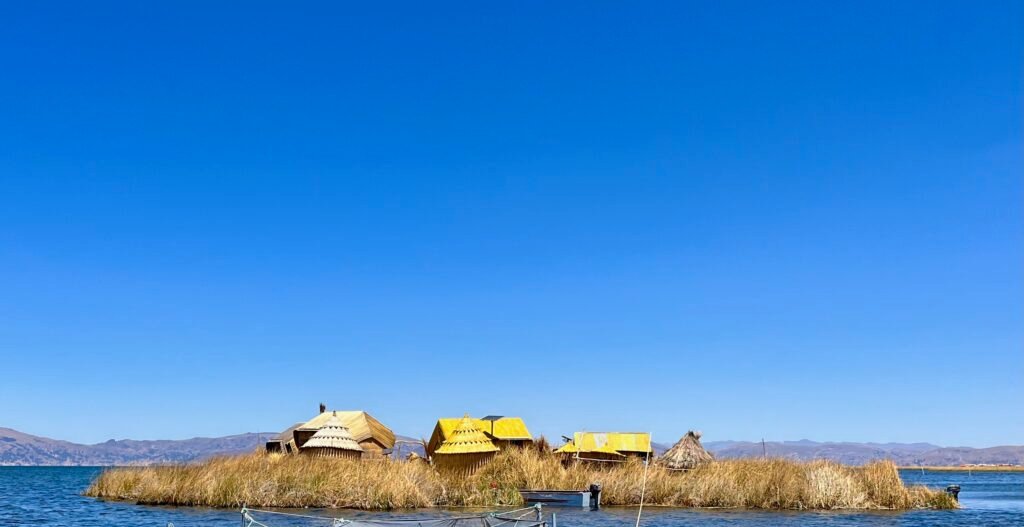
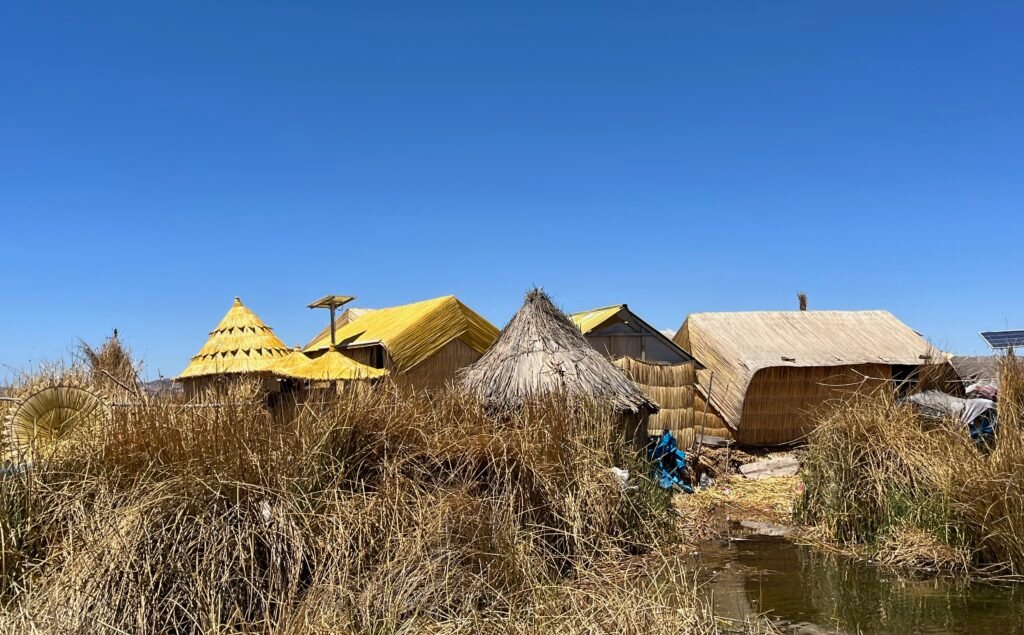
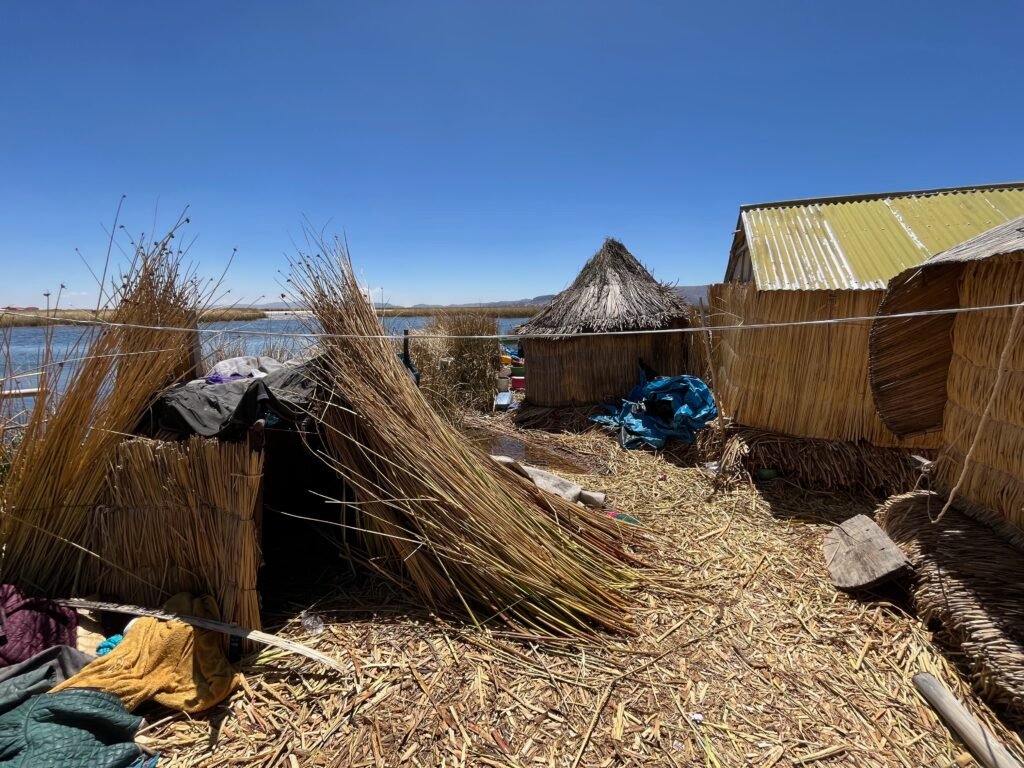
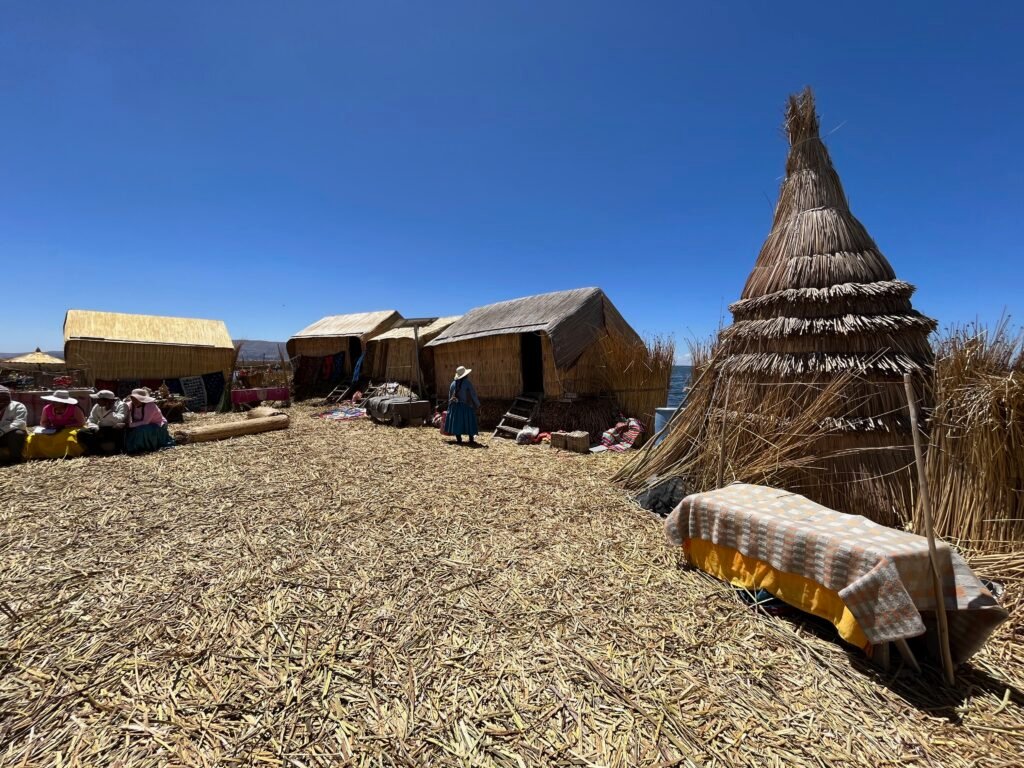
It is still hard to believe these exist in ‘modern’ times. But apparently the Uru people are a growing group, at least according to Wikipedia. And, as of today, there are over 120 floating islands in the lake! Maybe a half-acre in size, they are built completely from totora, a type of bulrush. And with proper care they can last over 30 years. A tradition started over 400 years ago.
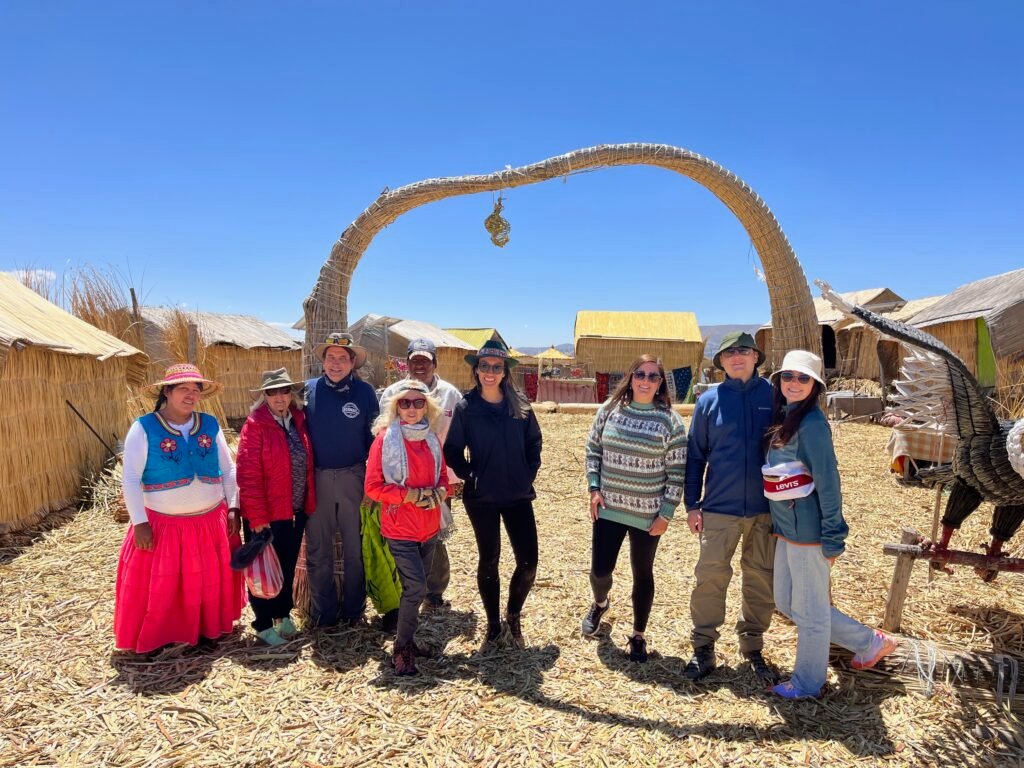
The island we visited contained five households, about 30 people. As the tour boat dropped off Ricardo’s group, I realized how fortunate we were to have a small group of seven!
Typically, tour boats visit the same island community once or twice a month and there are enough islands to rotate the guests without overloading the hosts.
While many of the communities embrace tourism, some do not. And while it’s apparent that our hosts were catering to us for our visit and selling their goods, it felt very comfortable and connected. I believe the approach, at least for our visit, is working well.
Why? How?
Apparently, centuries ago, people from the Amazon region discovered Lake Titicaca and decided it was the place for them. They began to make reed boats and live off the land and lake. As the Inca Empire grew, so did their need for labor. The Uru did not want to be a part of this and took to living on their reed boats away from shore and were left alone.
When the Spanish conquistadors arrived and started enslaving and killing the locals, the Uru moved further into the lake and started building the islands as permanent settlements, probably saving their culture. Since the islands could be moved, they were able to adapt to the threat and relocate as necessary.
So they’ve been making these islands for over 400 years, longer than the USA has existed!
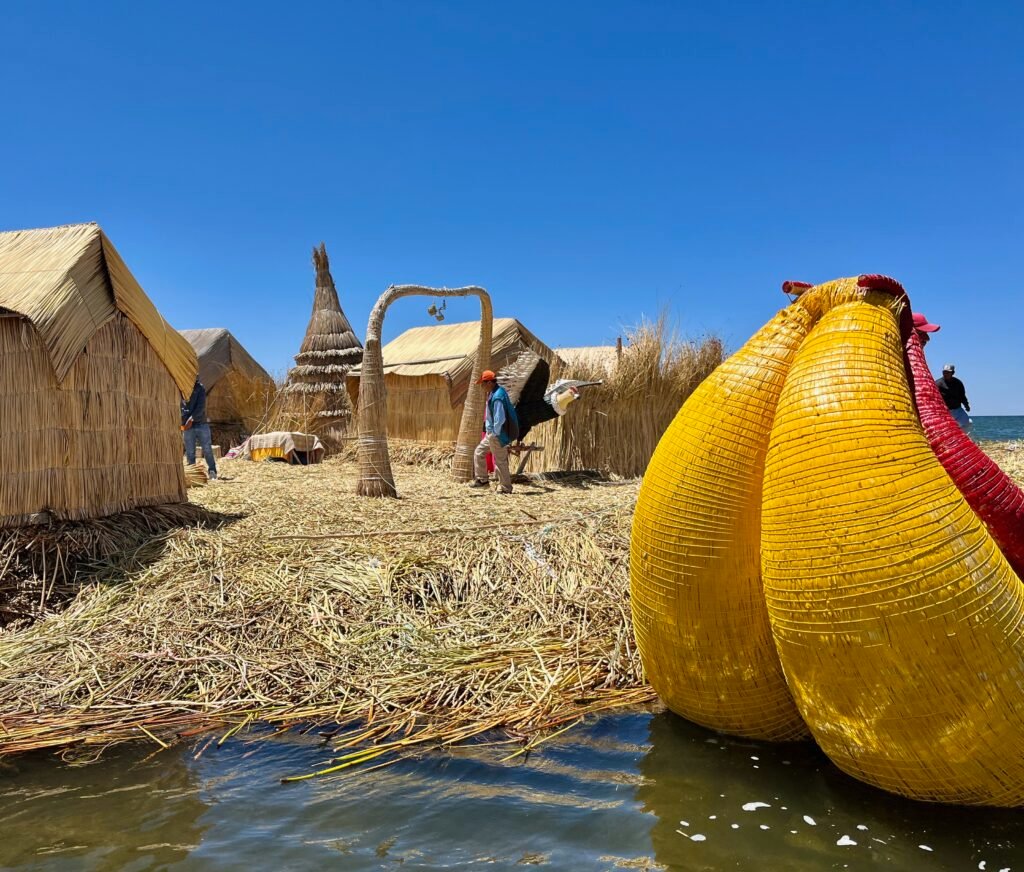
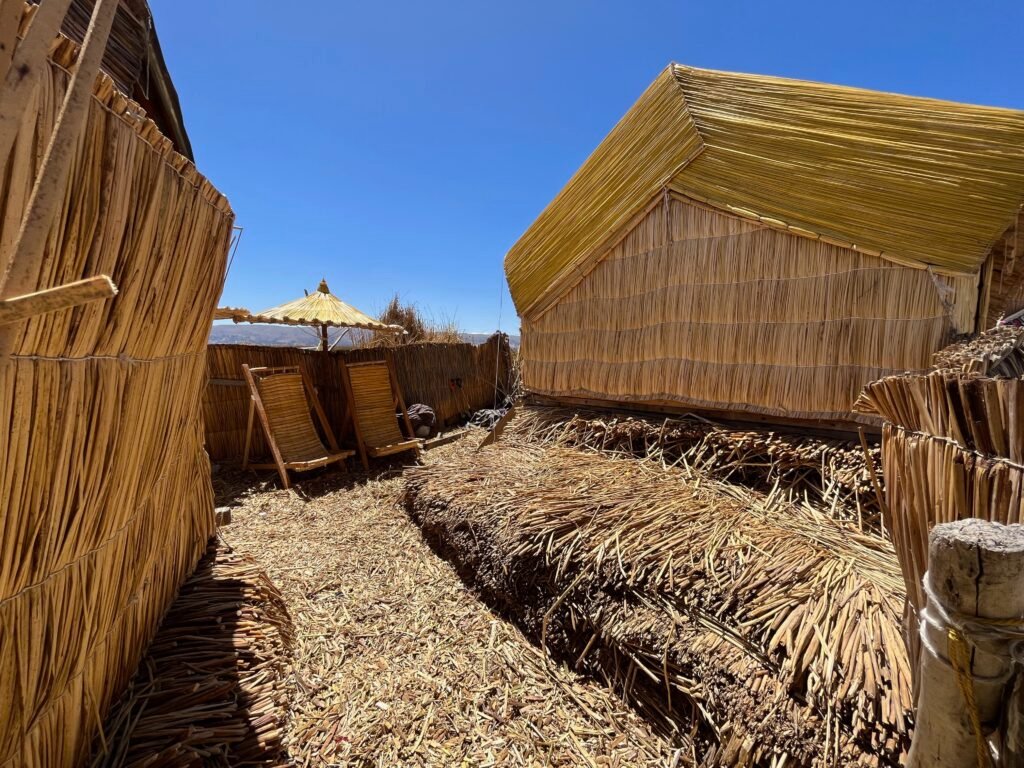
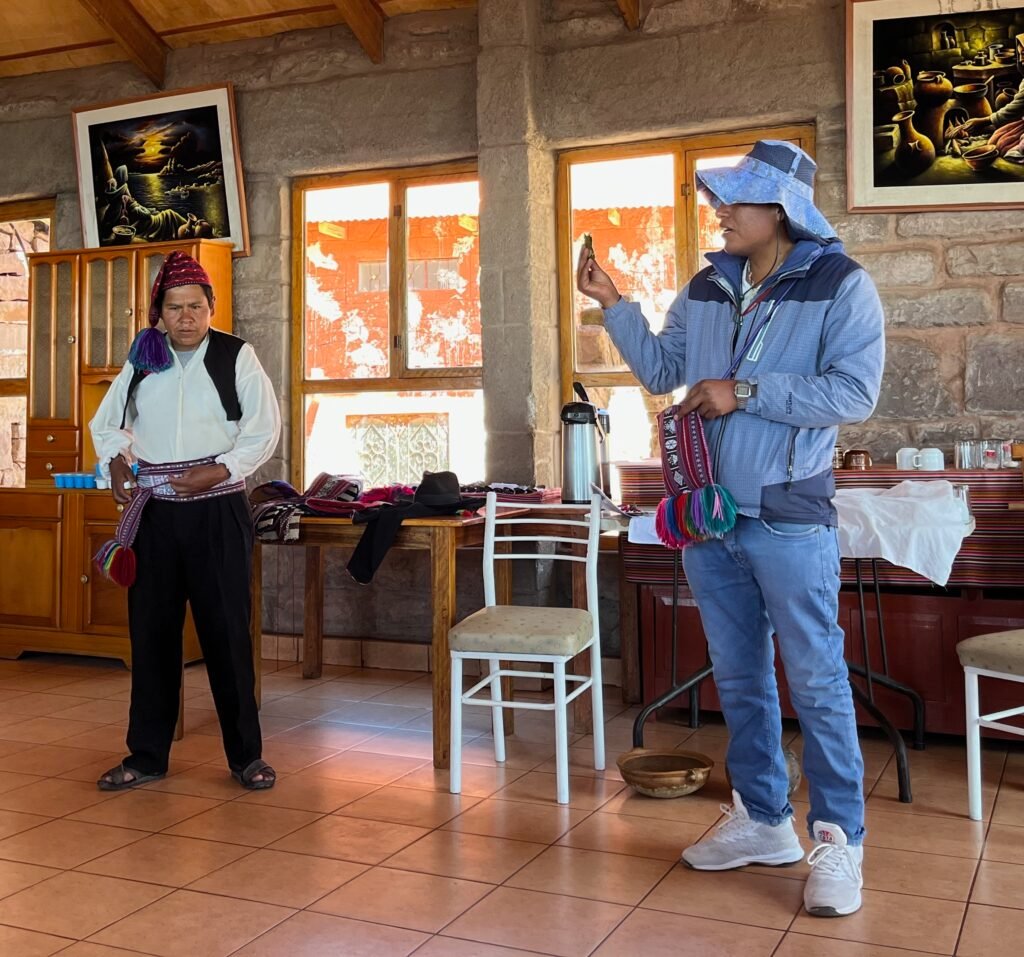
Ricardo, shown on the right, was born on a floating island. He and the village leader demonstrated how the heavy rootstock of the totora is separated from the lake bed and bound together in blocks to make the base of each island. The root blocks grow into each other and solidify the base. Totora reeds are then thatched over the top to make the platform. And every couple of years more is added as the layers decay.
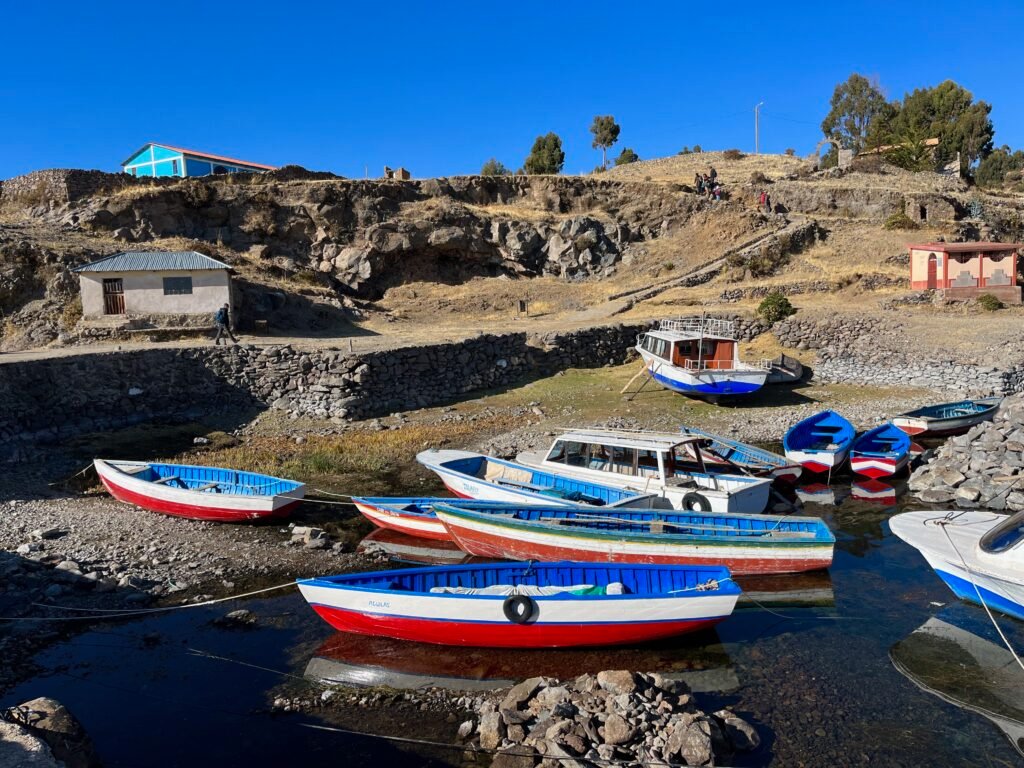
The islands are moored, but sometimes in storms they drift. Small motorboats are used to move them around when necessary.
So cool!
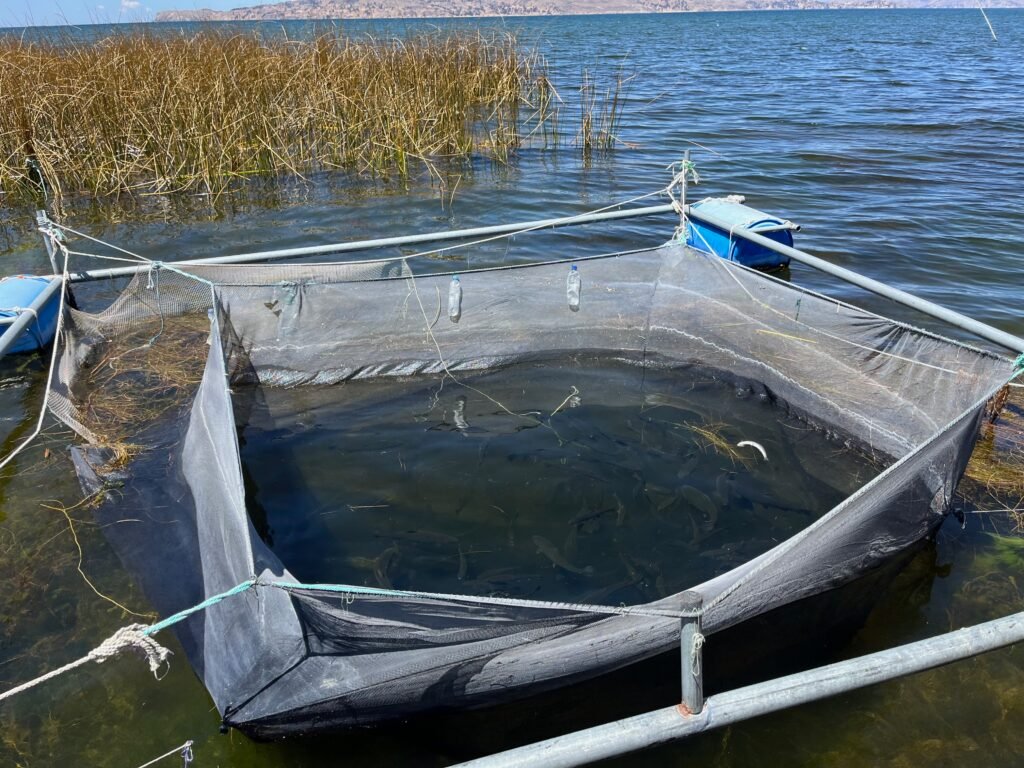
The leadership of the island rotates from household to household. The children learn to swim at an early age and each commands their own little motorboat at age 5 or 6 for the 30 minute ride to school on another island! The totora reed is quite edible and kind of like cucumber in taste. The Uru also raise ducks, guinea pigs, fish and hunt waterfowl. Rainbow trout were introduced a decade ago, so there are fish pens too.
Sometimes there is a dispute between families in the community that cannot be resolved. In this situation the home can literally be cut out of the island and floated to another location. This sounds like the perfect subdivision! Just take your home and move it to a different community!
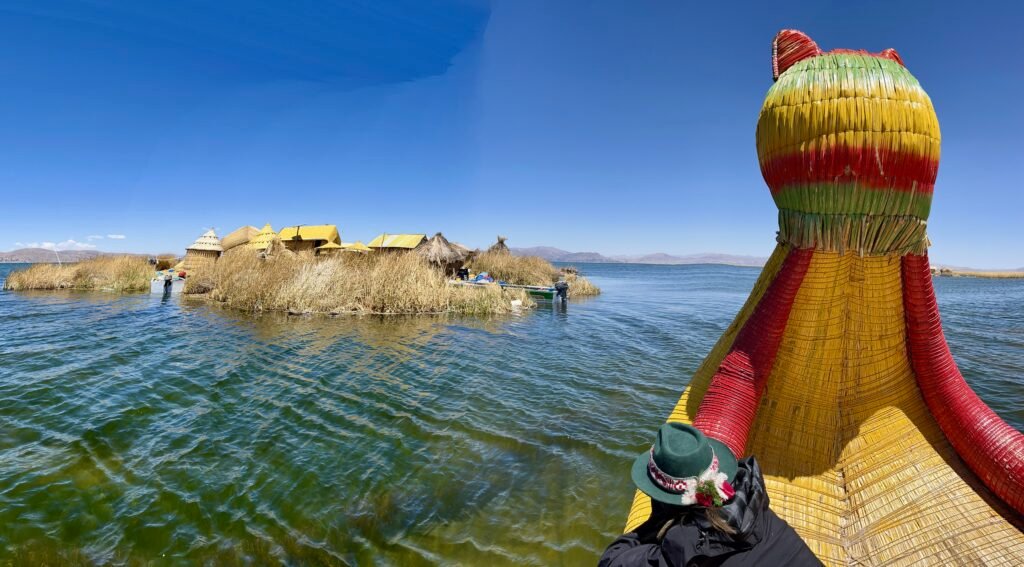
For a few soles, we opted for a 30 minute reed boat tour by the village leader. He showed us the surroundings, one of the fish pens, and how the totora reed is harvested. It was a great day to be out on the lake and we were just completely amazed at what we were seeing.
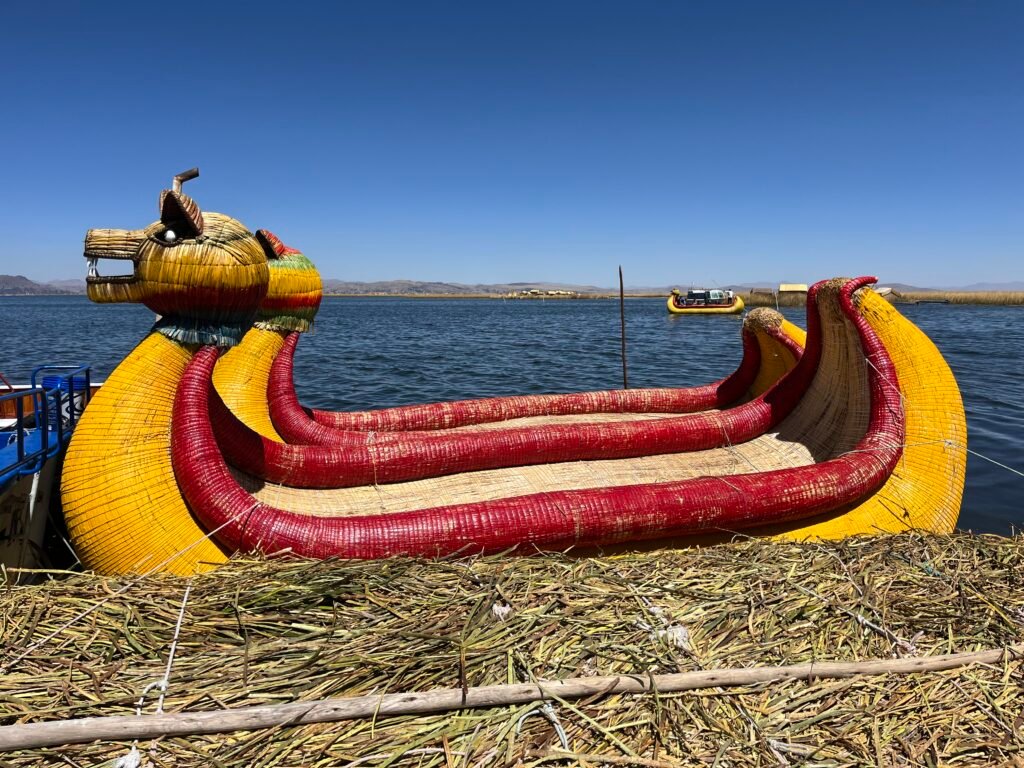
The leader called the colorful reed boats ‘romance boats’…
Two will go out and three will return.
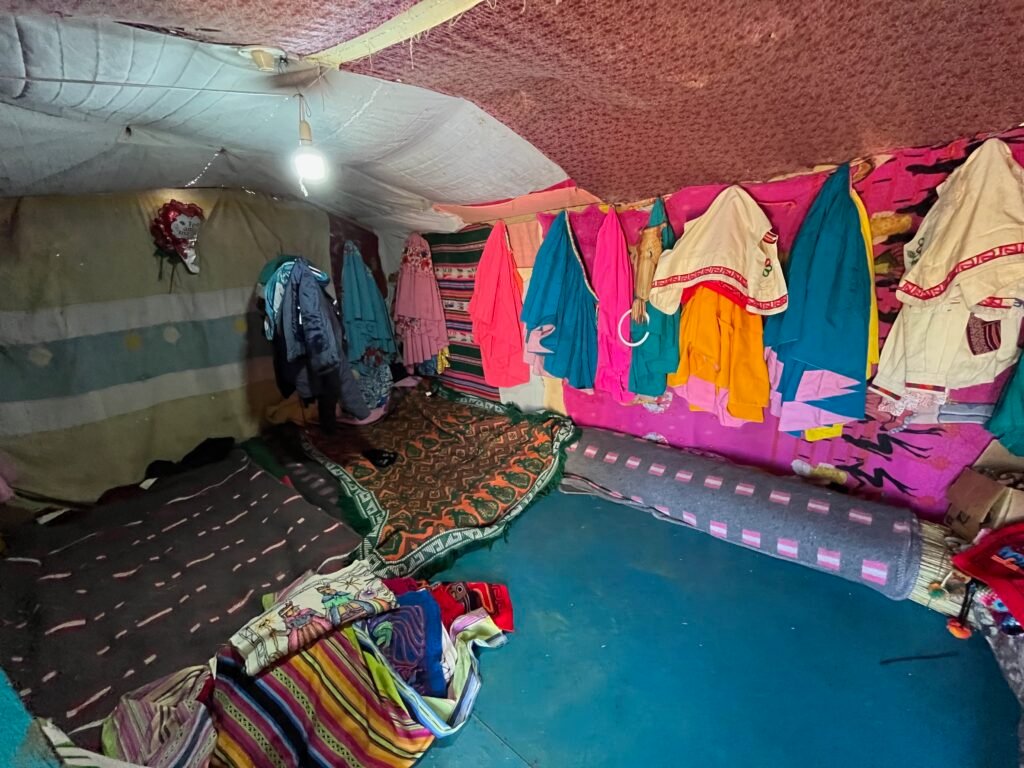
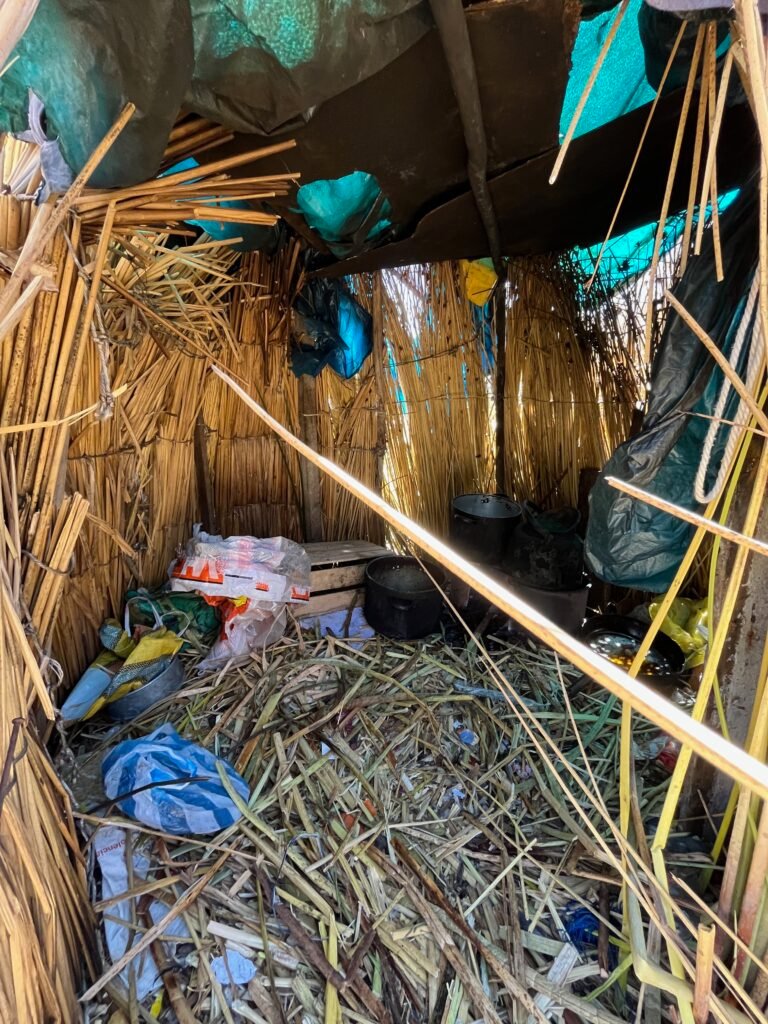
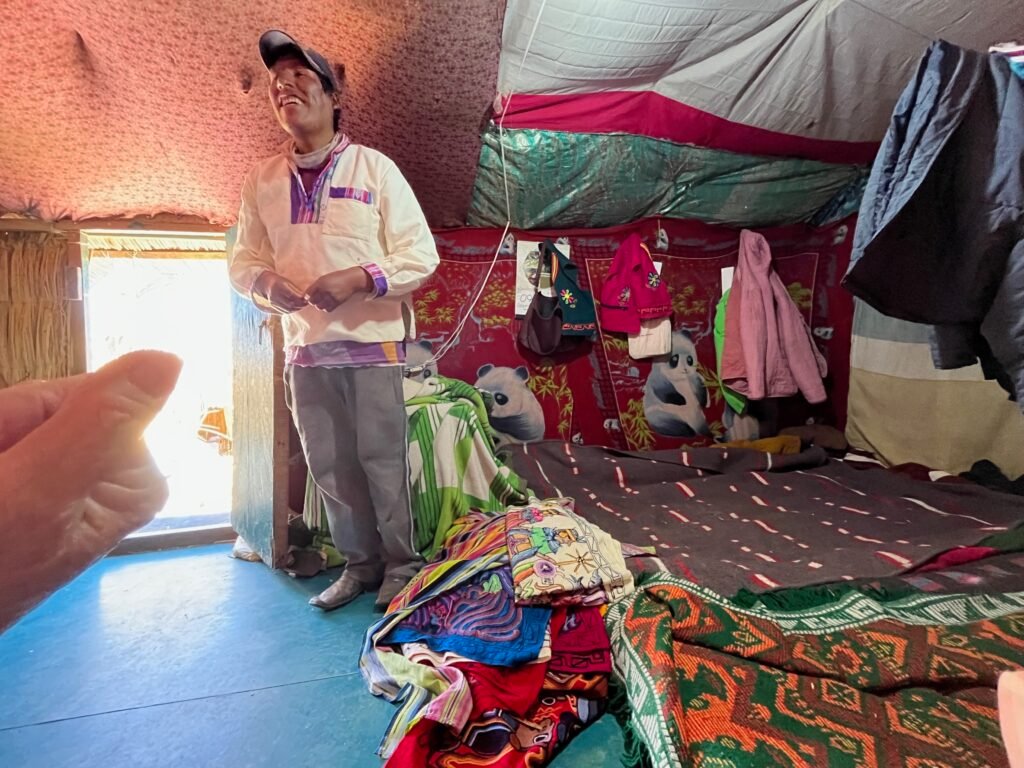
On the island, the seven of us split into groups and each visited a family’s home. Patricia and I got a close up look at how they live. The one-room hut sat on a thick reed base covered by painted plywood. The family of five slept close together for warmth and their clothing lined the walls. Two cooking huts were in the private space behind the hut, one used a propane double-burner, the other used the traditional double-opening clay stove that we’ve seen everywhere in Peru (including the museums). The private space had comfortable-looking reed chairs and a reed privacy fence surrounding it.
As you might expect, pretty much everyone that lived here was barefoot. I found it interesting that the man that showed us his home looked as if he had his dress shoes on. Maybe it was out of respect to his guests?
While no English was spoken, it struck me that he seemed serenely calm, just at peace. Fascinating. A young lady in our group was able to communicate with him and ask some questions.
As we came out of the home and around to the common space in the front, the family had some of their goods for sale. Things made out of the reed and some really nice woven rugs and pillows. Beautiful and colorful, we bought a few pieces.
We ourselves have been living in a 396 square foot tiny home for over four years. It’s fun to see how a family of five does it with less than half that space.
What a mind-blowing experience! Yet just another unexpected surprise in this fantastic country.
The tour boat picked us up and we were soon on our way to Amantini Island, another 12 miles or so.
Amantini Island
This is where we are to stay the night with one of the families. The island has about 5,000 inhabitants across 10 communities. About 50 tourists are spread across the homes in the community for the evening. Each community gets about 50 visitors a night for one week every couple of months. So again, a pretty low-key approach to tourist dollars.
At the dock, we were introduced to our hosts and ours just happened to be the community leader. Ricardo and his associate will be staying with us too. Which is great, because we sadly cannot speak any Spanish, the most common language in Peru. The native tongue on the floating islands is Aymara, here it is Quechua. Our young guide Ricardo is fluent in all three plus English. And he is learning French! Pretty humbling actually.
The community leader had other tasks to do, so his wife Polly (that’s as close as I can get) guided us up to their home. Very slowly, knitting as we climbed the entire way.
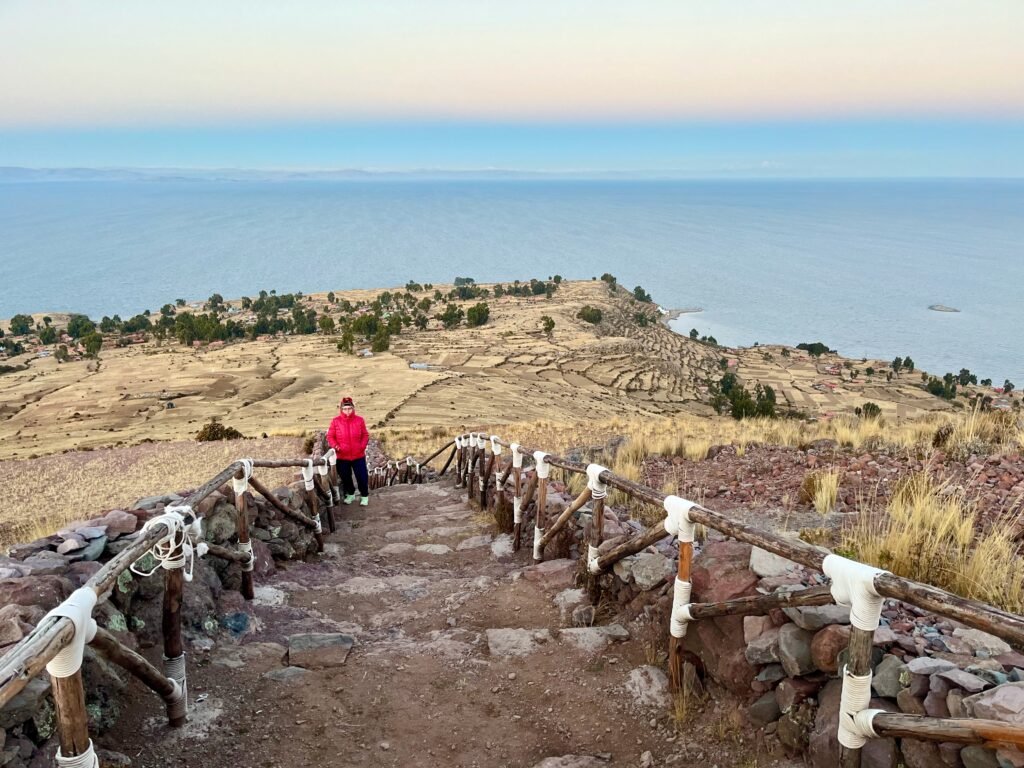
And very slowly for a reason. Lake Titicaca sits at 12,500 feet! And the village is about 500 feet above that. Even after two weeks, grabbing enough oxygen is still a lot of work! So we go slowly, slowly…
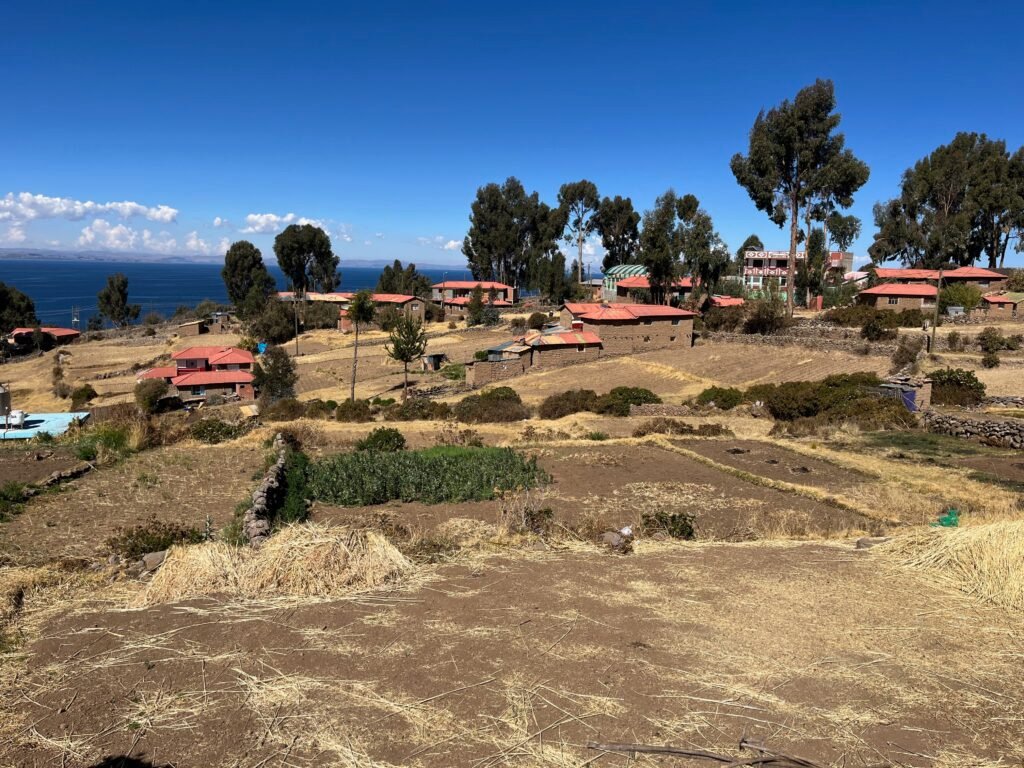
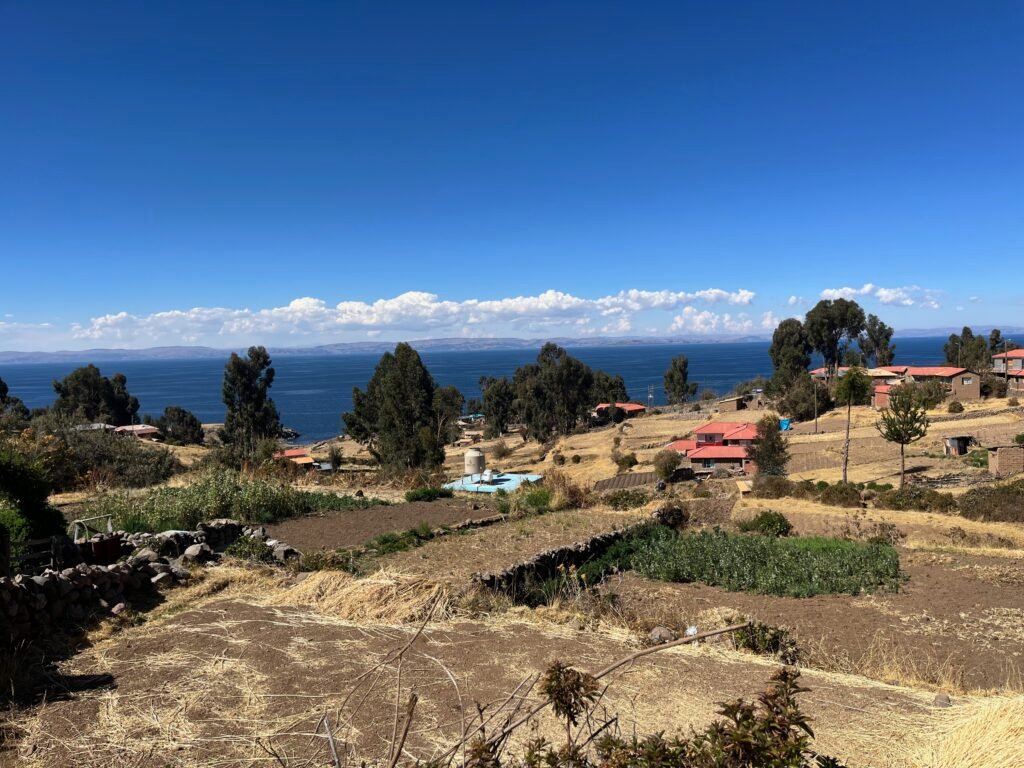
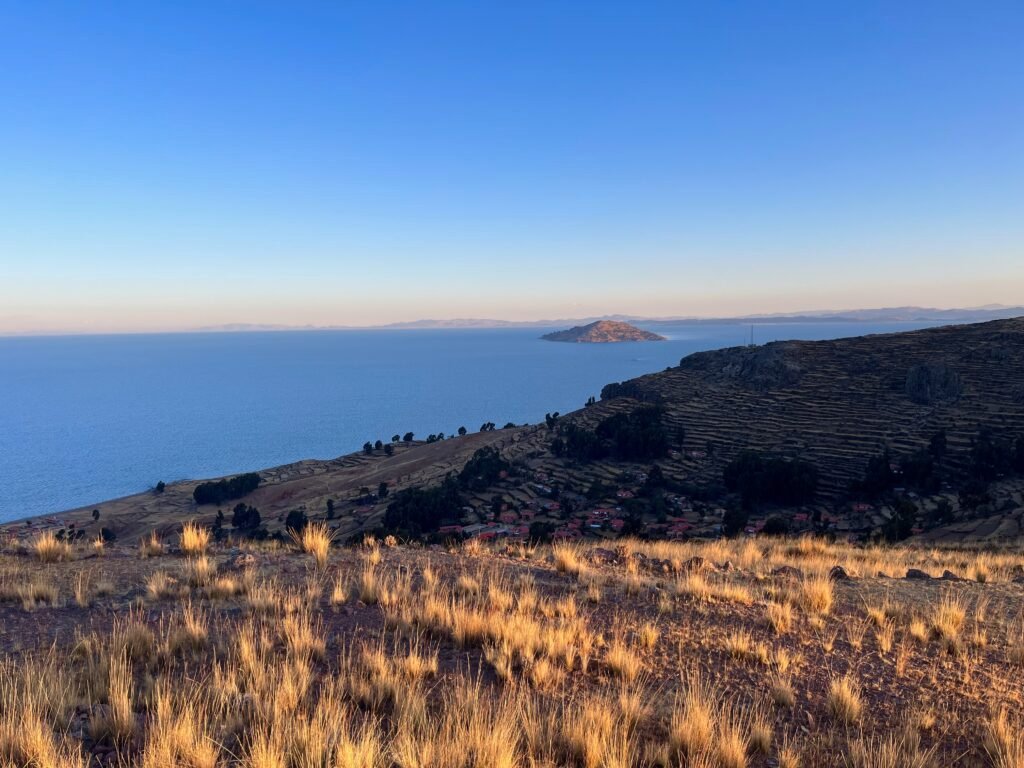
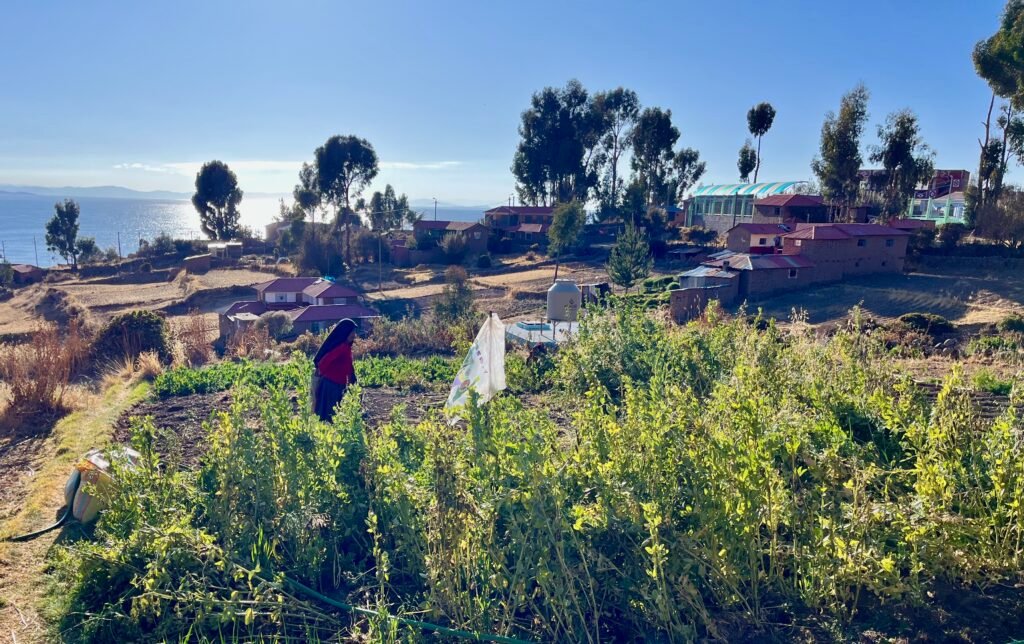
It’s stunning countryside. You feel like you’re in Europe on the Adriatic Sea or something. Small stuccoed homes perched on the steep hillsides, so picturesque.
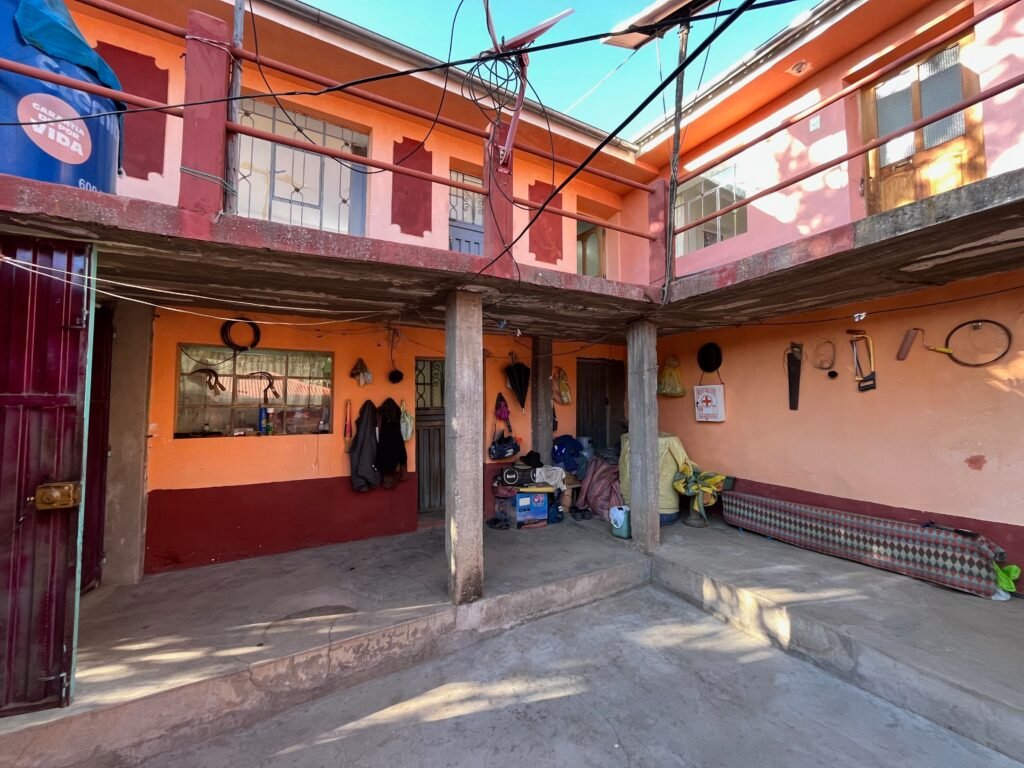
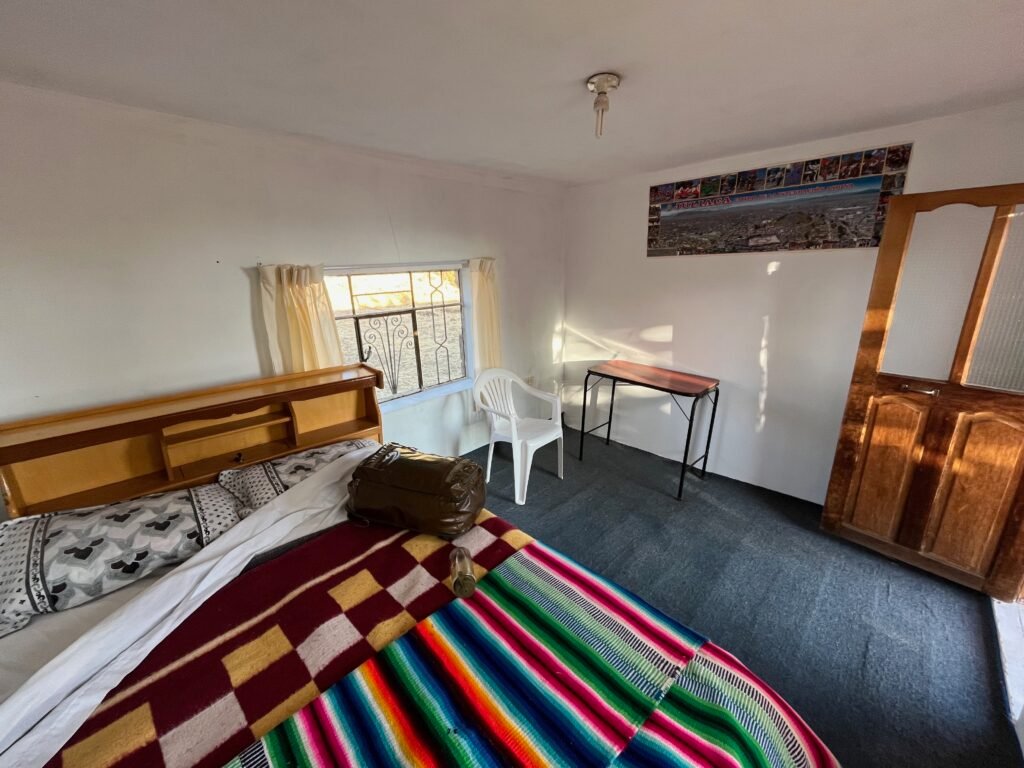
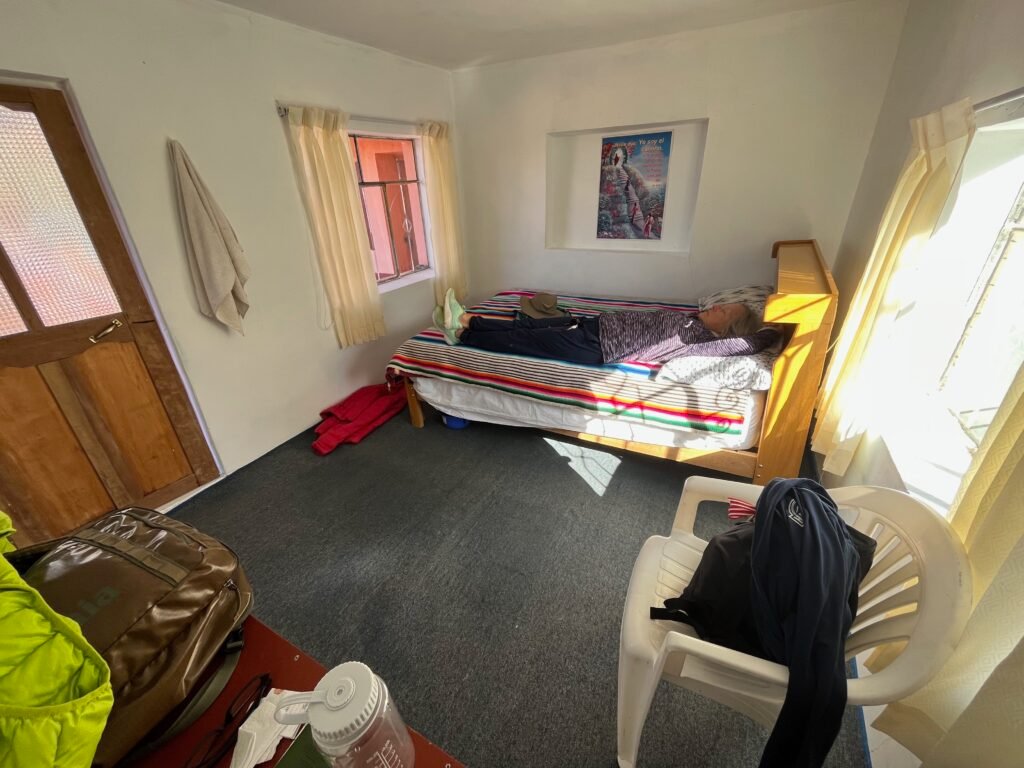
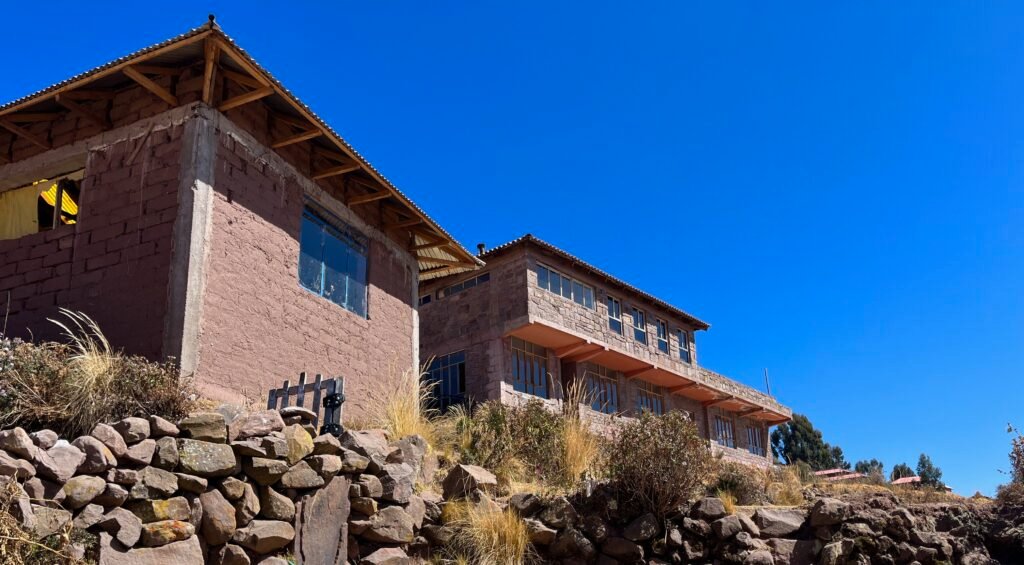
Amantini Island only received electricity two years ago from a solar project. And there are only a few small motorbikes. They raise sheep, but apparently dogs are not allowed. Mama Polly’s home was a step back in time for us. Like most of the homes, it contained a small, open courtyard that connected the rooms. Our bedroom made me feel right at home. It reminded me of my youth where things might be well-worn but they were always clean and functional.
Our room was upstairs, accessed by the exterior walkway. There was no lock on the inside of the door. In fact, there was no latch or doorknob of any kind, just a simple pull handle. The headboard did have a little built-in lockable cabinet with a key if you had concerns about your valuables. We had no such concerns. In the above picture, there was a central ceiling fixture containing a CFL. But while the door is on the left, the actual switch is mounted in the single wall outlet, which is behind the chair to the right.
Simple, simple, simple living. And oh so lovely!
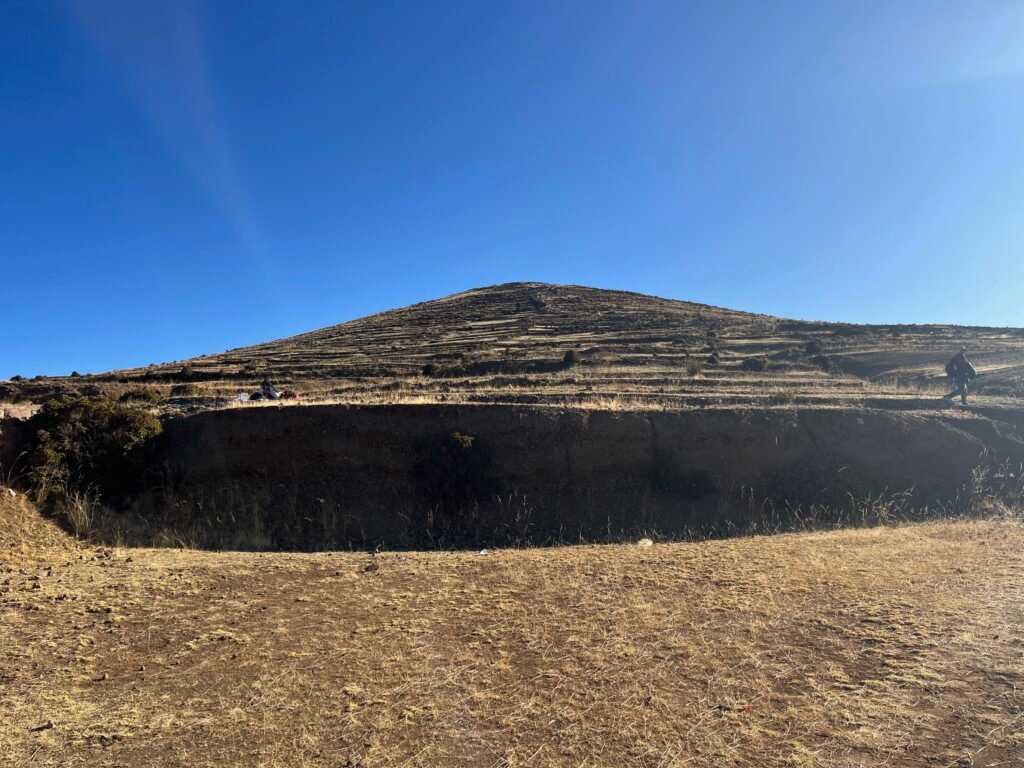
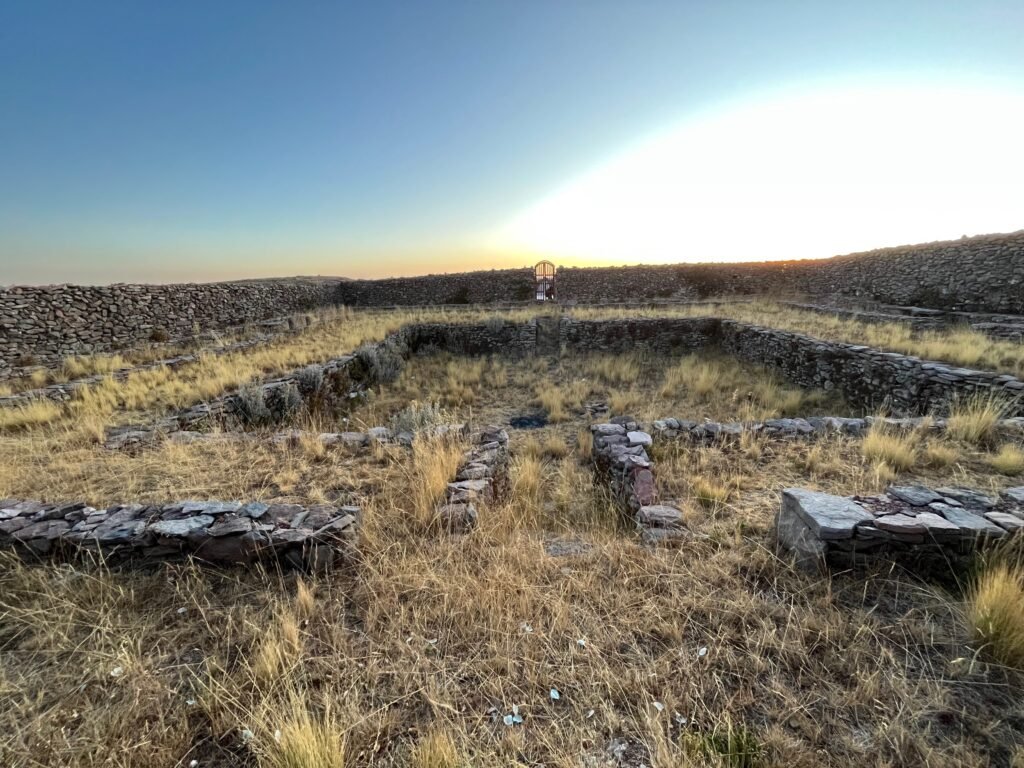
After dinner, we hiked to the top of Pachatata, one of two sacred peaks on the island and the site of old temple grounds where they have a yearly ritual of thanksgiving. It was about a 500 foot climb, putting us at 13,500 feet at the top and quite a struggle for many of the tourists!
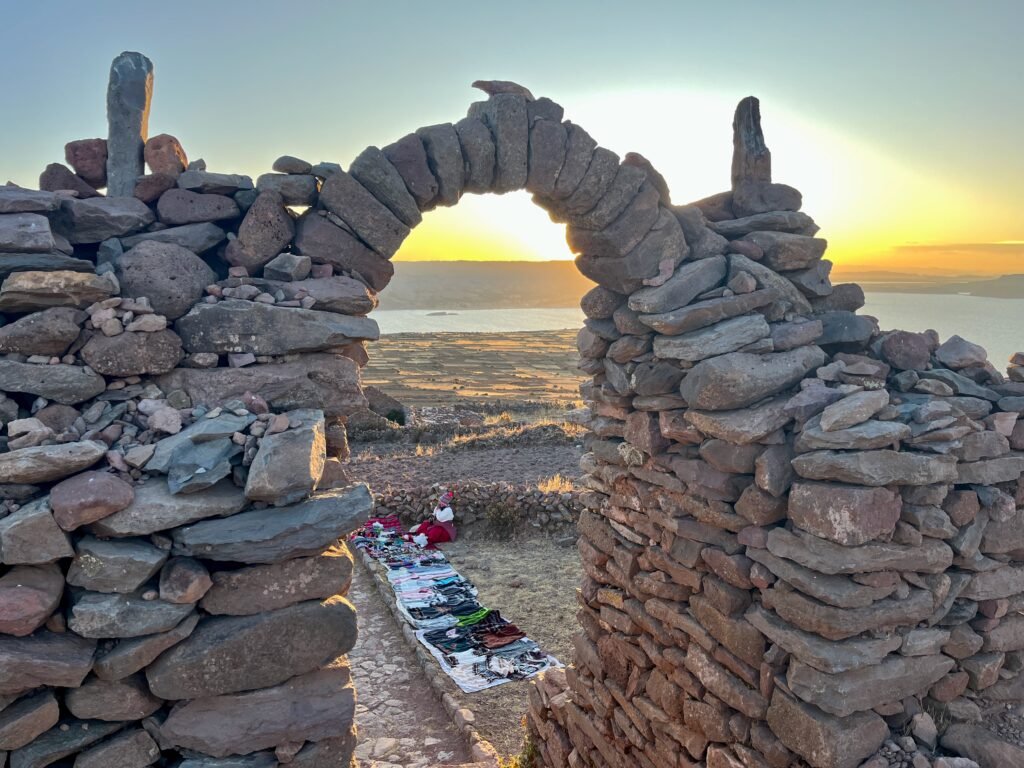
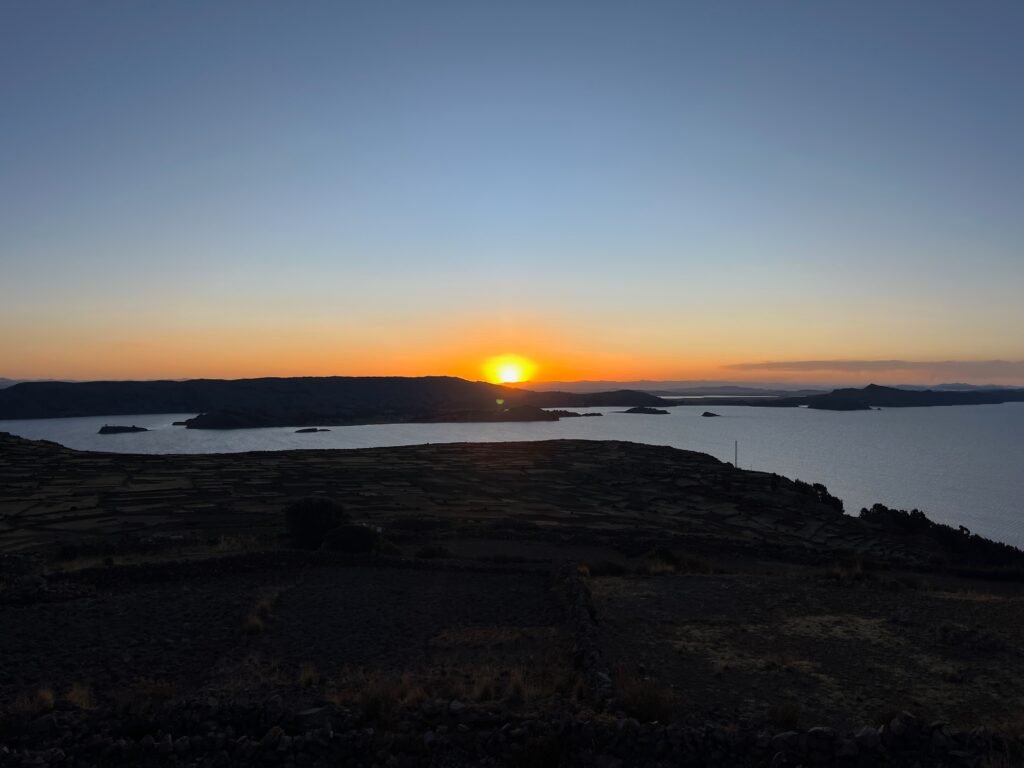
Before sunset, we were shown how to perform the three-coca leaf ritual of giving thanks by circumnavigating the temple wall three times in meditation and then saying prayers of thanks before placing our leaves inside the temple gate. A wonderful time to reflect followed by a beautiful and peaceful sunset.
And after this very full day, we still had the community dance on the agenda!
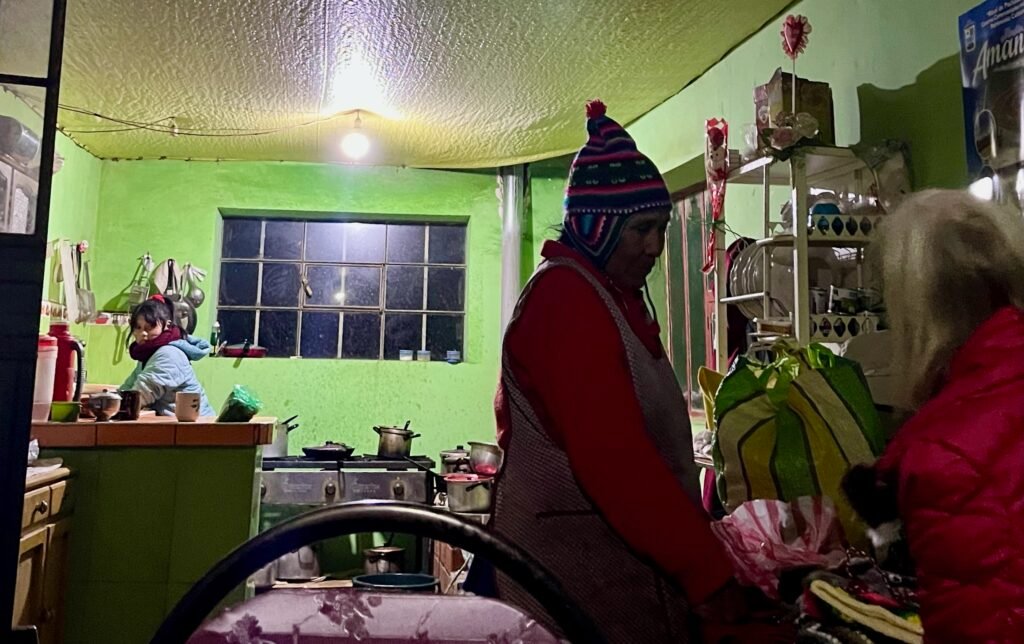
While we waited until the time to leave, Patricia looked over some of Mama Polly’s goods for sale.
The granddaughter was cleaning up from dinner…and keeping a very watchful eye on the guests!
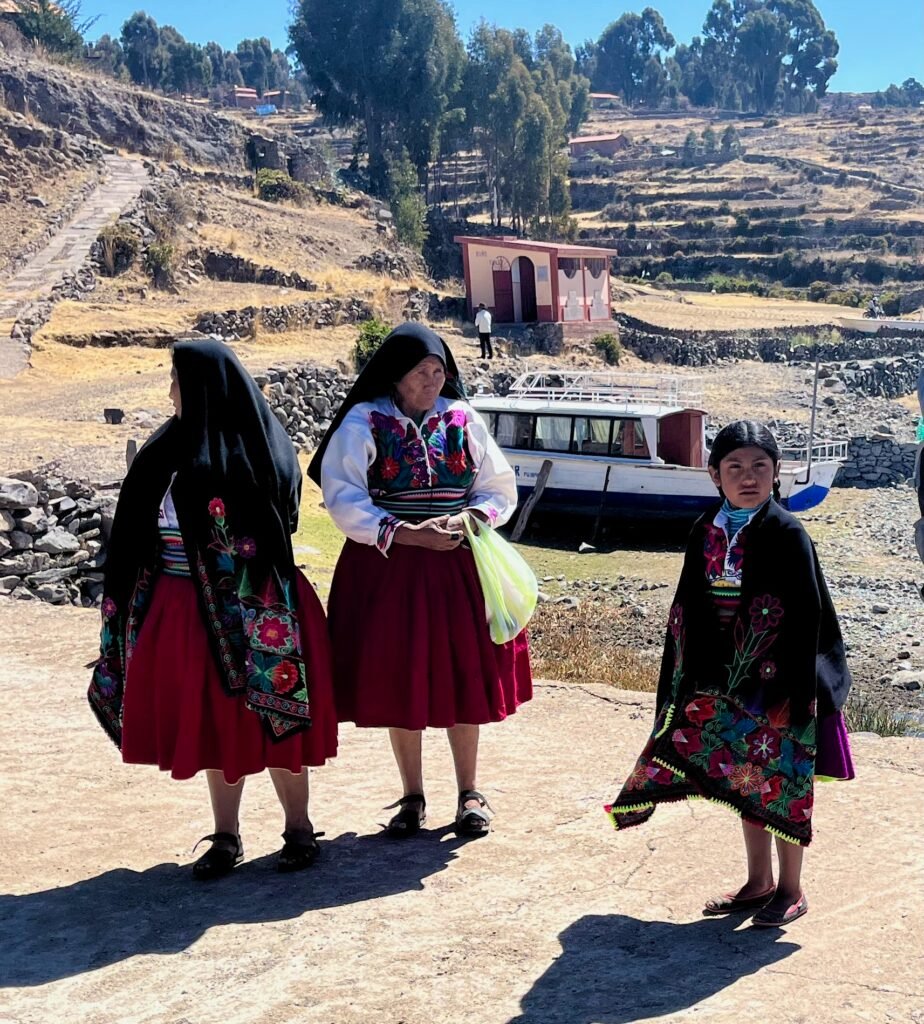
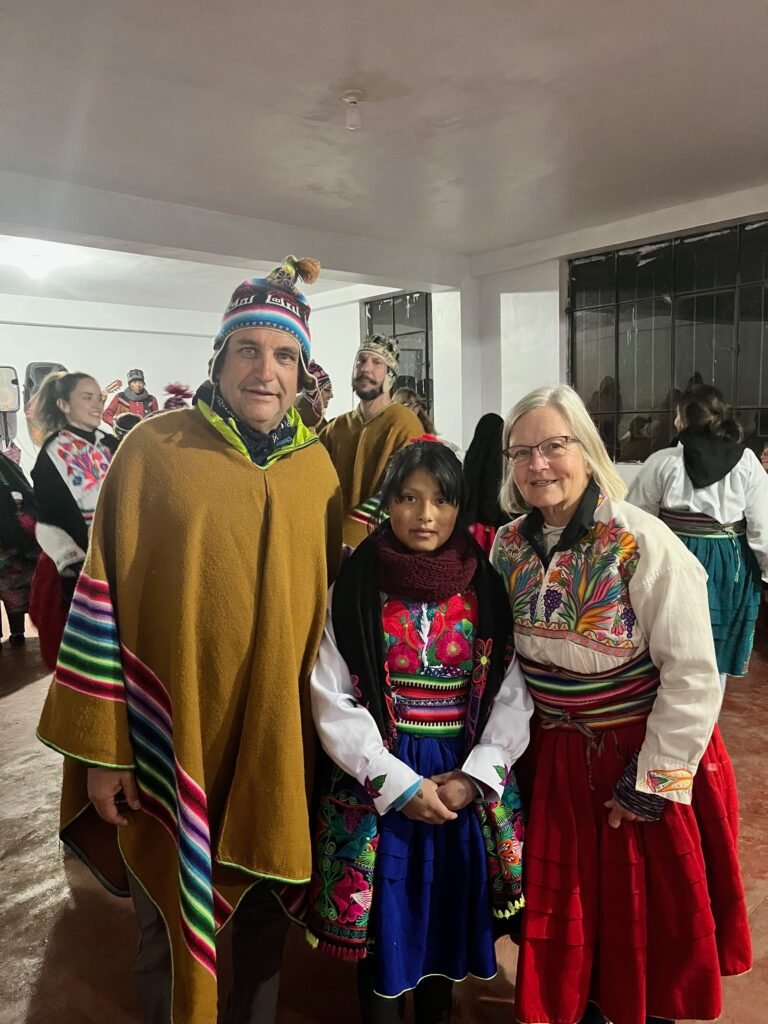
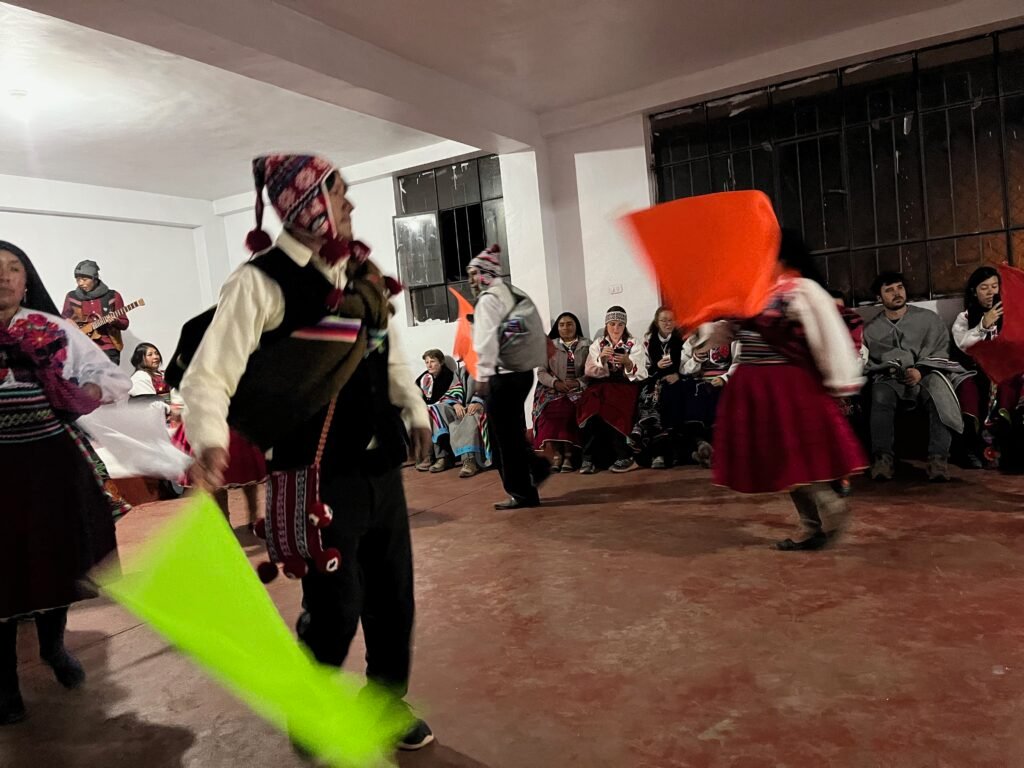
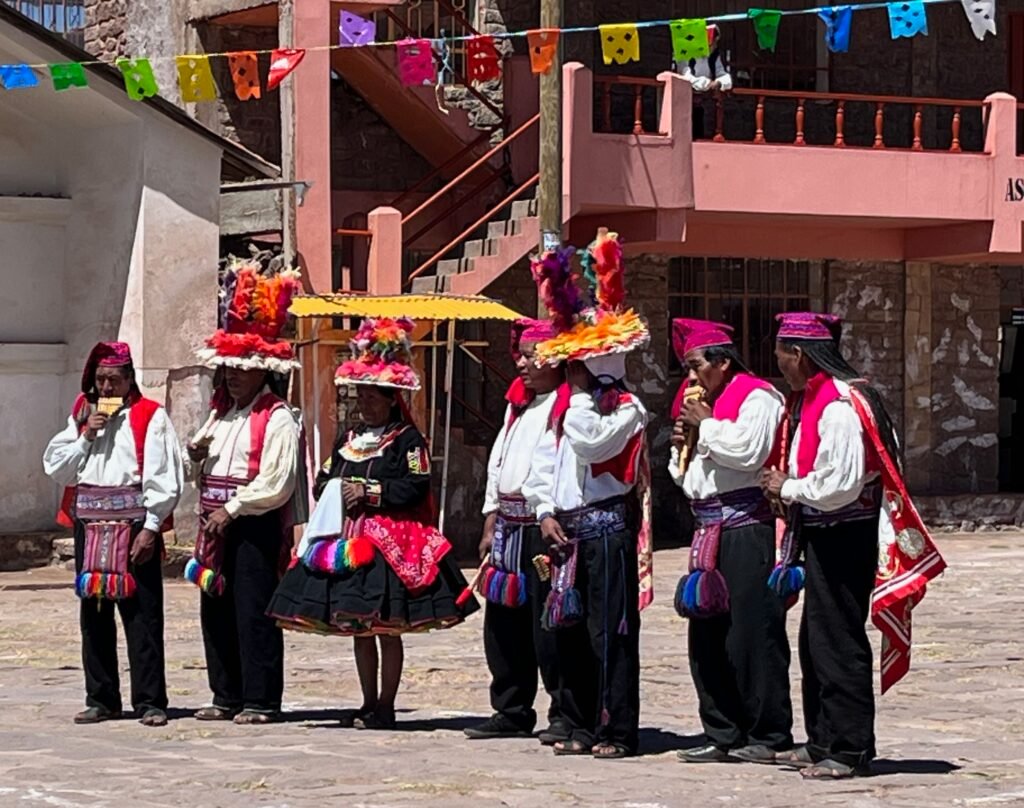
Mama Polly fitted us both with the traditional dress for the dance. She stayed behind while the granddaughter escorted us to the community center, probably a quarter of a mile away along various footpaths. While she did not have nor need a flashlight, we had to use ours even under the starlit sky.
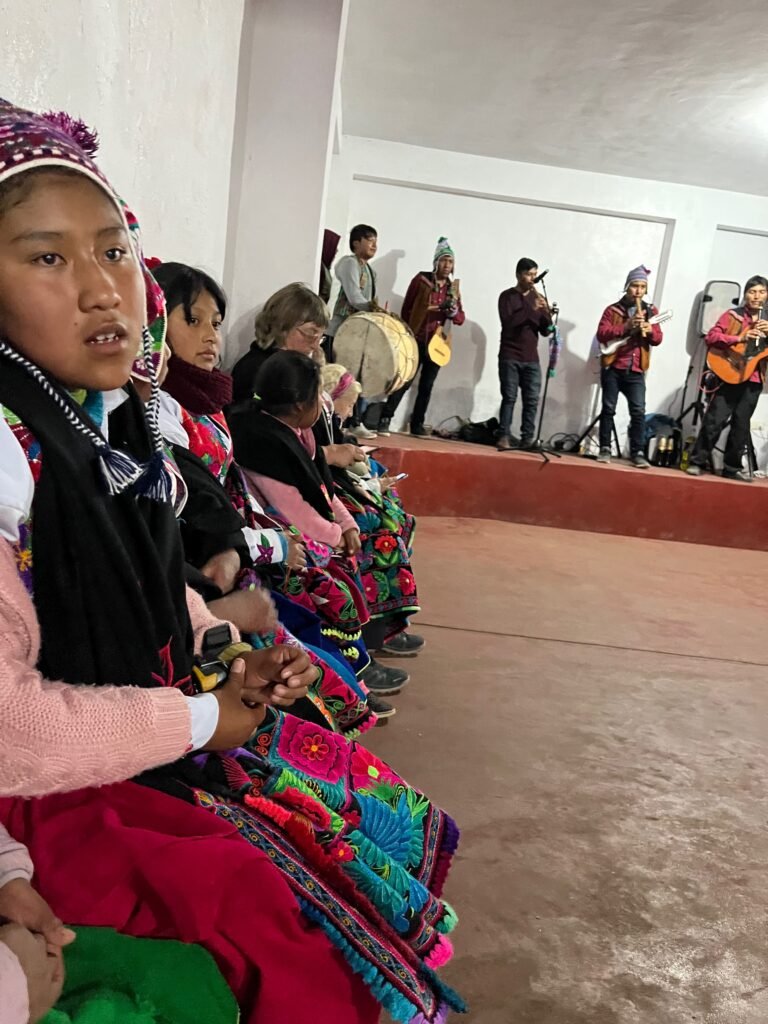
I think most of the tourists came to the dance hall, it was a pretty big crowd! And we were all kitted out in our new clothes. The band cranked it up and, fortunately for me, the dance step was dead simple!
It was a lot of fun, although I don’t think taking care of two old people was what the granddaughter had in mind.
She had a complete poker face almost the entire night. But every once in a while one of her friends would take a good poke at her and you could see her crack a discrete smile.
After about an hour, the band took a break and many of the guests headed out the door.
The band, seeing their income for the night disappearing, made a fairly straightforward address to those of us remaining, making the rounds for donations and using solid eye contact. I can’t blame them at all! I gladly emptied out almost all of my soles and tossed them into the sack.
With intermission over and the band once again in full swing, things were getting pretty late for us! The songs seem to last forever and we were trying to figure out how to exit gracefully.
The granddaughter came over to check on us again and encourage us to dance, albeit with a stone-cold expression that showed she was in great chaperone-induced pain.
How to relieve this stress? My deplorable grasp of Spanish was not helping. And then I remembered two words from my feeble work with Duolingo!
“Abuela’s casa.“
Her eyes lit up like it was Christmas morning! She smiled and hustled us out of the community center and quickly back to grandmother’s house. And, as I had hoped, she was now free to return to be with her friends, her penance done.
We’re up early, today we will visit Taquile Island, known for its men weavers, and then make our way back to Puno and on to Juliaca, where we will catch a hopper flight back to Lima.
Mama Polly’s mother is already in the garden as we leave. Another beautiful day.
As we walk to the tour boat, some locals are selling their wares. I find a man selling chacana stones made from the other sacred peak, Pachamama, and I have just enough coins to make the deal. Pretty cool!
The chacana has a long history that is much debated, but one simple definition is that it represents the dynamic between the universe and everything that lives in it.
Taquile Island
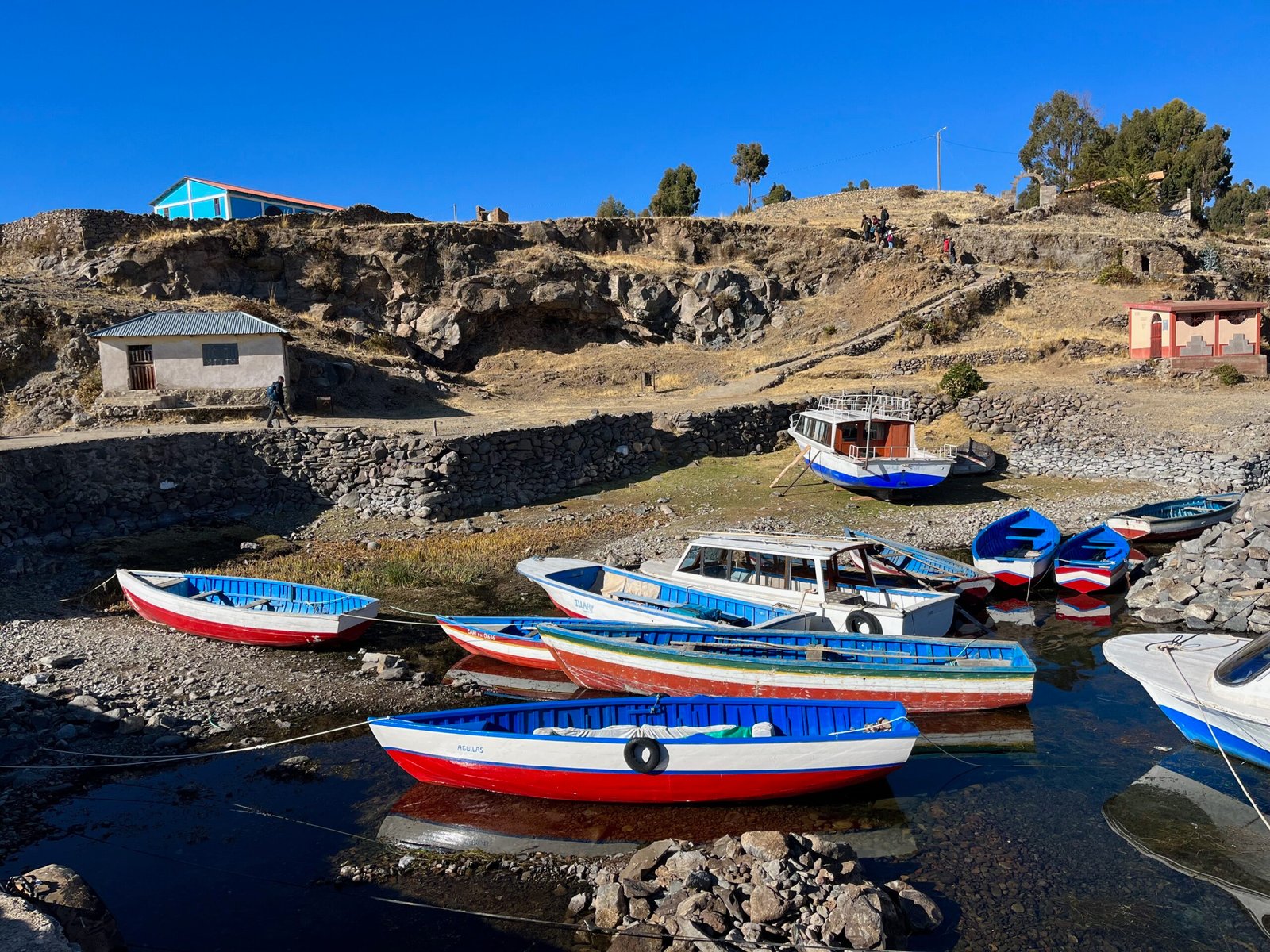
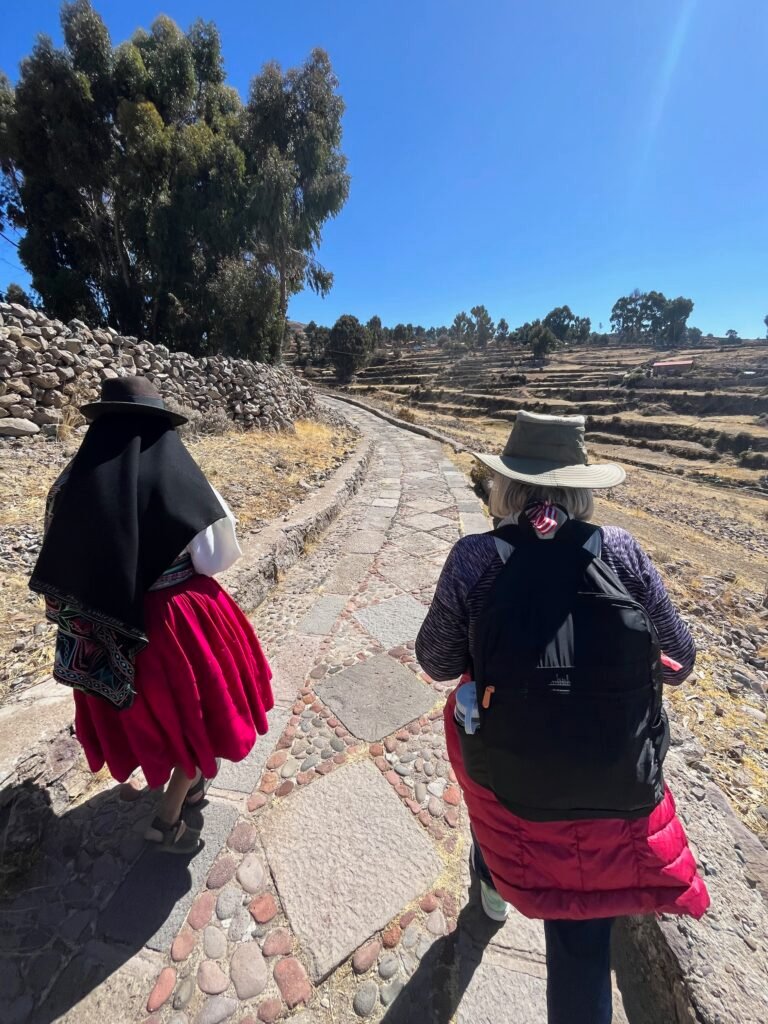
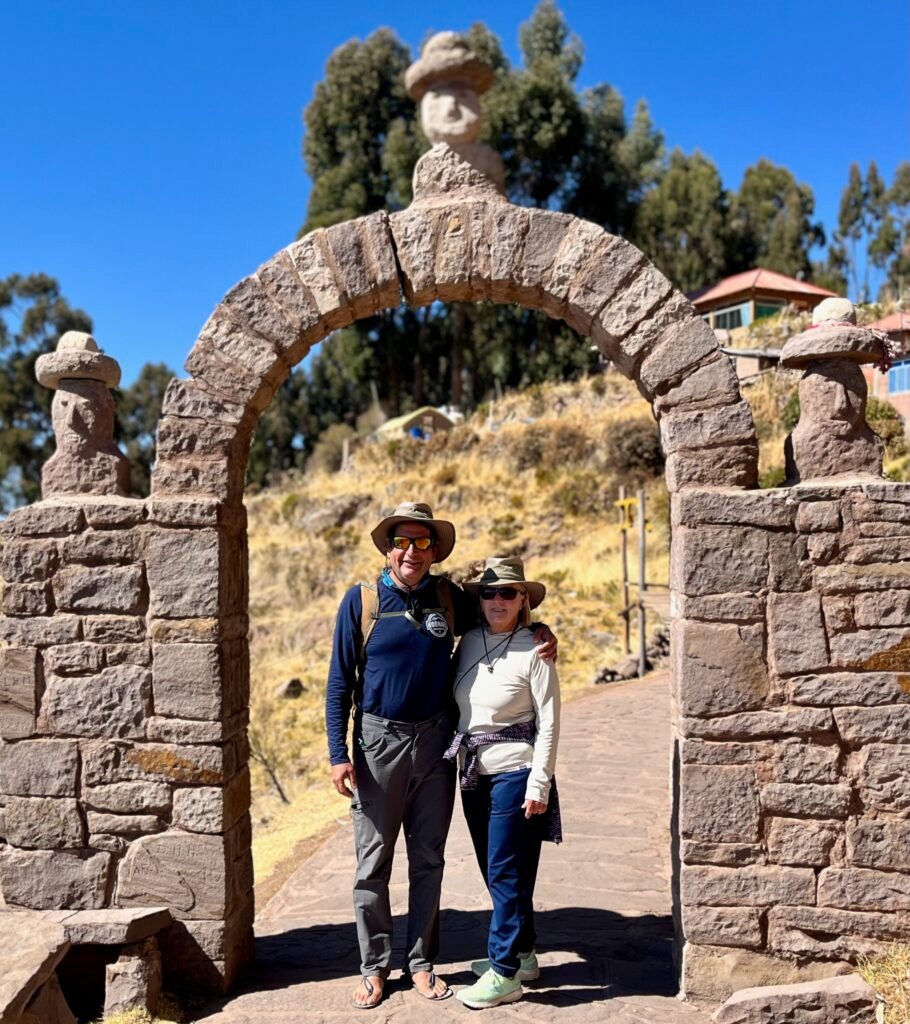
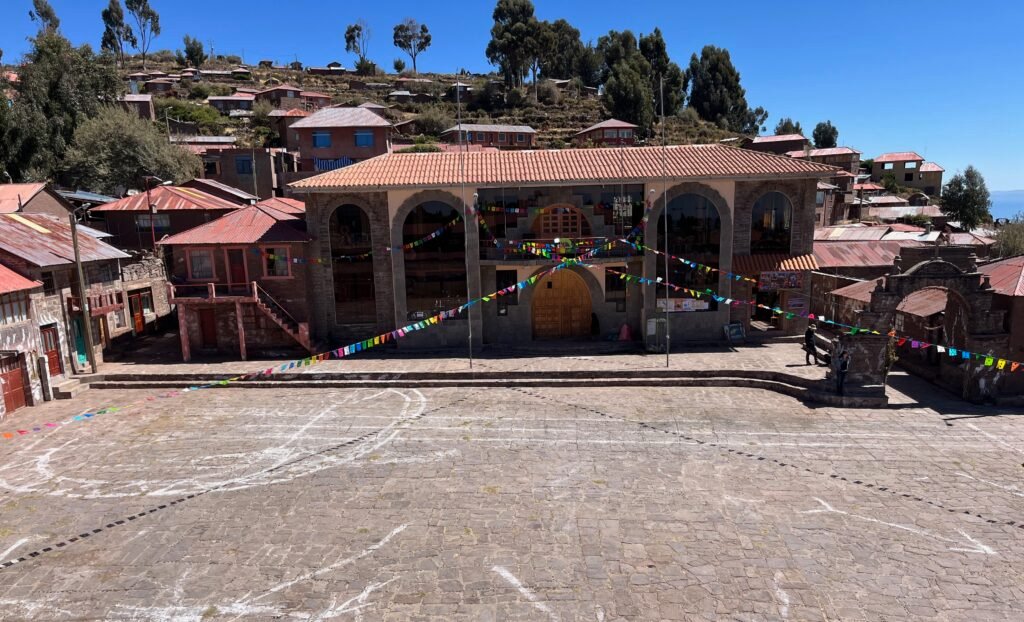
Before being renamed to a Spanish nobleman, it was “island of the sunflowers” and is still known as Intika today by the locals. It hosts about 2,000 residents and is half the size of Amantini Island. Its sides are steep, requiring 540 steps to reach the main community. Because it is remote and almost 30 miles from Puno, the culture has remained largely intact and has a unique weaving tradition.
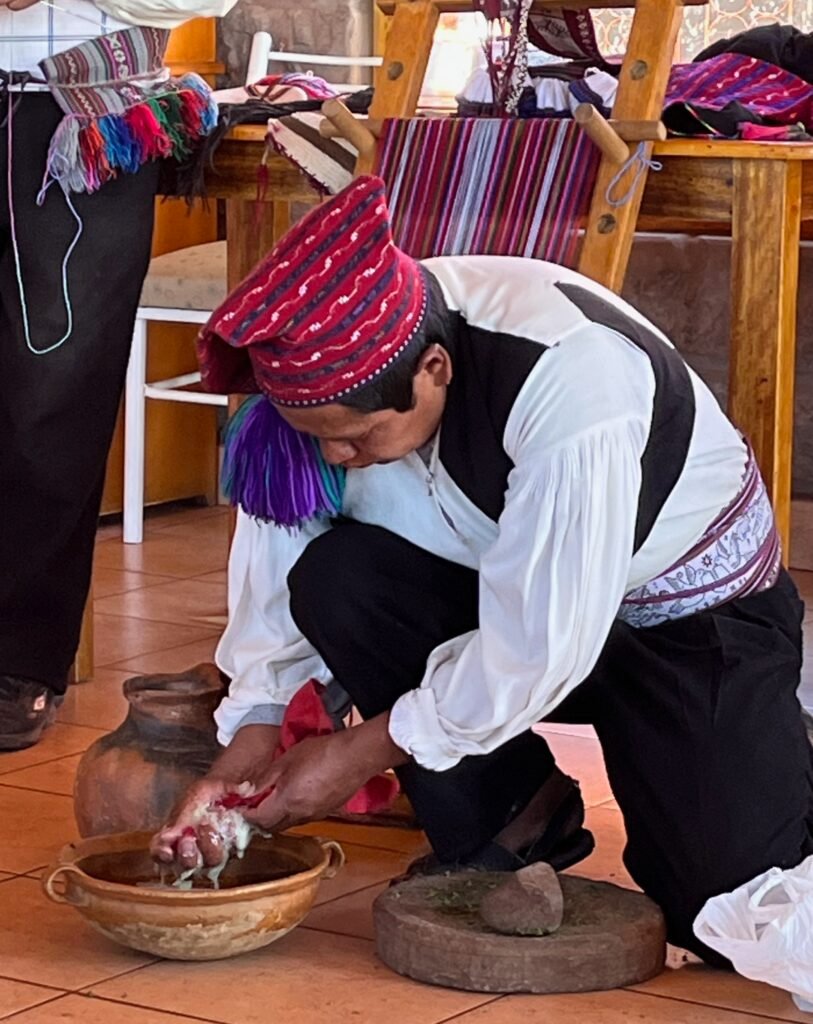
The men are renowned for their weaving here. In fact, any prospective couple is expected to live with each family for 5 months before marriage to ensure that the suitor is proficient at weaving and knitting!
I was excited to have the chance to buy one of these unique and finely knitted hats! But as it turns out, the finest ones were incredibly tight on my head, and not actually intended to cover my ears!
They carry meaning. If the top half of the hat is red, the man is married. If it’s white, he is unmarried. If the top falls on one side he is available, but unavailable if it is placed on the other side.
There is even a weaving competition in the community to see who can make the tightest weave. The test is to see which one holds water the longest!
Taquile Island has only had electricity for a year and things are done simply here. No motorized equipment or work animals are used. Building a house requires a team of locals to haul materials from the dock to its location.
The Perfect Twenty
As I mentioned earlier, I ran out of soles on Amantini Island. And Mama Polly was not happy accepting US dollars, even though Patricia added extra for her trouble.
Here on Taquile, we had picked out several goods at the community cooperative. But the cashier wasn’t comfortable with our money and called in the manager.
Ricardo helped out with the language barrier, and after it was all said and done, I realized that we had put them in a tough position. You see, any US dollars will have to be exchanged somewhere eventually, and if they are damaged in any way they will be discounted.
And on top of that, the most desirable US bill is the twenty. Anything else is frowned upon. This makes sense as it is still the most popular international currency. So we hope that Mama Polly eventually is rewarded for her troubles.
Now for the manager, my total was about $36USD. He had zero interest in my exact change. Finally he agreed to two $20’s (more easily exchanged) and provided the change in soles. BUT, they needed to be perfect! I eventually just emptied my money stash of all twenties so that he could find something that met the standard.
Lesson learned, crisp US $20’s are good to have on hand.
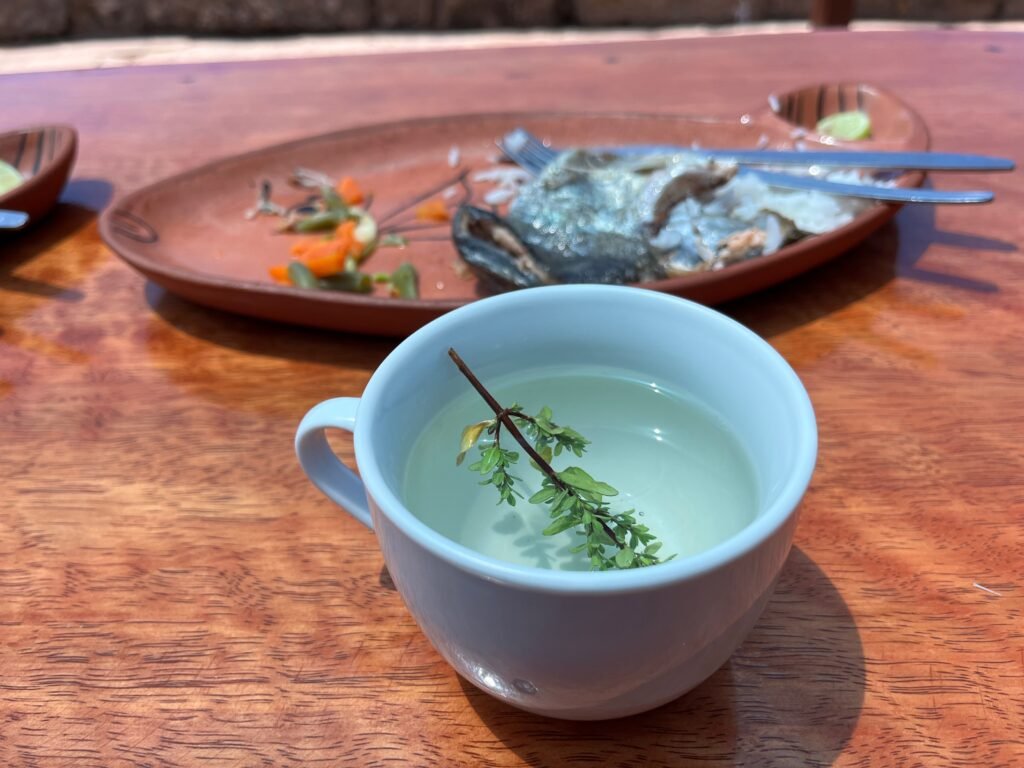
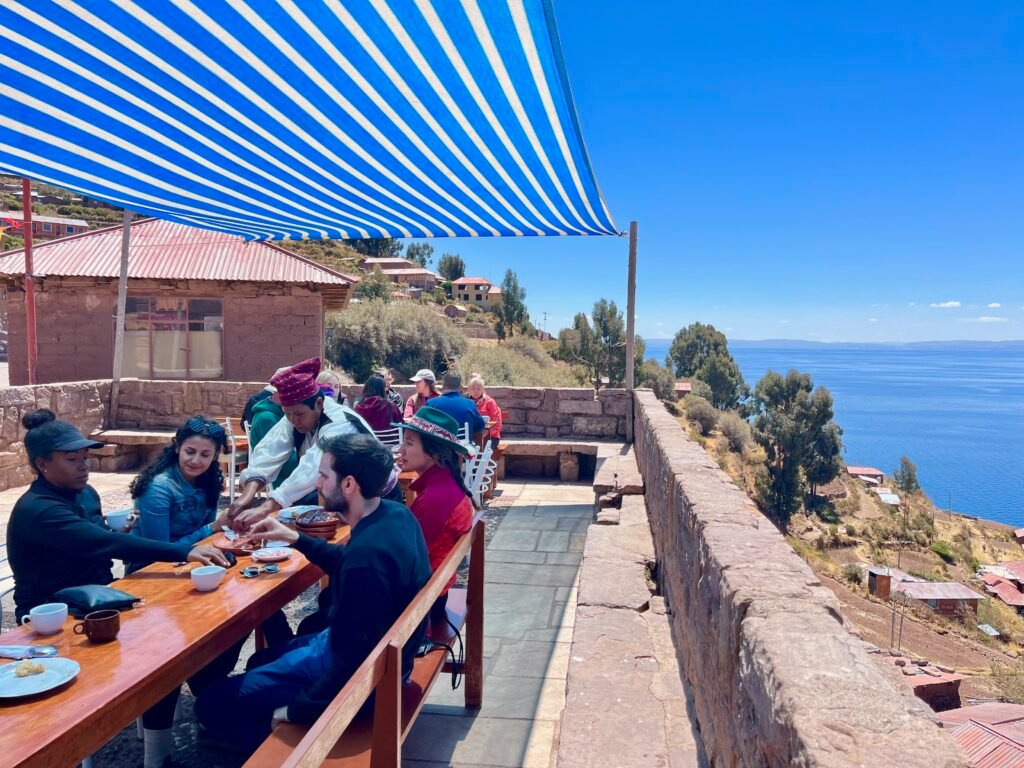
After a fabulous lunch of rainbow trout and muña tea, we worked our way down to the dock for the three-hour ride back to Puno.
Back to Lima
At Puno, we said our goodbyes to Ricardo and his team and were whisked away to Juliaca where we caught a flight back to Lima. The airport was wonderful and the workers seemed extra friendly. A great way to end our stay in southern Peru.
The view from the plane as we were chasing the sun.
Once in Lima, we were picked up at the airport for our trip to the hotel in Mira Flores. Our last day is upon us!
We’re nearing the end of our odyssey. It’s Day 13 of our 17 day journey and we have seen and experienced so much! Every day has been epic and different from the one before. And we have had incredibly full and active days. In fact, we started thinking about home, that far away place nestled in the forests of Tennessee. Maybe we could just skip this part?
Today the odyssey shifts gears to a more laid-back pace and looking at the remaining itinerary, something maybe better suited to the ‘tourist’ crowd rather than us ‘travelers.’ Wait, what does that even mean? As much as I want to be a traveler, I think I’m still pretty much a tourist. Hmm, what does the Google turn up…
Tourists often visit places for short durations, prioritizing popular sights and activities; travelers, on the other hand, may take longer trips, delving deeper into local cultures and customs.
While tourists tend to stick to well-trodden paths and comfort zones, travelers often venture off the beaten path, seeking authentic experiences and connections.
Tourists typically seek relaxation and entertainment in their destinations; travelers look for broader understanding and personal growth through their journeys.
Okay, I think I can get behind these definitions. Although to really ‘delve deeper,’ learning the language would have made it much richer!
So maybe we are travelers who are going to experience touring for a couple of days!
That’s what I was thinking anyways…
The Ride to Puno…
As surprising as it may sound, Hobnail Trekking and Alpaca Expeditions picked us up and delivered us to the bus station right on time. It was so nice to have our tickets handed to us, and find all the options for the day already included! We have felt pretty spoiled on this trip.
The ground transportation here and the roads have been an unexpected surprise. Yeah, there are some scary unpaved mountain roads and nary a guardrail in all of Peru, but they were all in great shape.
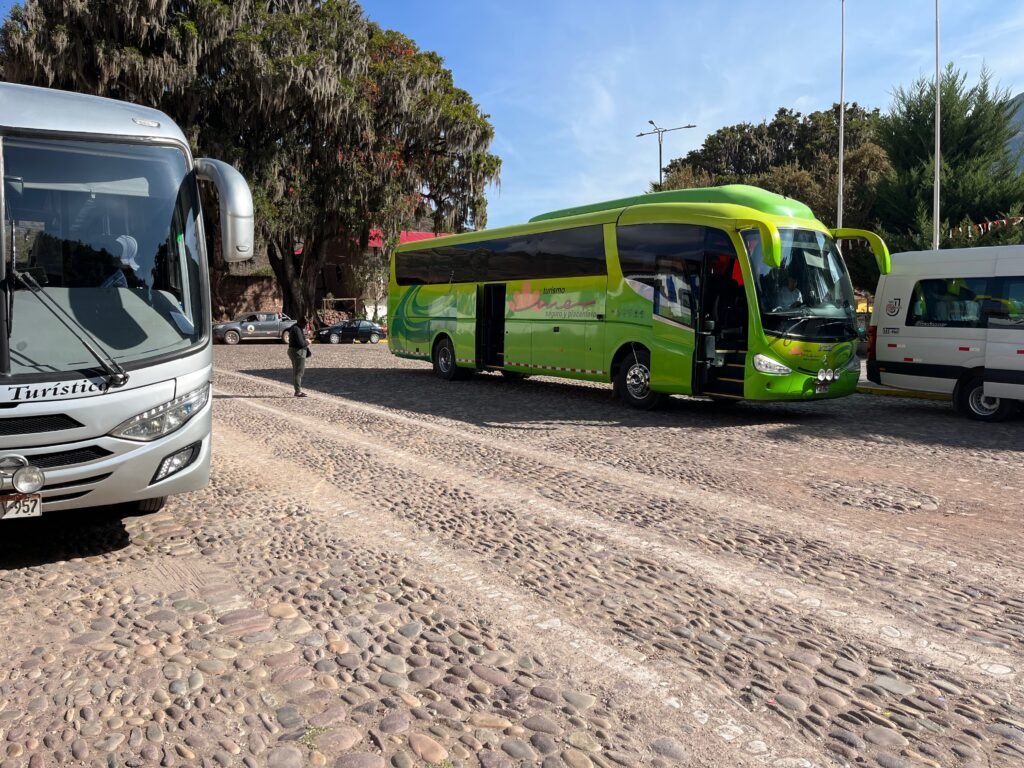
And the touring coaches were very cool. Modern and sleek, kinda like jetliners. Except more comfortable and quiet!
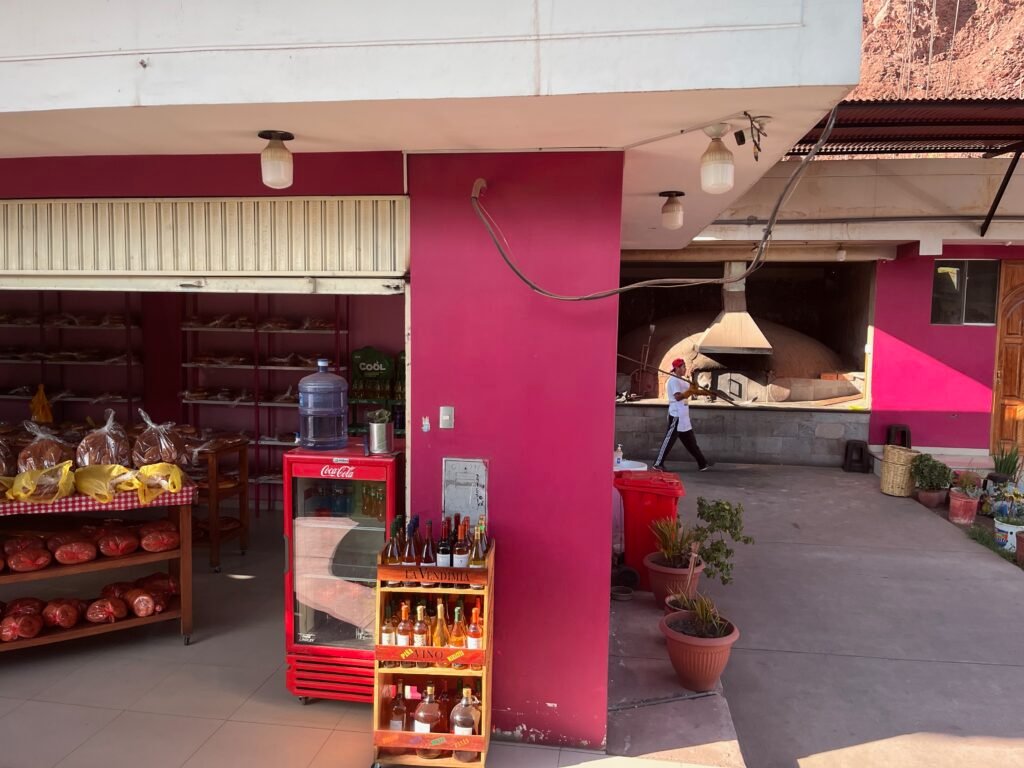
On our way out of Cusco, our big green Mercedes coach (green seems to be a thing for us on this trip, I like it) pulled over so that the tour guide could grab some fresh bread.
I found this humorous because this is also where Alpaca pulled off to get bread for our lunch at Rainbow Mountain!
You can see the baked goods on the left…and the massive oven in the back on the right. It seemed most restaurants had an oven like this, but this is the biggest one I saw.
Obviously a local favorite.
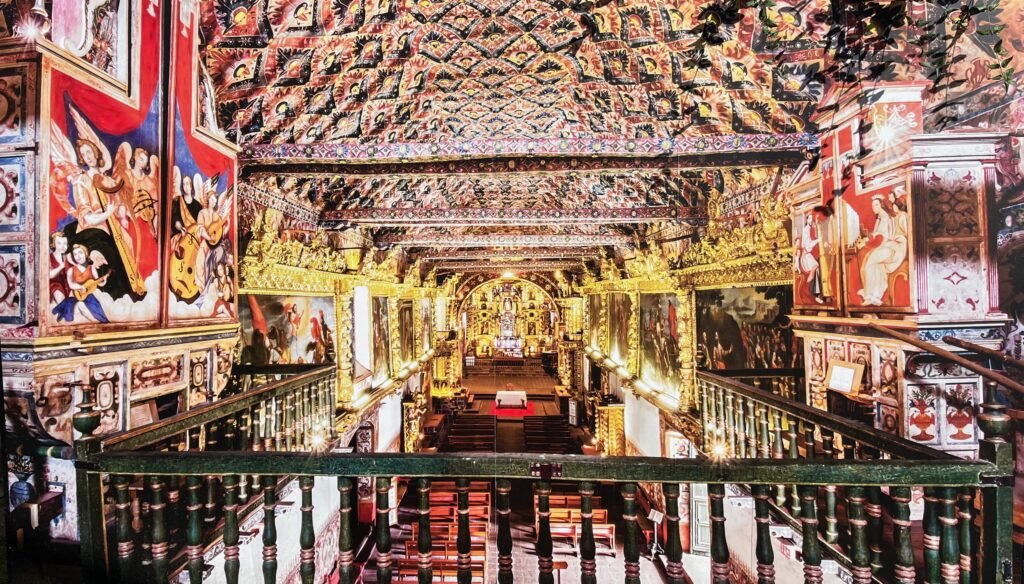
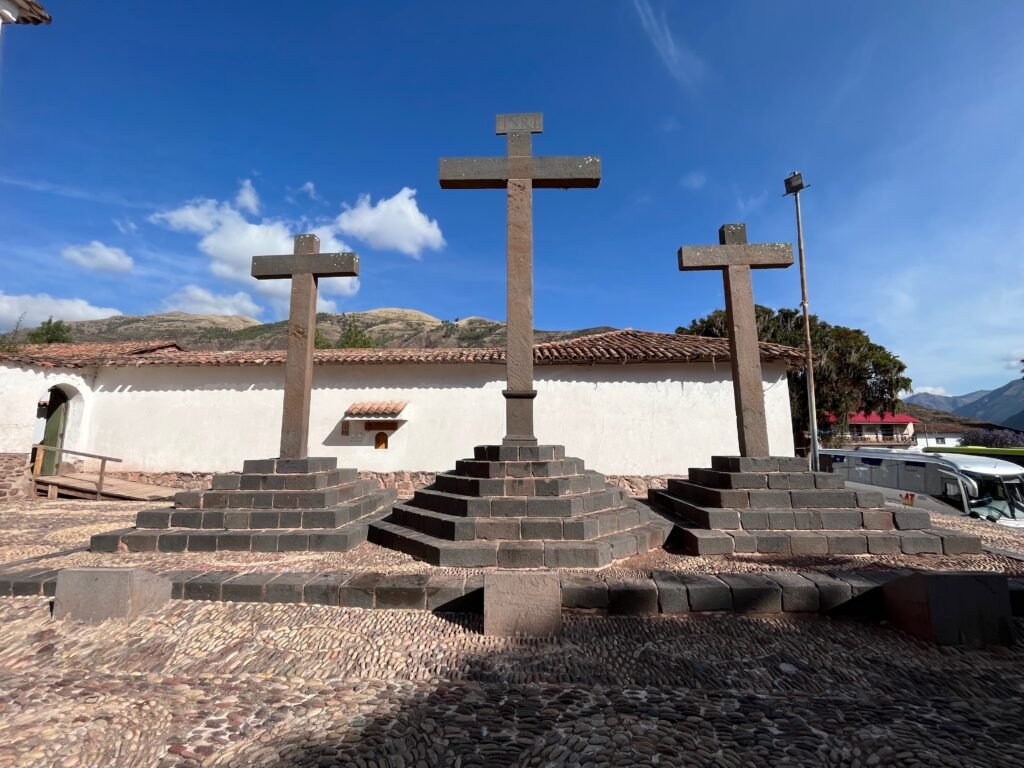
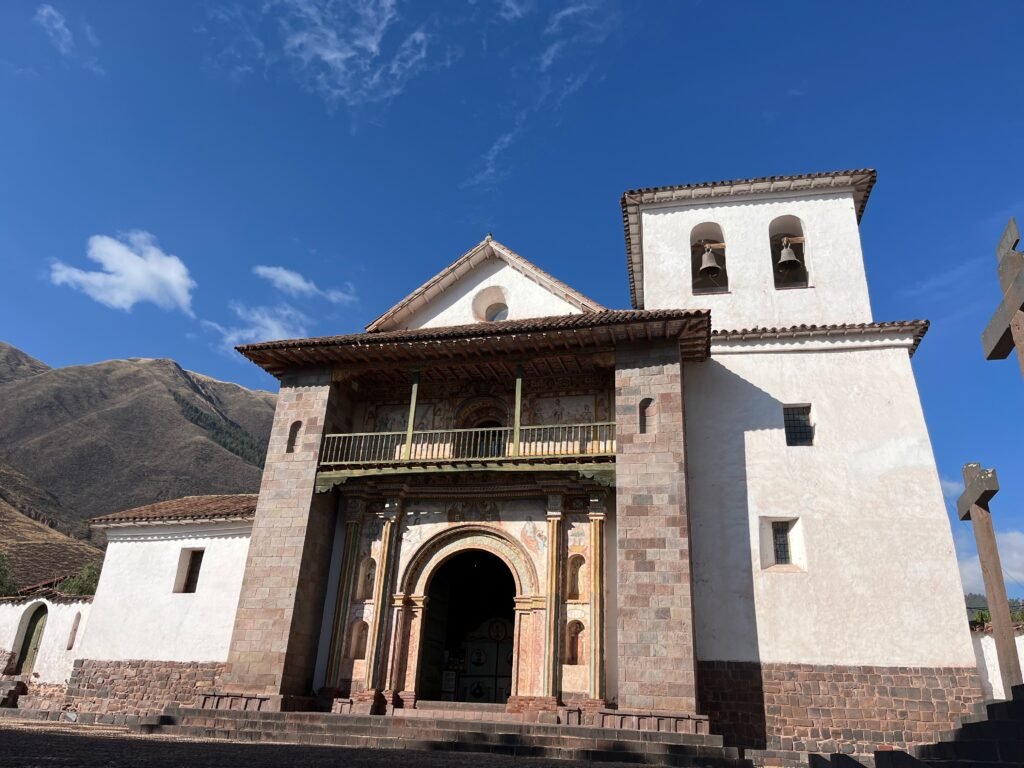
Our first big stop on the 8-hour coach ride was the Temple of Andahuaylillas, also known as the Sistine Chapel of America. Built after the Spanish conquest of the Incas by the Franciscans, and then later ‘redecorated’ by the Jesuits, the outside does not prepare you for what’s on the inside.
Once again, no photographs were allowed in any of the churches, the one above is actually a photograph of a billboard outside the church. It’s maybe the most ornate thing I’ve ever seen. All of the gilded structures were put in place by the Jesuits…and over the wall art of the Franciscans that were before them. There were huge paintings of various Biblical events, like the beheading of John the Baptist, all around the upper walls. Full-sized sculpture and relief of angels and saints were everywhere, their eyes watching my every move. The whole place kinda creeped me out. I can’t imagine how one would find a peaceful worship in there, but maybe that’s just me!
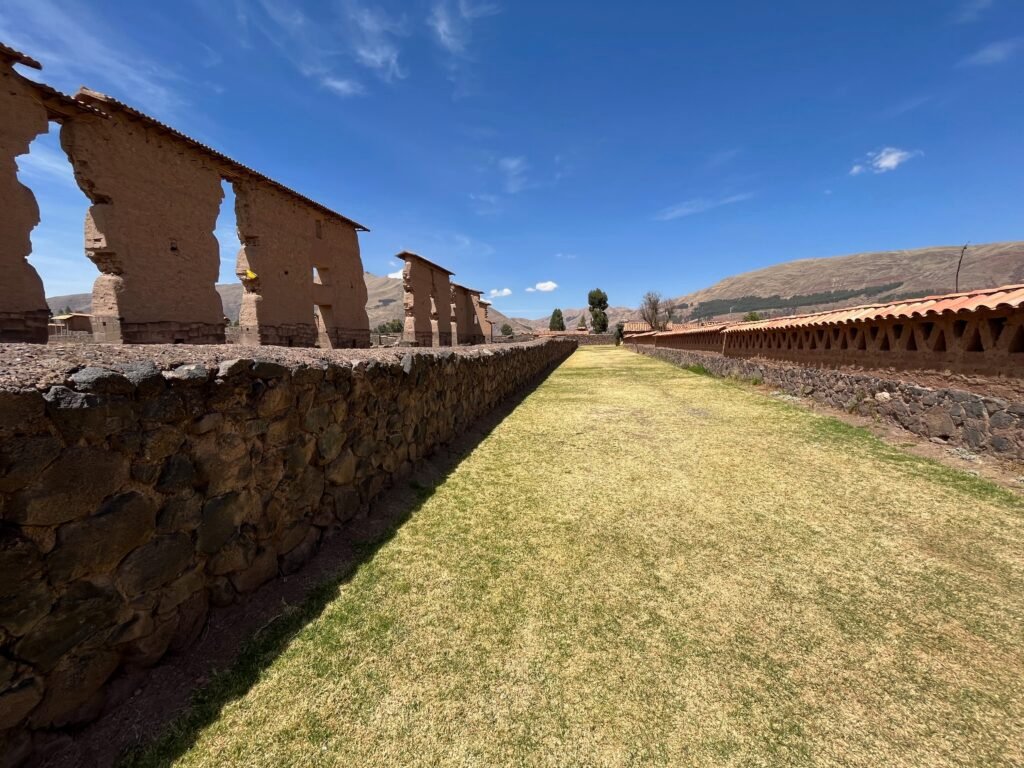
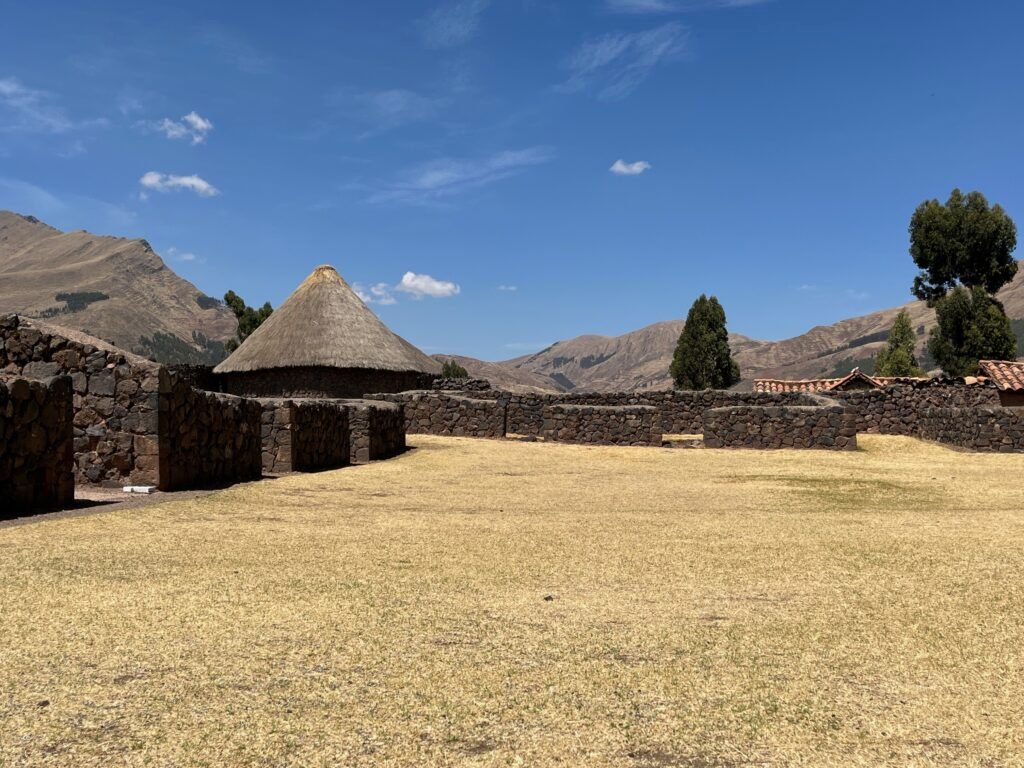
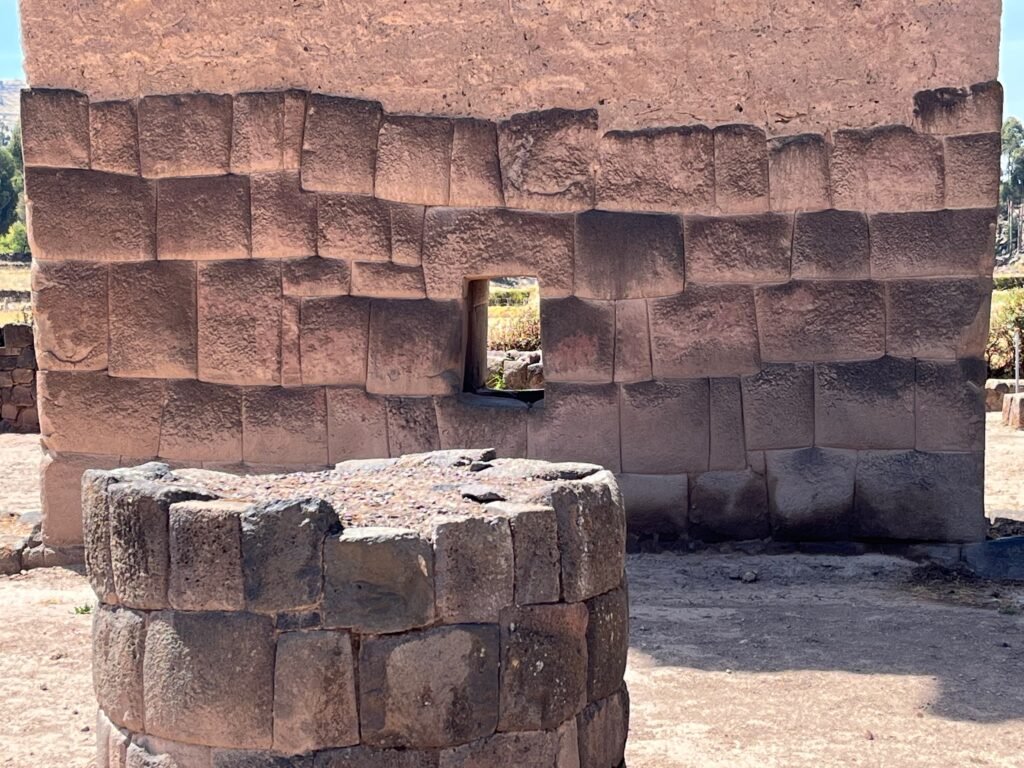
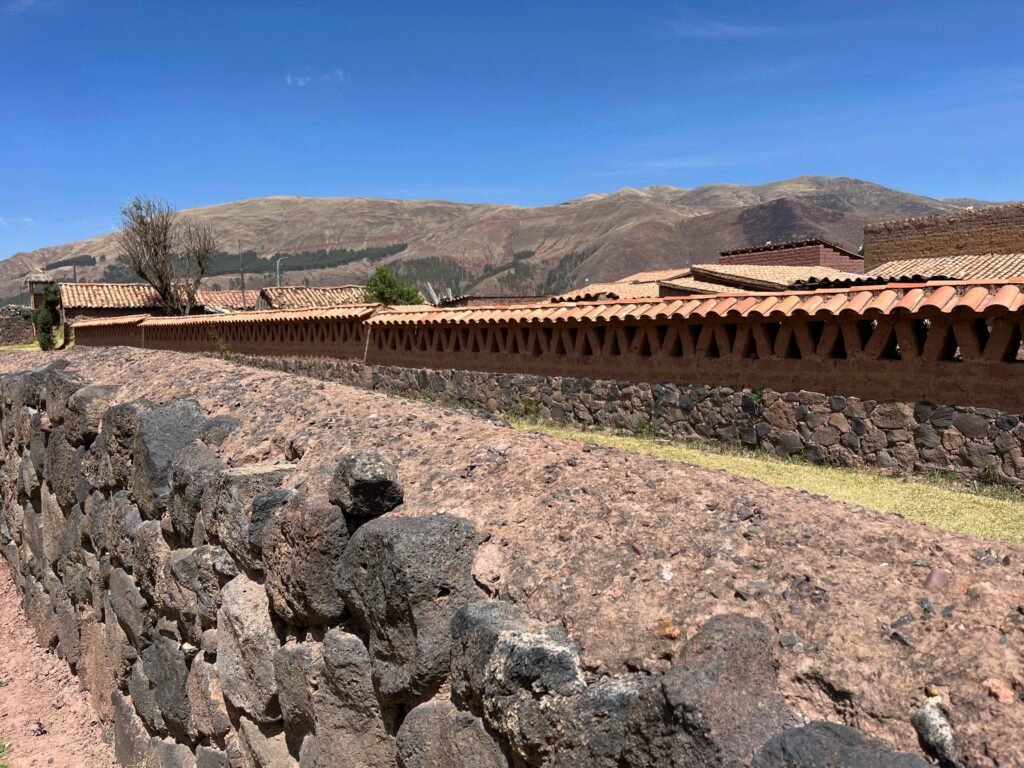
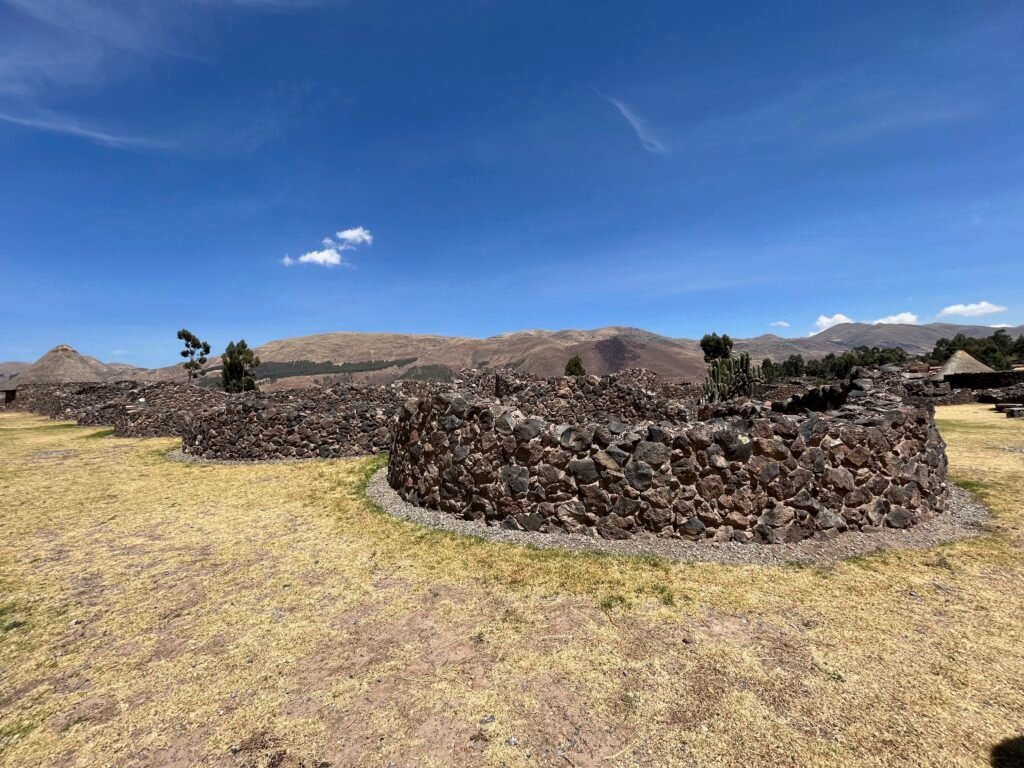
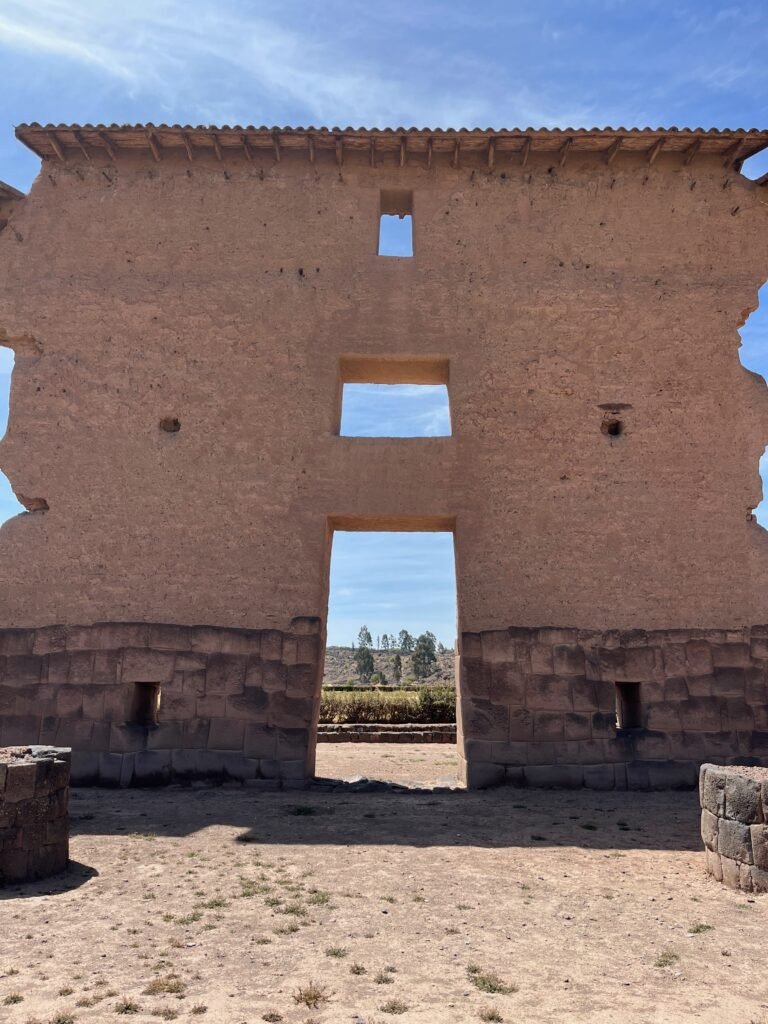
The Inca temple of Raqchi was next on our list, and it was impressive. It’s not fully known what it was all about, but it was certainly a control point on one of the main Inca road systems. There were over 200 storehouses and the Temple of Wiracocha was considered the largest single-gable structure in the Incan empire, over 80 feet wide and 300 feet long. The grounds were surrounded by a stone wall nearly 3 miles long, enclosing about 8,000 acres.
You might be able to get a glimpse of the protective wall running along the hills in the distance.
Altiplano
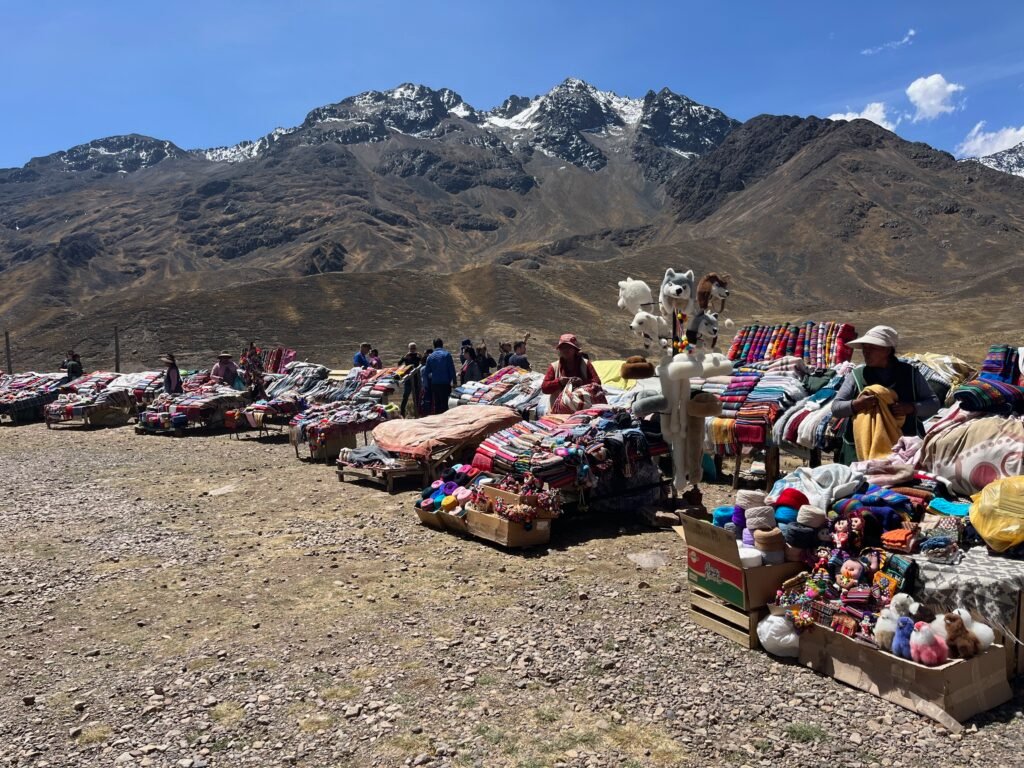
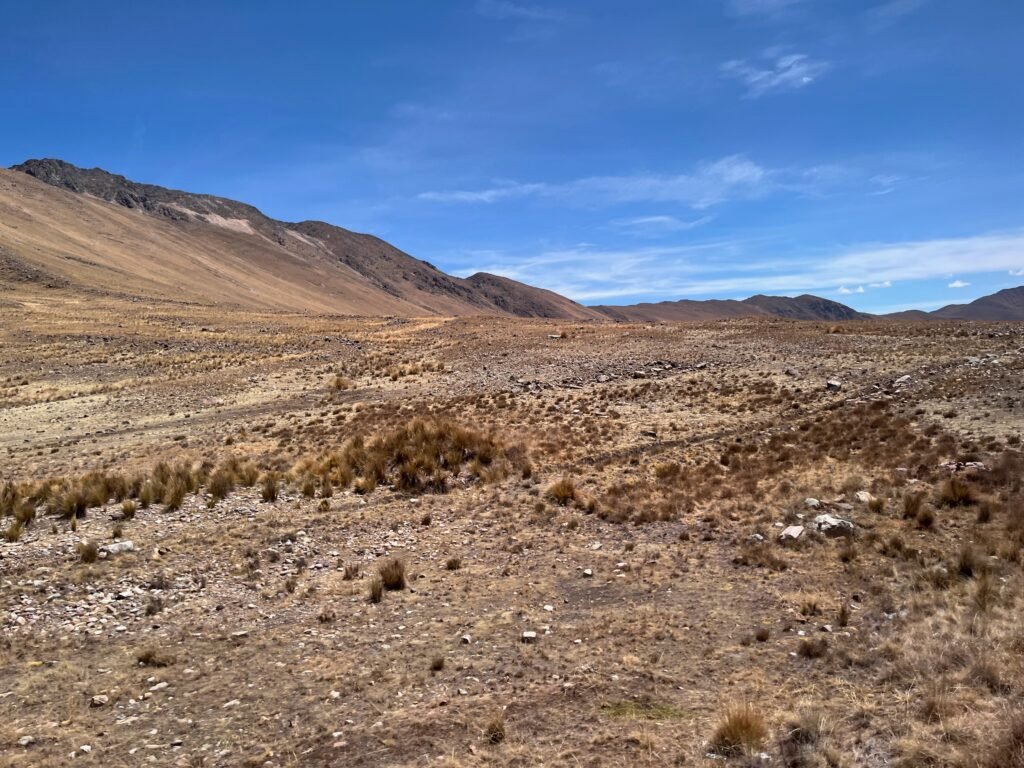
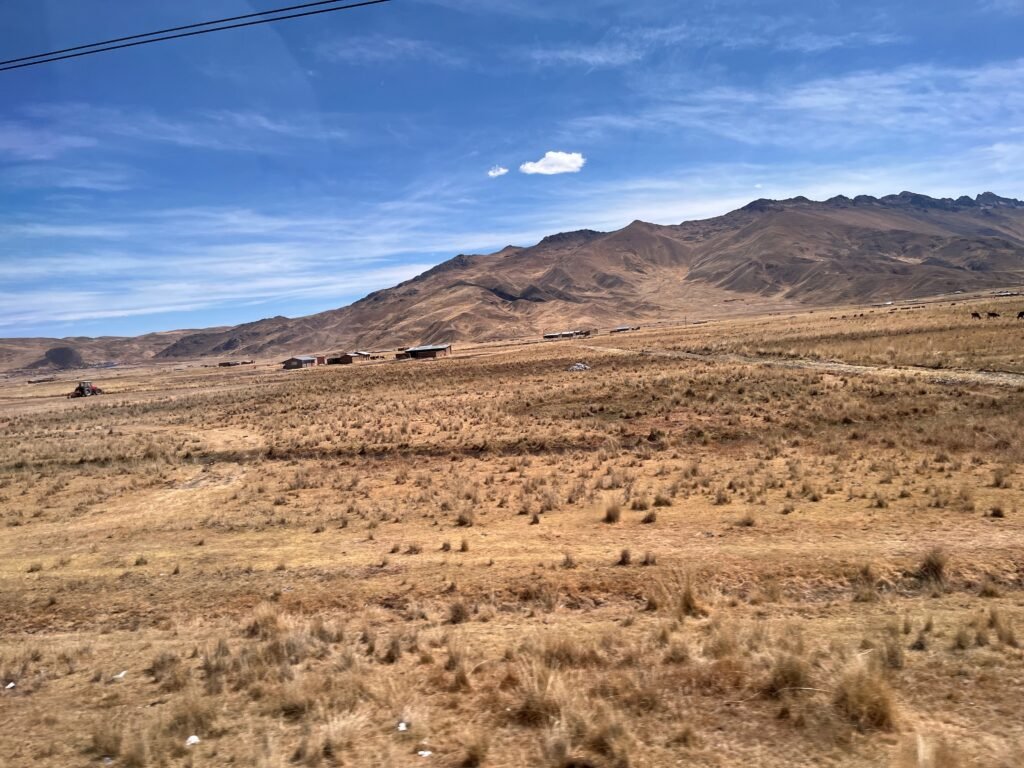
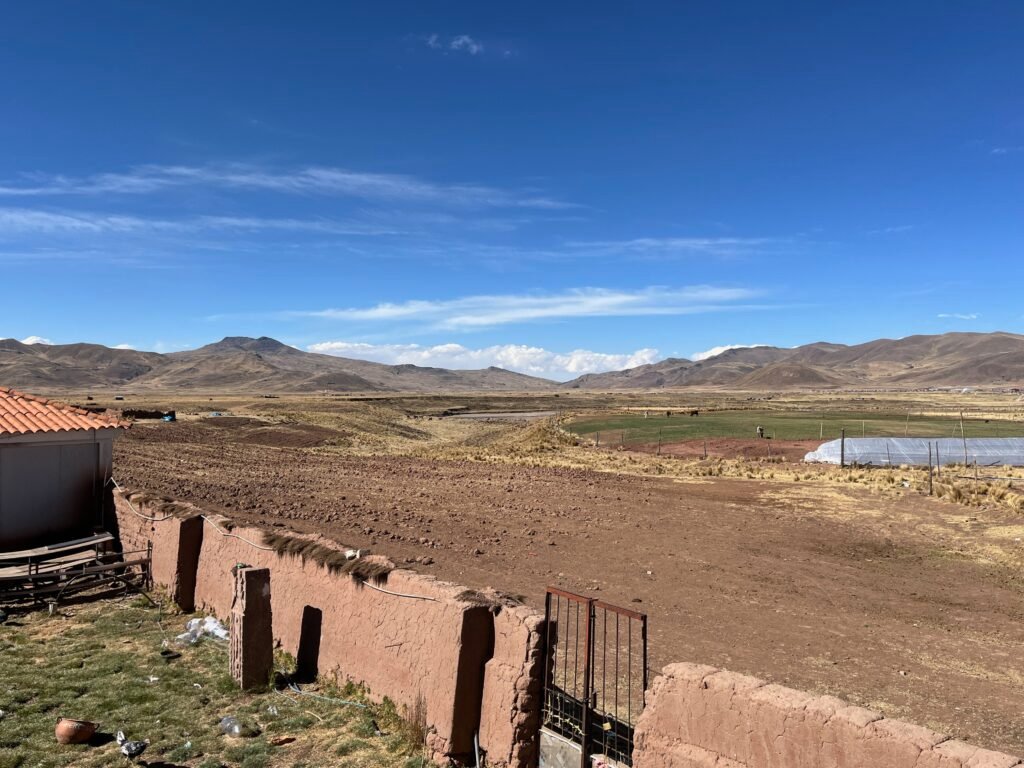
The word means ‘high plain’ in Spanish, an indeed it is! The Altiplano is the second largest high plateau after Tibet. It averages well over 13,000 feet and is 5,500 miles long! As we traveled through this high, dry country we left the Cusco region behind at La Raya pass. A different culture, the Aymara, come into being here in the Puno region.
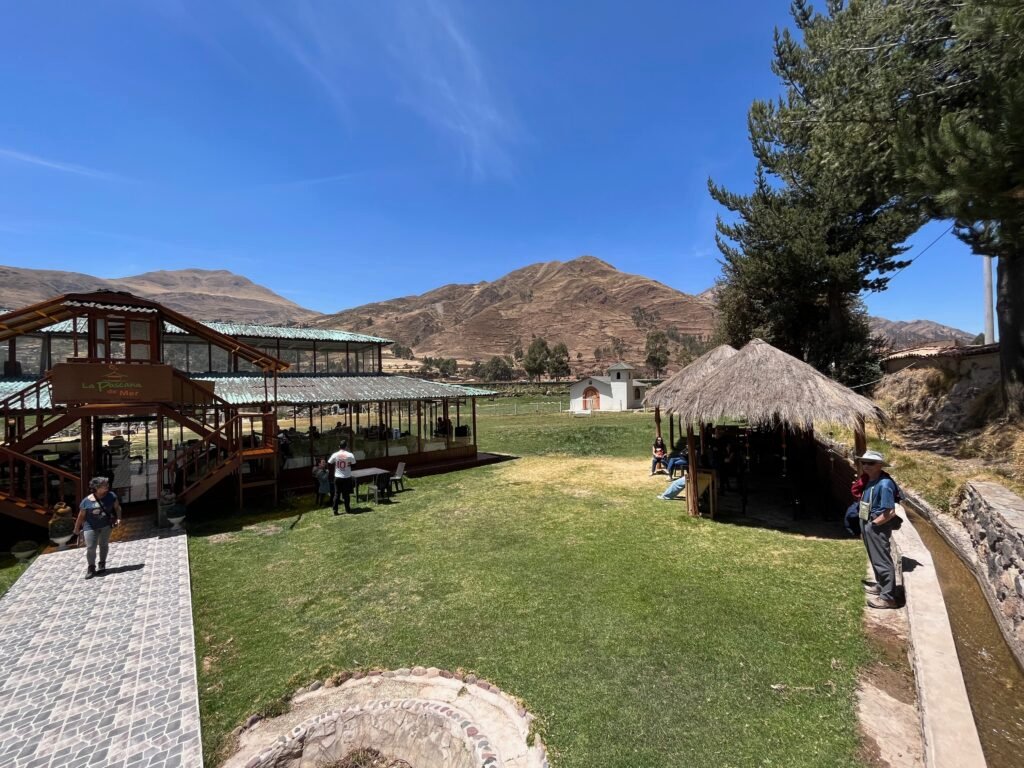
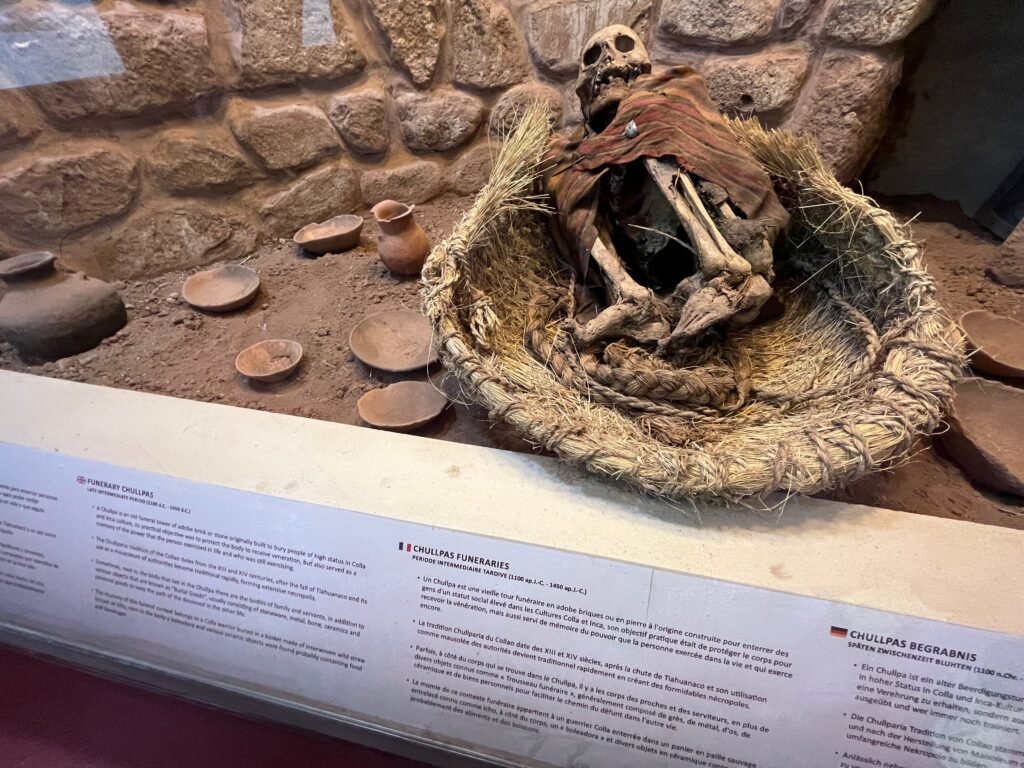
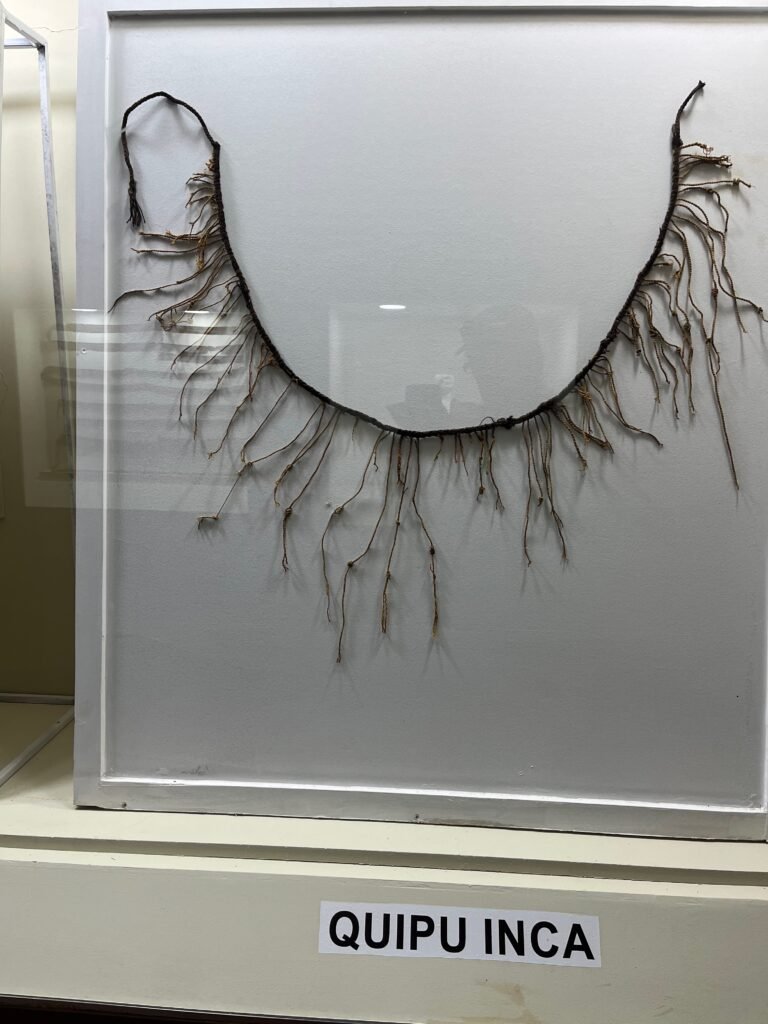
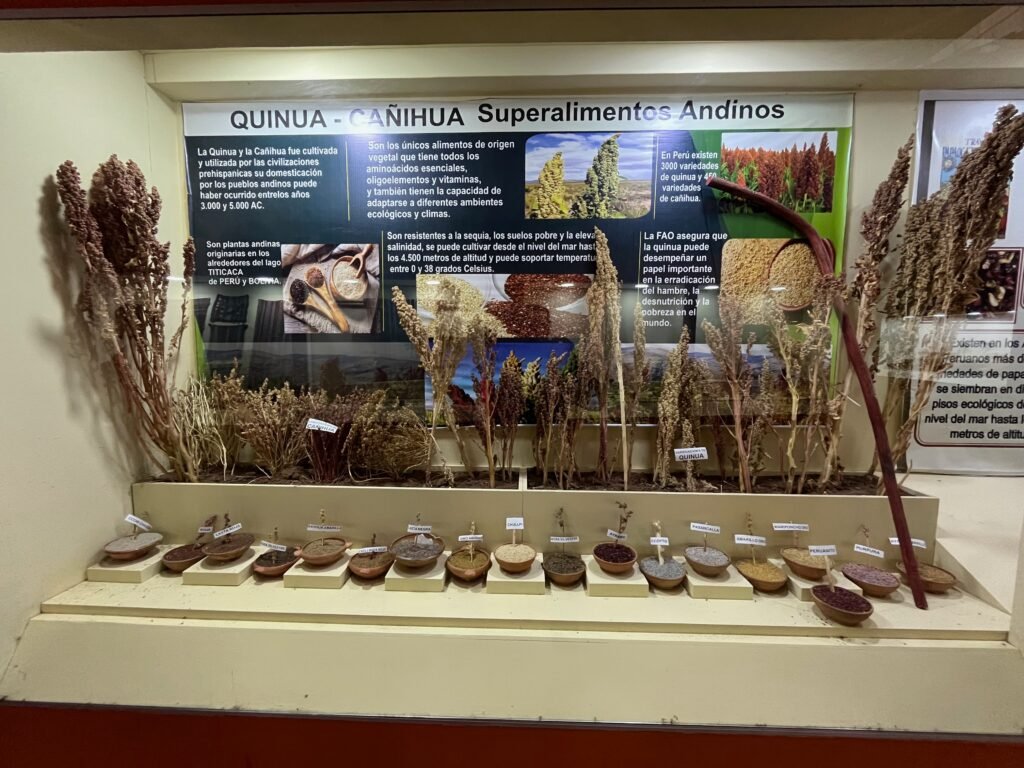
A nice lunch buffet at the Restaurant Turistico La Portada del Sol was followed by the small but wonderful Inca/Aymara museum at the Pukara archaeological site.
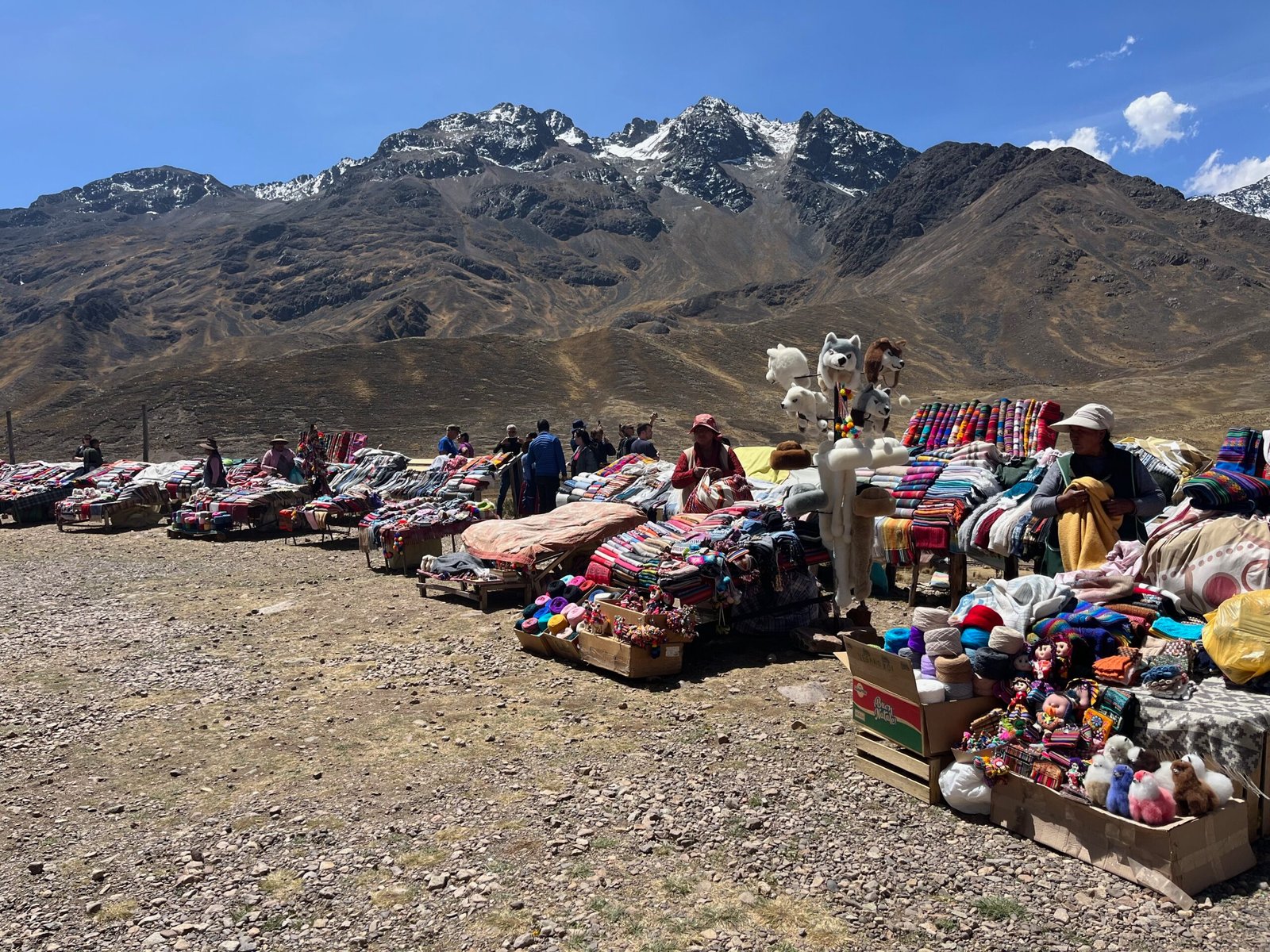
Roadside sellers at La Raya pass.The high plain.The high plain.Lunch time! I loved seeing all the old-school aqueducts.Playful pottery.As always, a good tour guide adds so much.Did you know there are over 3,000 varieties of quinoa in Peru?
Puno at Last!
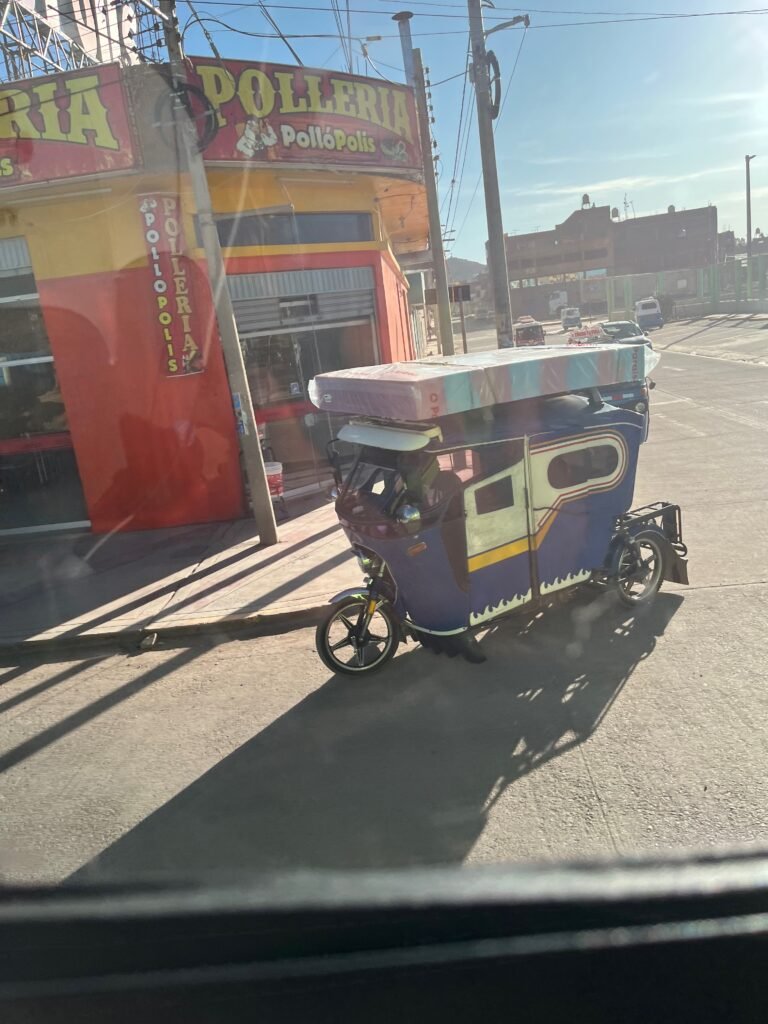
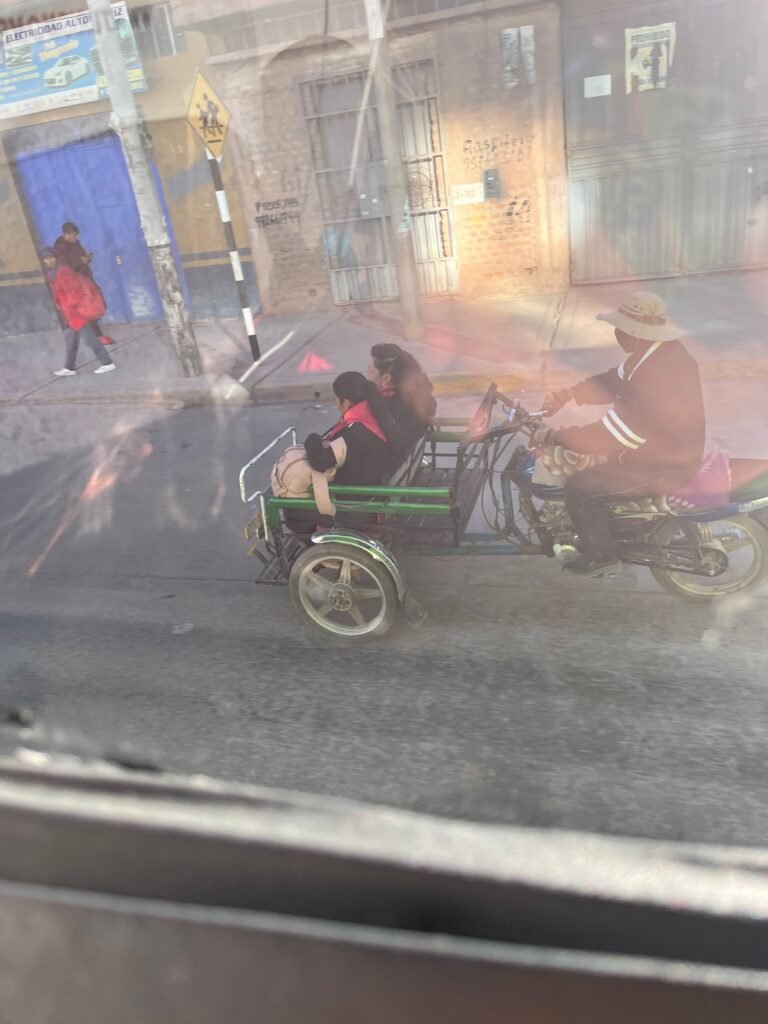
The traffic in Puno was, shall we say, more eclectic! Most of the towns we have visited had a predominant type of vehicle. Cusco for example was filled with small car taxis. A small town in Sacred Valley was mainly tuk-tuks.
But Puno had it all and had a lot of it! Buses, trucks, cars, tuk-tuks, and an amazing amount of small three-wheeled motorcycle cart things, where the guests sit up front, hanging over the front wheels and are completely exposed. With all the big vehicles, I would be terrified!
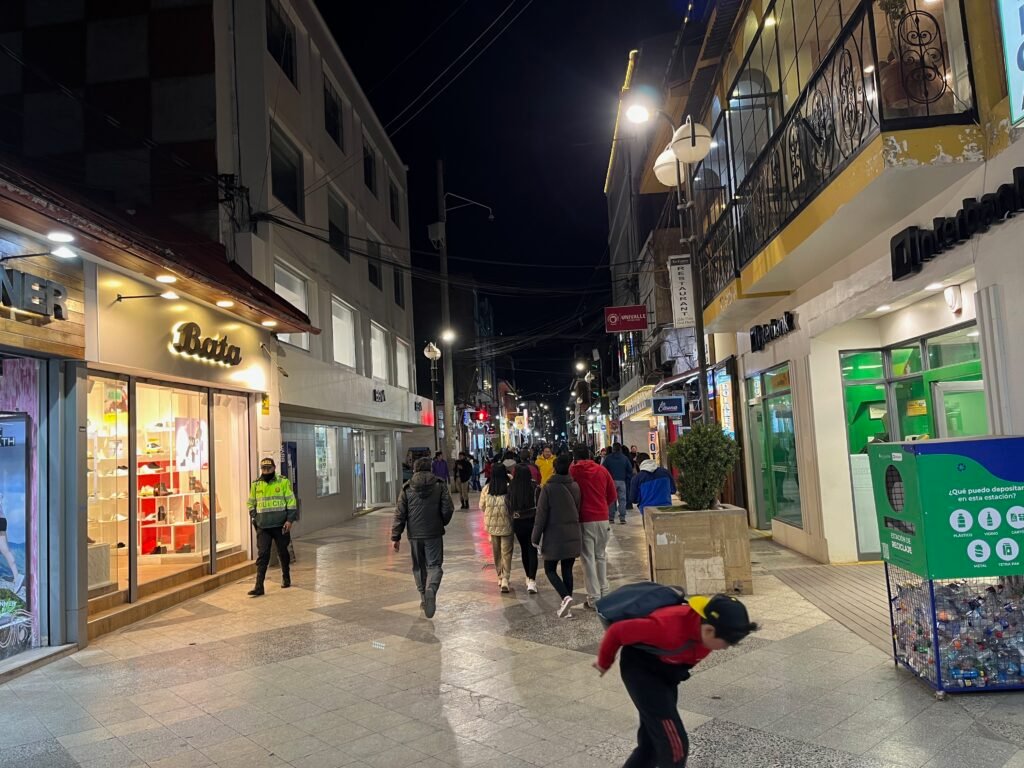
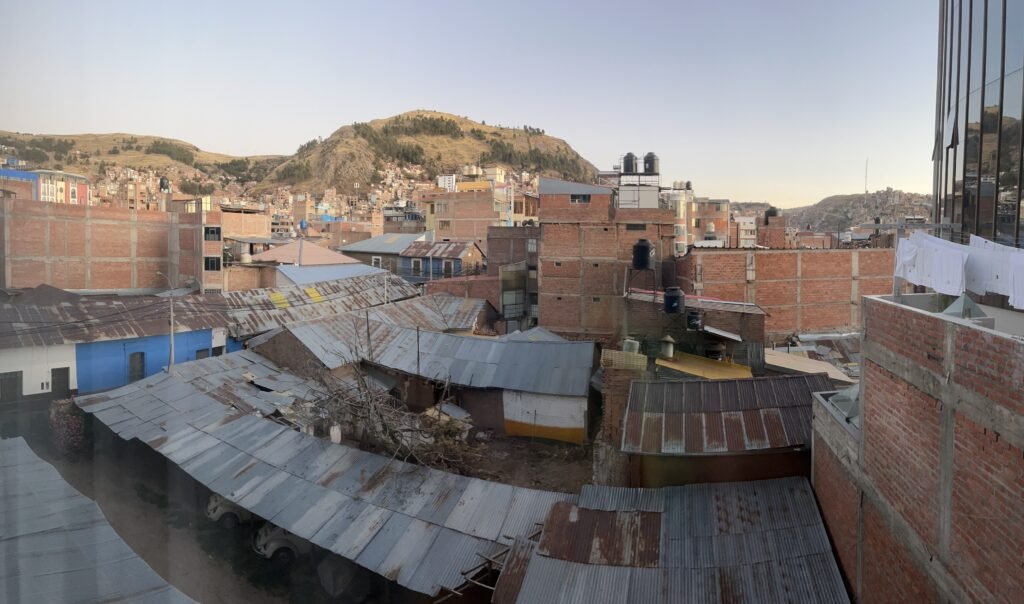
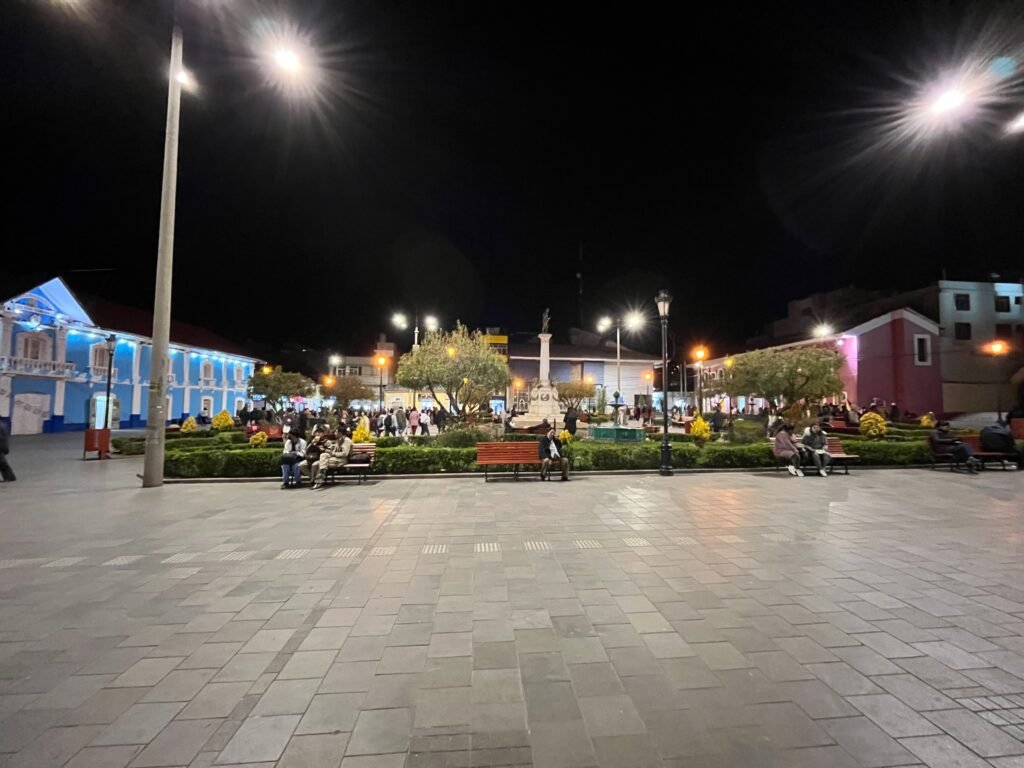
Tuk-tuks carry it all.Wow.Downtown is very friendly.Behind the hotel.The main square in Puno, very nice.
We were picked up promptly at the bus stop and then shuttled to the Tierra Viva Puno Plaza Hotel near the main square in Puno. It had been a full day and we were tired and a bit nervous about navigating the big city. But the hotel staff completely put us at ease and gave us excellent advice on where to explore, some good restaurants, and the closest supermercado, a supermarket.
Because tomorrow, we are going to stay overnight with a family on Amantini Island in Lake Titicaca, and a housewarming gift of food staples is considered a nice gesture. The supermercado was interesting. It was more like an indoor flea market, with small rooms crammed full of food stuffs. And tucked somewhere in every room was the seller. There was a ‘block’ dedicated to meats, a block of fresh vegetables, etc. Like a giant supermarket but broken into many sellers. We wandered around and found a booth with our staples and bought 1 kilo each of sugar, quinoa, and rice for our hosts tomorrow. It was all weighed out of big sacks and packed for us.
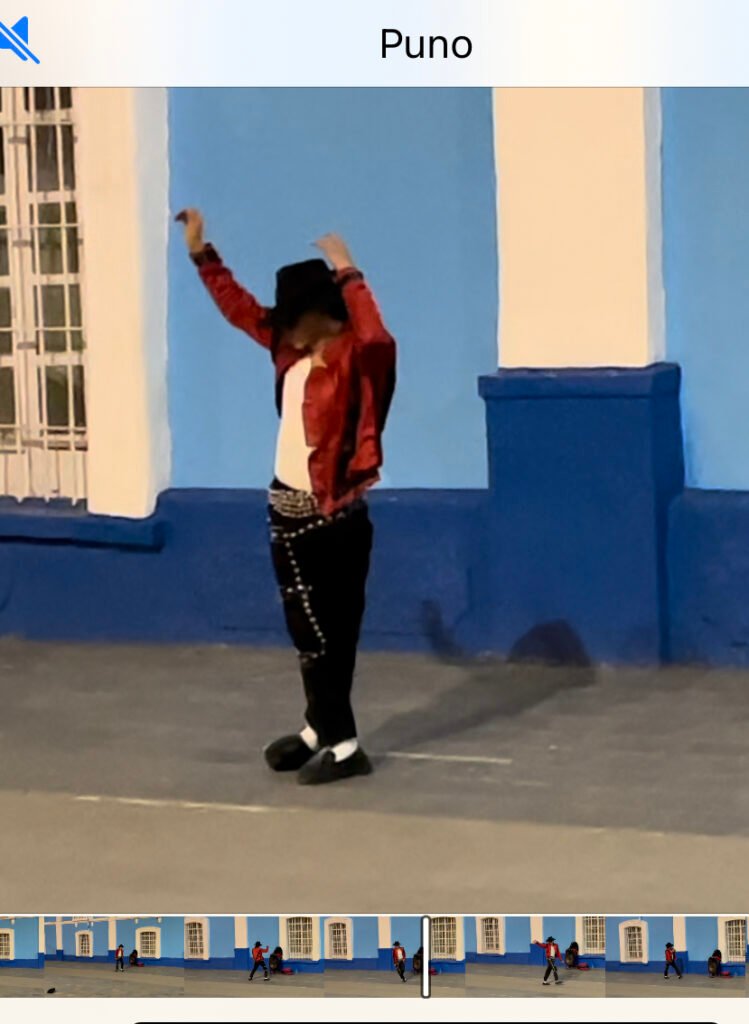
On our way back to the hotel, we wandered toward the main square. We heard music and as we came around the corner, there he was.
We always knew Michael Jackson was around somewhere, and apparently it’s Puno!
We were just in time to watch him dance and he nailed it!
We finished out the day with a light meal and nestled in for the night.
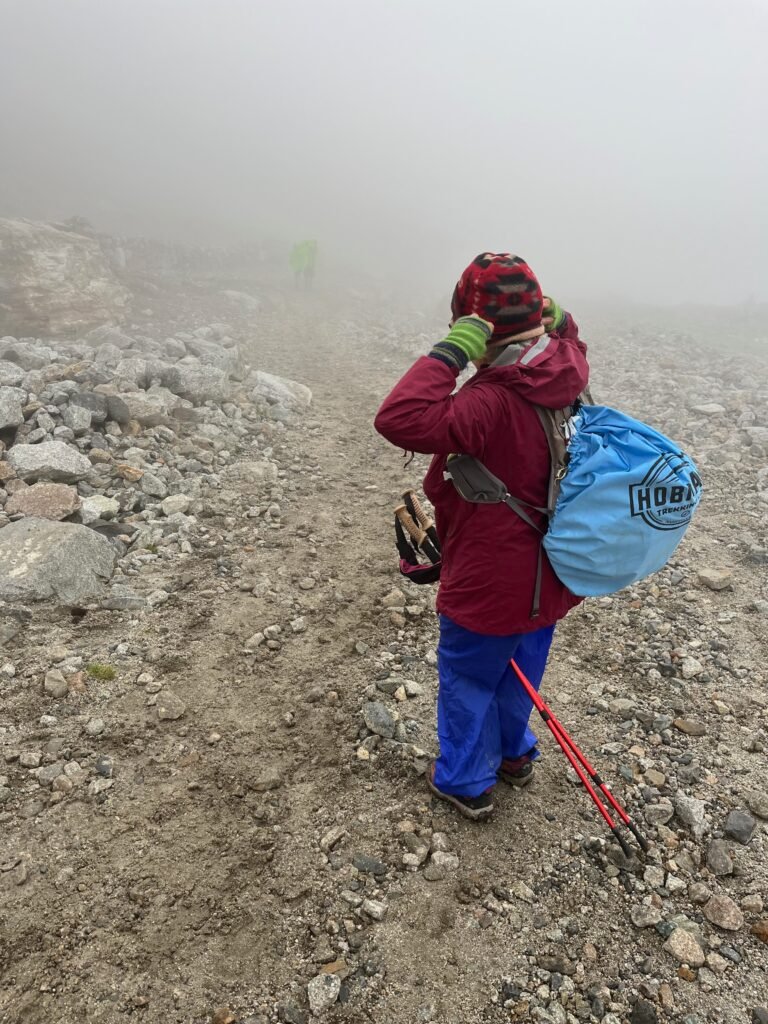
Emma, our Aussie friend, coined the name. It came from her watching Patricia square herself up with her trekking poles on the rocky trails. On a particularly challenging section, she would make quick moves in order to line up properly and it became a habit.
This trek has been the hardest thing Patricia has ever done and the hardest thing we’ve ever done together.
And I think a lot of it is because there were so many truly epic days back-to-back. An early rise, a long strenuous day, and a late dinner from the get-go. A stomach bug and the altitude were big factors as well. With the altitude, it literally takes weeks for the body to fully adjust.
So this has been quite an amazing accomplishment in its own right. But there’s more to the story and I want to share a little on how this all came to be. Or how we came to be here.
So I’m going to go back in history and expose a couple of decision points in our lives. Probably points we never really thought much about at the time, but that’s what makes up the journey of life, right? And then I think I can tie it together and paint you a better picture of my soul mate.
Why do I want to share any of this? I dunno, I guess it’s because she’s made life grand for me, and we’ve had a grand time together on the adventure. An odyssey of life I suppose. But it’s not because we’ve purposely sought out challenges, maybe it’s more because we like the experiences of adventures. And all the expected and unexpected things that may challenge us are just part of the process of exploring.
Or maybe because we like to see and show others just how big and marvelous the natural world is. A world that includes all the peoples. And many times it shows us ourselves. And we realize that there are other, simpler, different and more important things that go on. And, for some reason, and even after approaching 40 years, we seem to come out of the other side with a story to tell and a gladness at the attempt, whether or not we’d ever do it again.
We first met in the 1980’s at our workplace when I was fresh out of college. I have always been active and loved the outdoors. Anything adventurous that didn’t cost much money. So backpacking, climbing, canoeing and the like, the harder the better. Patricia, on the other hand, had not had those opportunities and had not done much more than a car or boat camp with her family on summer weekends.
As we got to know each other, it became obvious she was up for any challenge. And, whether good or bad, she seemed ready to follow me just about anywhere and at anytime. Our hikes became extended hikes. And our extended hikes became backpacking trips. I can’t even recall how many adventures we had together in those early years.
One time in the mid-’80’s while we were dating, I asked Patricia if she wanted to go on an overnight backpacking trip into a true wilderness area, the Joyce Kilmer Memorial Forest. She was up for it! So on a blustery, rainy day we drove the old ’79 Dodge three-on-the-tree pickup with the manual steering all the way over to Big Fat Gap in North Carolina. We saddled our big external frame packs, put on our ponchos, and left the truck in the rain.
In wilderness areas, there are no trail markers, only trail signs at the junctions. There are also no bridges, in keeping with the wild ethic. Our goal (my goal, I’m sure she had no idea where we were going) was to hike up alongside Slickrock Creek a few miles and then take the Naked Ground trail up to the saddle for camp. Tomorrow we would come out via the Hangover with resplendent views of the Smokies. An adventure sure to impress!
Did I mention it was late November? And all the leaves were down? Following a trail upstream in downed leaves with no trail markers is actually pretty difficult. Every little tributary has a game trail that looks like the main trail, but wanders off into the forest until it closes in and you have to backtrack. It took us hours to get up to the trail junction for Naked Ground. It rained the whole way.
Looking at the trail sign, I see “Naked Ground 3.1” officially carved into the wood. But down in the lower right corner what catches my eye are the unofficially carved words, “BALL BUSTER“. Hmmm. Maybe Patricia won’t notice.
The Naked Ground trail is steep, with about a 2,800 foot elevation gain in the 3-ish miles. It’s steepest at the top and switchbacks are rare. Patricia, to this day, has a ‘fond memory’ of being able to stand straight up on the trail and actually touch the trail in front of her with her finger.
Oh, this is also bear country, and hunting was in full swing. Partway up the trail, a bear dog joined us. Bear dogs are typically Walker dogs with radio collars so their owners can track them as they run the bear. This guy was lost and quite hungry, and no manner of shooing was going to run him off. He knew we were coming out somewhere and he was going to be a part of it.
The trio made camp about dark. I set up the big dome tent and turned to grab the stakes. When I turned back I could see the entire bottom of the tent as the wind carried it off the saddle like a big kite. Fortunately, the trees eventually pinned it down and we were finally able to crawl in, completely bushed. The food situation was light, but the dog nonetheless enjoyed the remaining chicken soup.
We came all the way out the next day. It had rained the entire time and the clouds were thick with no views to be had. The Hangover Lead trail dropped quickly and steeply and was nearly as bad as the Naked Ground trail. And it was slick, slick, slick from the mud and the leaves. I gave the bear dog to some hunters coming in that said they knew the owner. Once we got home I splurged for a long distance call (remember those?) to the number on the collar just to make sure he made it home okay.
This would have been a good opportunity for Patricia to beg out of future adventures or even decide that maybe she needed to go in a different direction with her future. Fortunately, she did neither.
One more story to get to where I want to go. By 1988, we had saved enough vacation time for some significant travel time Out West. We took my AMC Cherokee and camped every night, exploring as much as we could with no reservations or destinations pinned down.
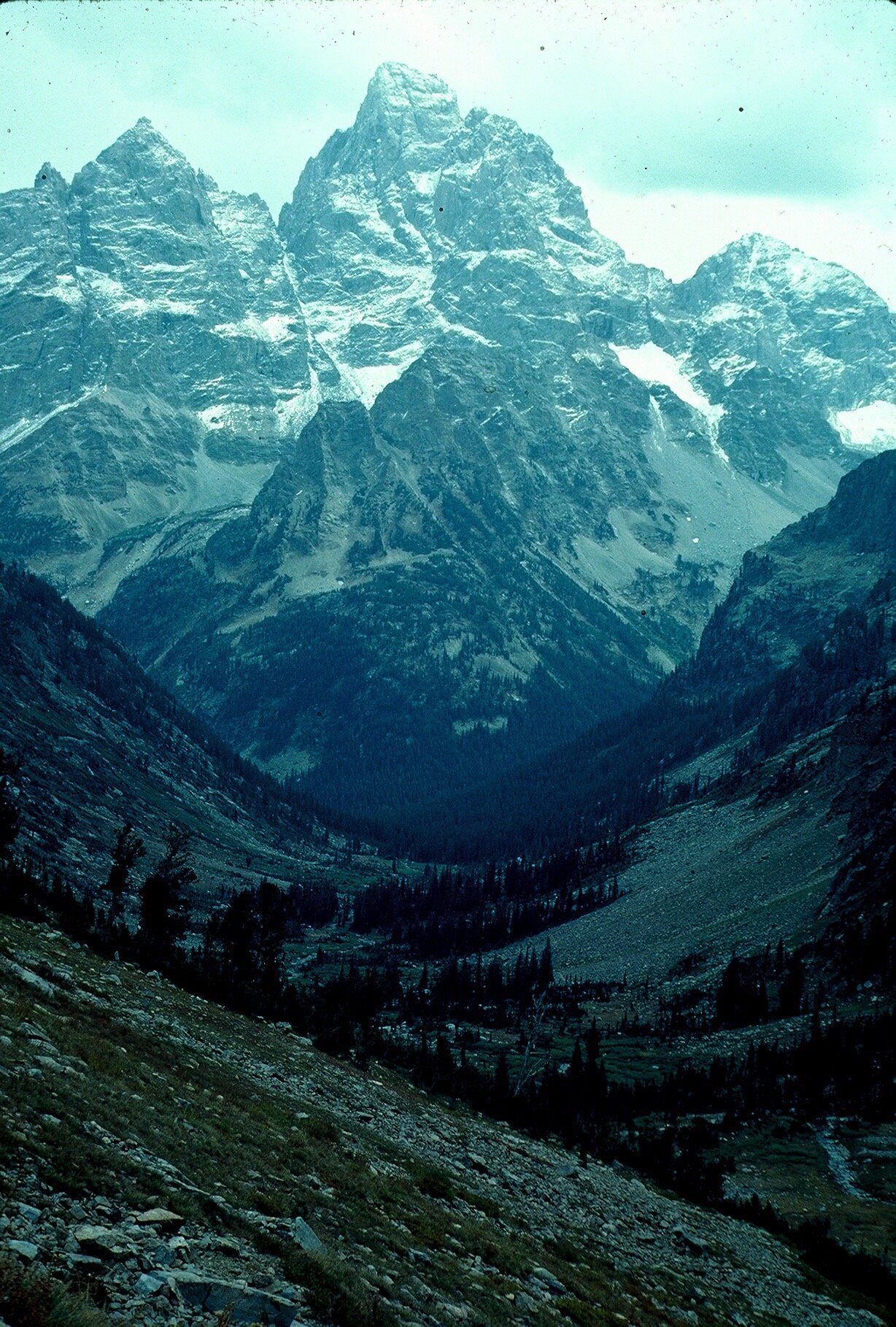
Patricia and I ended up in the Tetons while the fires raged in Yellowstone that year, it was a major event. Yellowstone was obviously closed, and overnighting in the Tetons was banned too, due to the smoke and fire danger. Disappointed, ‘we’ opted for a long day hike instead. 23 miles to be exact. Up Cascade Creek to Lake Solitude, then across Paintbrush Divide, and down the Paintbrush Canyon trail.
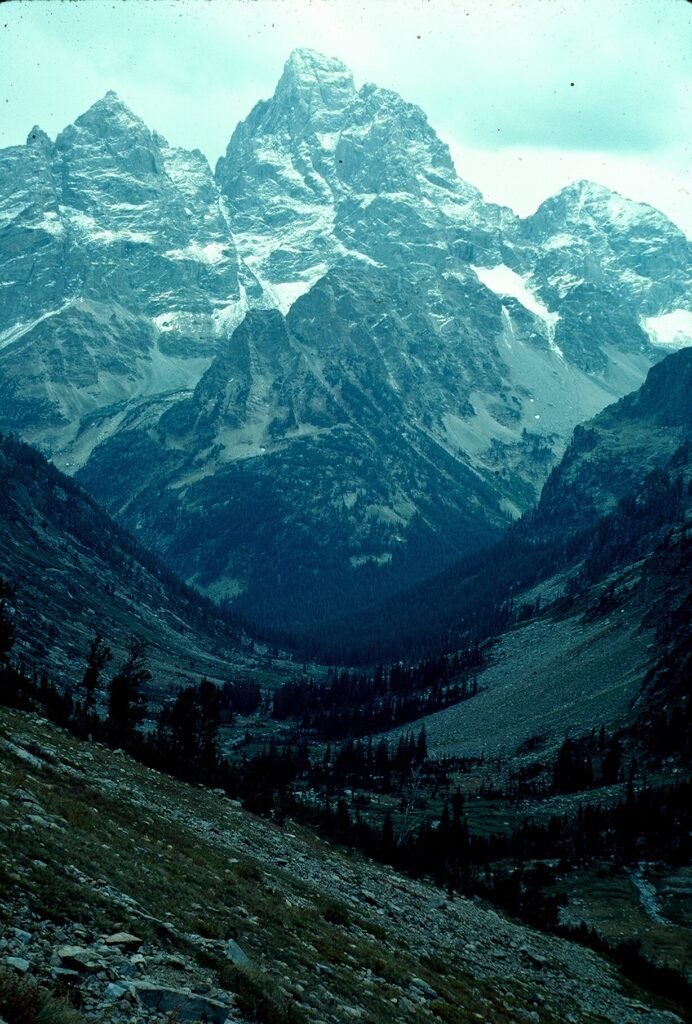
Starting well before daylight, we hiked around Jenny Lake before climbing into the hanging valley of Cascade Creek. It was a cold, snowy day and somewhere up above Lake Solitude, after about 3,000 feet of climbing, we stopped for a breather. Looking back down, Grand Teton nearly brought tears to my eyes. It was perfectly centered in the glacier-carved valley below and I was filled with our Peru guide Ruben’s “mountain energy.”
It was decision time. If we continued on, we’d have another 800 foot of climbing and a much longer return to camp down the rocky and steep Paintbrush Canyon trail. It would be well after dark and include a couple of miles of road walking. So I asked Patricia what she wanted to do.
“Well, I don’t want to go back the way we came.” … We were married the following spring.
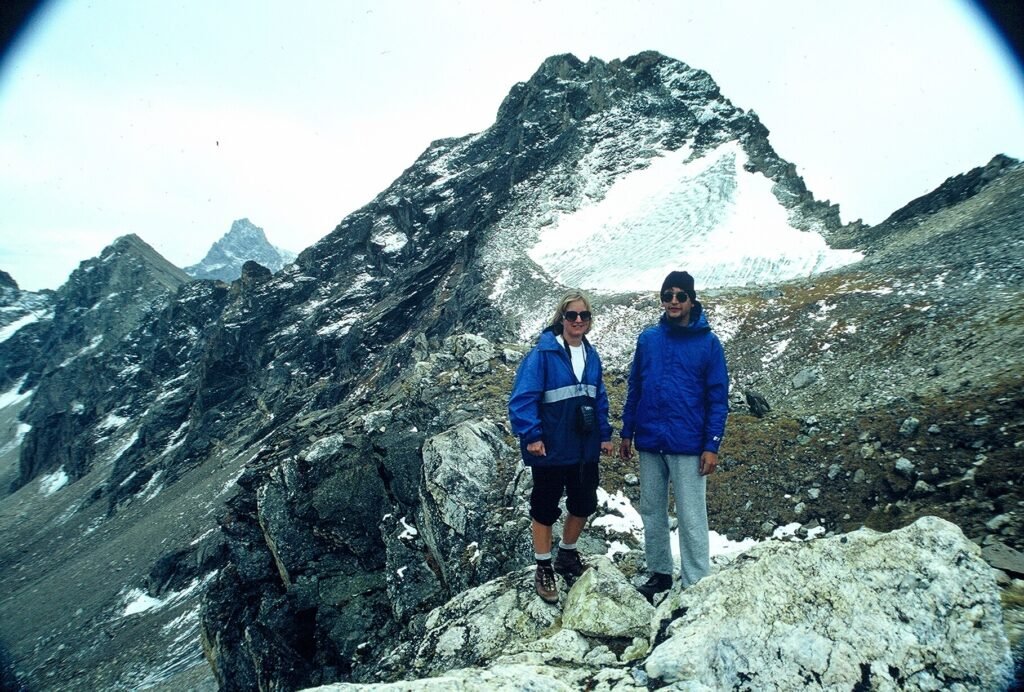
The intrepid hikers at Paintbrush Divide, September 1988. The 35mm film camera is balanced on a rock, we didn’t see a soul the entire day. By the way, Patricia did this hike and many others not knowing she had a PFO until many years later.
How lucky can a man be? I am blessed beyond measure with her attitude and willingness to explore, to see new things, to experience new cultures. If I said tomorrow “Hey, do you want to go hike the Andes in Peru in late winter at high altitude?” I’m pretty sure she’d do it.
Oh wait, I actually think the Peru trip was her idea….
But there’s a bit more to the story. Over the years, Patricia has had to work through several physical issues. After a stroke about 20 years ago, we found that she had a Patent Foramen Ovale (PFO), literally a large hole between the upper heart chambers. Something that was supposed to close after birth. The PFO allowed blood returning to the lungs to bypass back into the oxygenated blood, reducing available oxygen and possibly allowing blood clots, normally collected by the lungs, to get to the brain. Amazingly, this was repaired successfully. Patricia could actually feel a difference in her stamina, something she never knew was missing. She’s had chronic lower vertebrae issues for years, possibly stemming from a car accident at a young age. At one point Vanderbilt told her not to come back until she was ready for screws and plates. And for the past two or three years, there have been issues with migraines and other seemingly neurological problems. Last year, plantar fasciitis severely limited our activity traveling around the Great Lakes, and flared up again this year, threatening to derail our odyssey!
Patricia has a strong will and she just doesn’t give up. And with each issue she learned more about herself and how to manage the problems. In short, she’s learned to listen to her body. And it has been amazing to watch her determination pull it all together for this trip. And on the Peruvian Odyssey, it was almost like none of these issues ever existed! Which was good, because we really need to keep our focus on breathing, hahaha!
What a journey it has been so far! One thing we’ve learned together is that through your life journey you can adapt without compromising who you are. In fact, for a well-lived life, it’s probably a requirement.
Emma’s observation was spot-on. I’ve been working on a ‘badge of accomplishment’ just to remind Patricia that, no matter what the future holds, she can enjoy her status as a Trail Ninja. She’s not beholden to anyone. And now she has all these stories to tell!
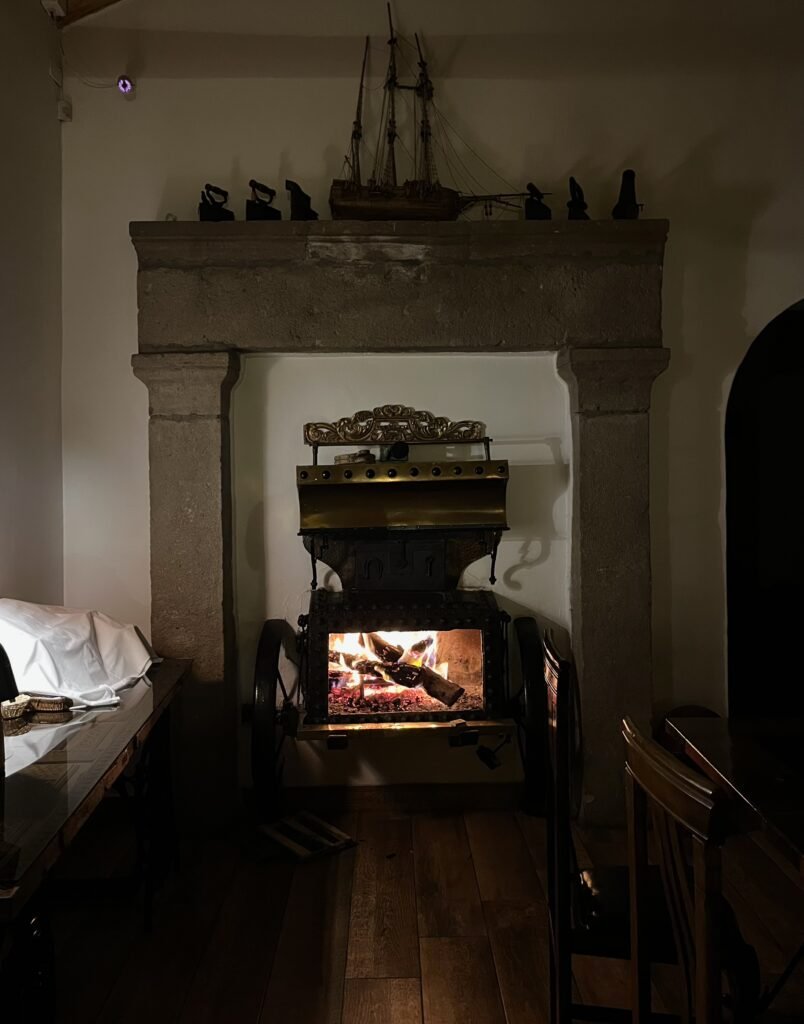
The staff at the Rumi Punku already had the fire going when we came down a little after 4am.
Today is the day for Rainbow Mountain and we wanted to stay ahead of the crowds.
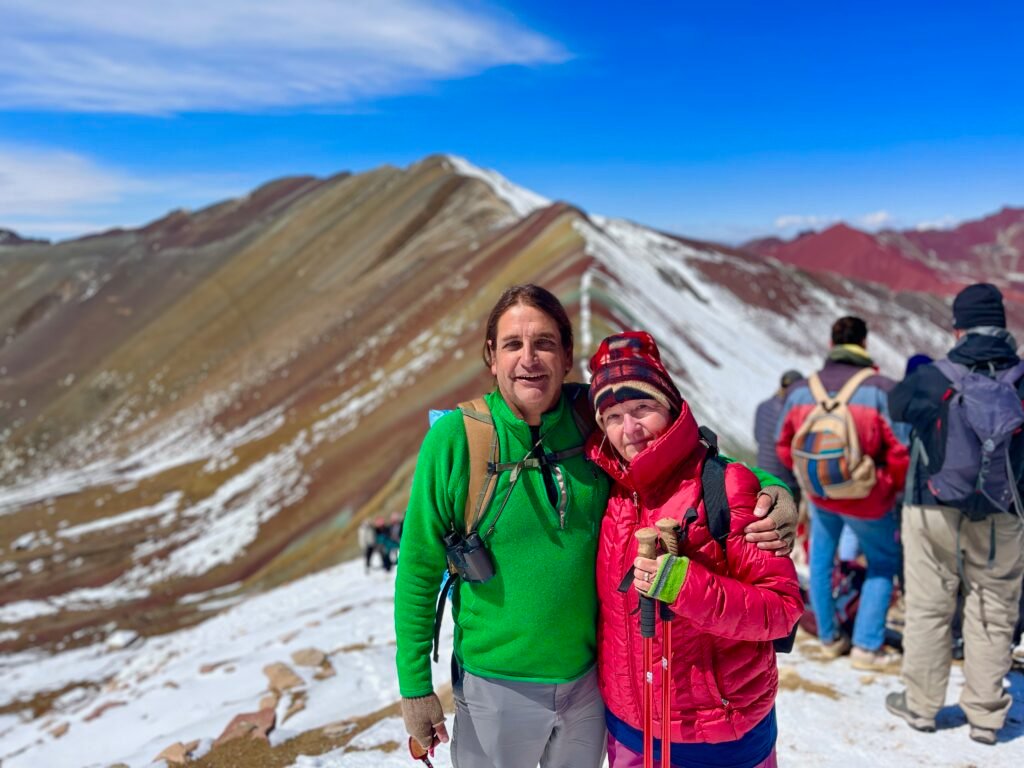
It’s the thing that caught Patricia’s eye in the Odyssey. And our last major hike of the trip.
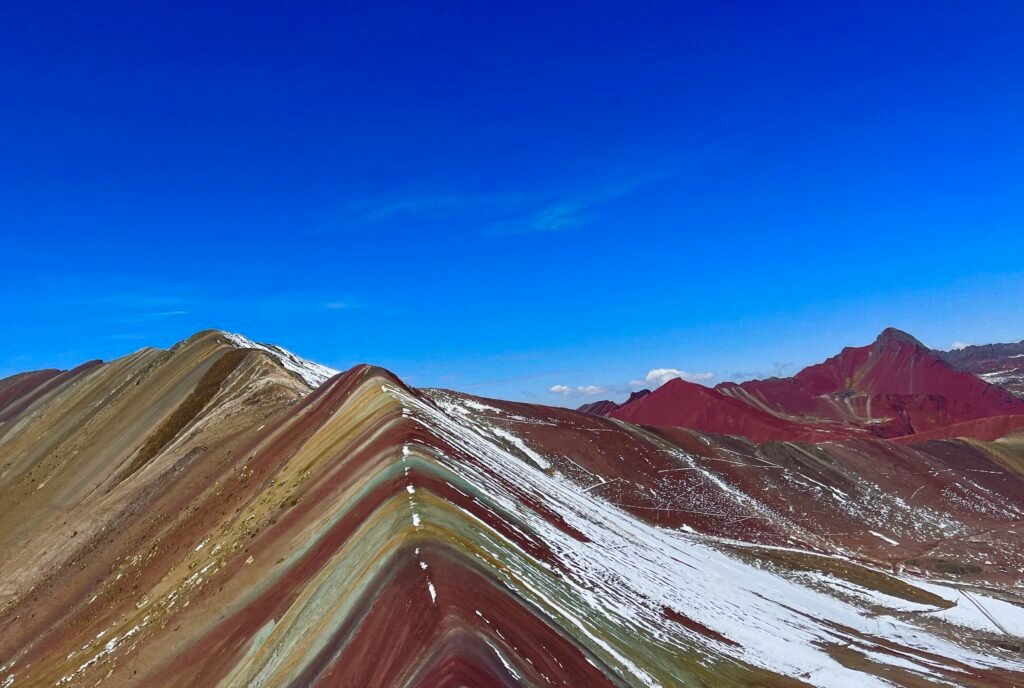
Rainbow Mountain has an interesting story. It was only ‘discovered’ around the year 2000, when the changing climate melted what was perennial snow and ice, revealing the colorful minerals underneath. Since the number one income generator for Peru is mineral extraction, the companies were lining up to take advantage of the opportunity.
The local indigenous people were none too happy and launched a protest to keep the heavy industry out of their villages. Surprisingly, the government gave the mountain over to them so that they could manage it for tourism, the second largest income generator in Peru.
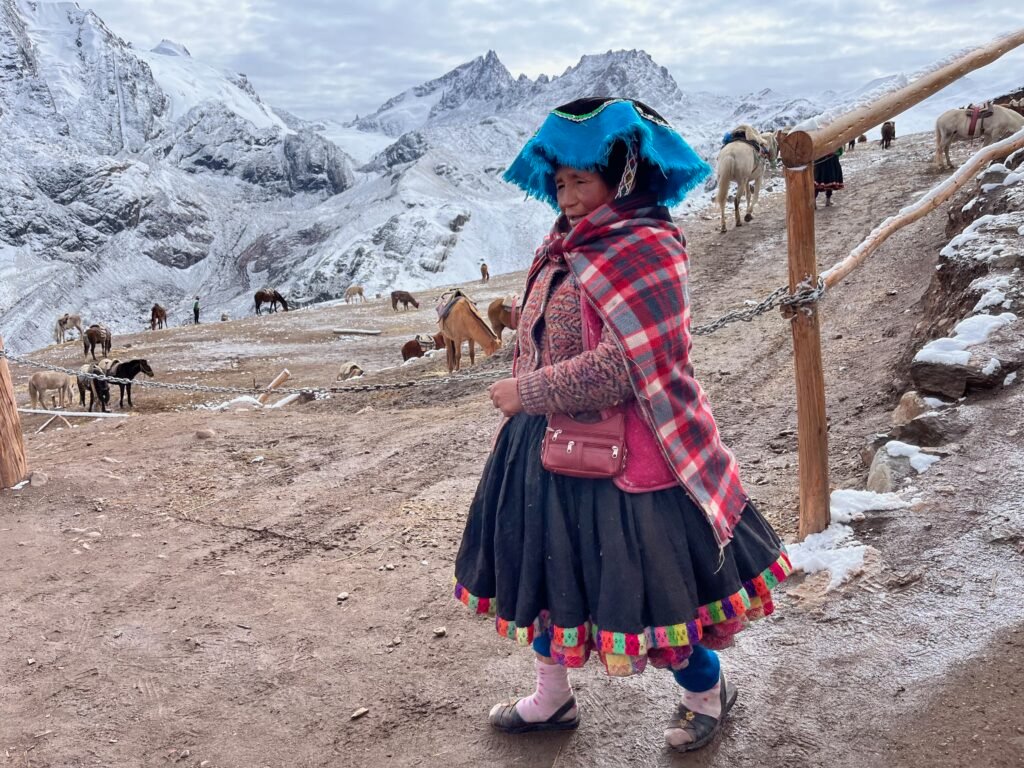
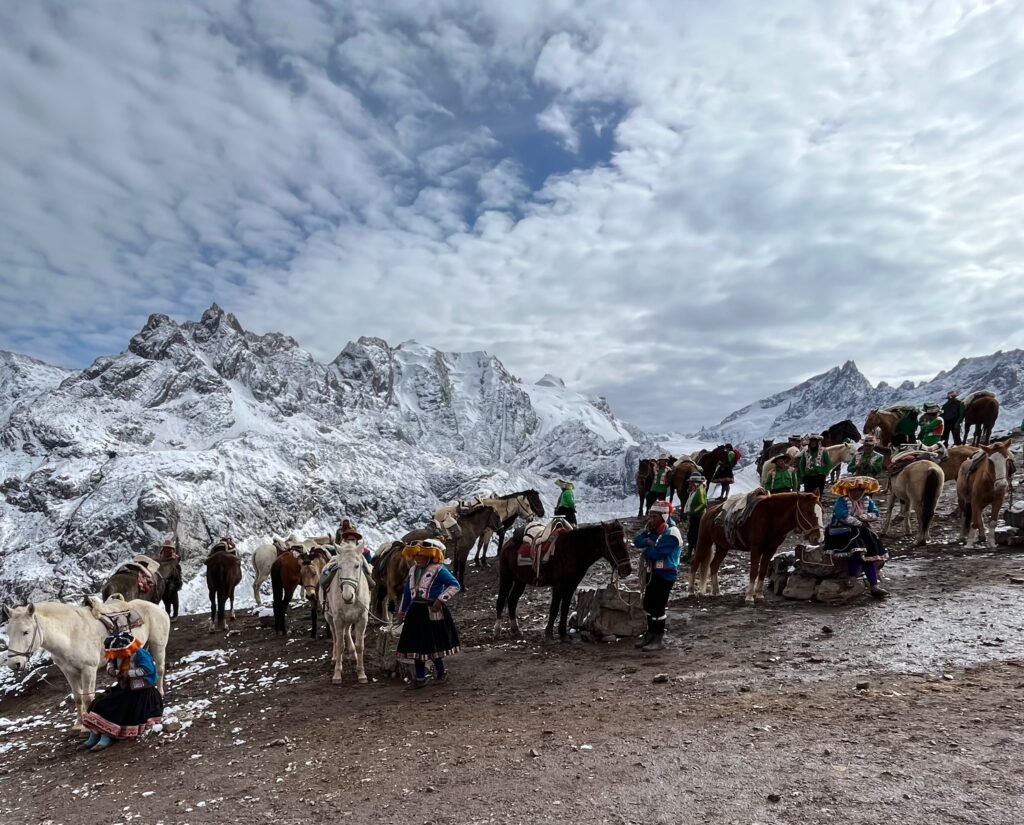
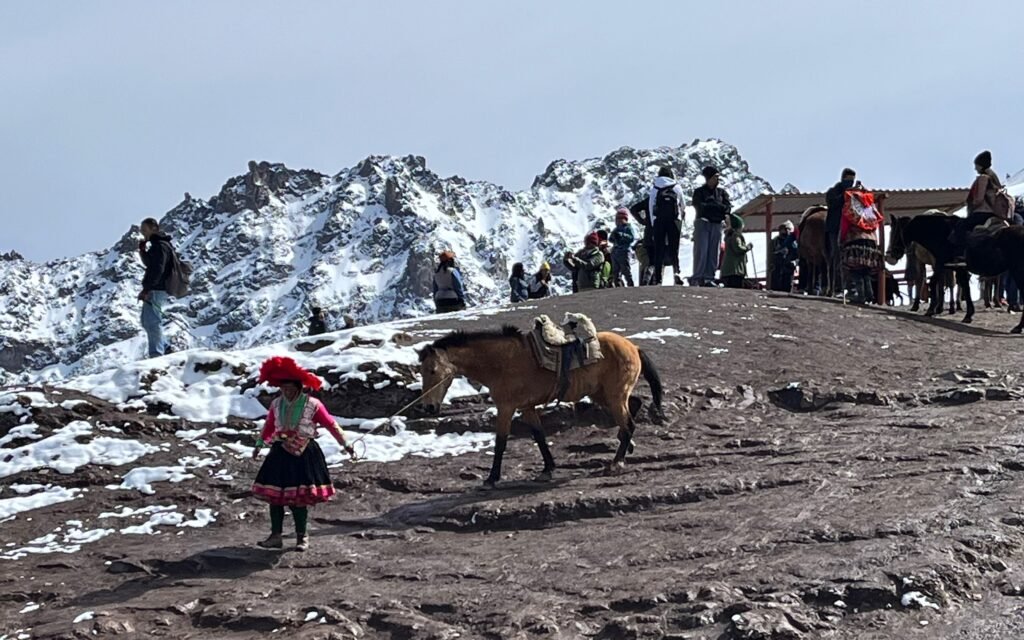
In 2016 or so, the four communities on the way to Rainbow Mountain improved the road, built restroom facilities, parking areas, and trails for the climb. And what I think was a smart move, created a horse trail parallel to the hiking trail on the lower slope. This allowed the locals to run a horseback taxi service to the base of the peak and, with the horses being on a separate trail, kept the footpath in good shape and enjoyable. It’s obvious that the endeavor has become an important income stream for these remote communities.
Of course, with the new revenue comes consequences. The extra income has increased the use of sugary foods and the young people are losing their teeth by age 20!
Before we left Tennessee, our hygienist daughter Karen helped us gathered a big duffel bag of dental products including nearly 100 toothbrushes. On our first day in Cusco, we passed these on to Ruben and Alpaca Expeditions, but hadn’t heard anything.
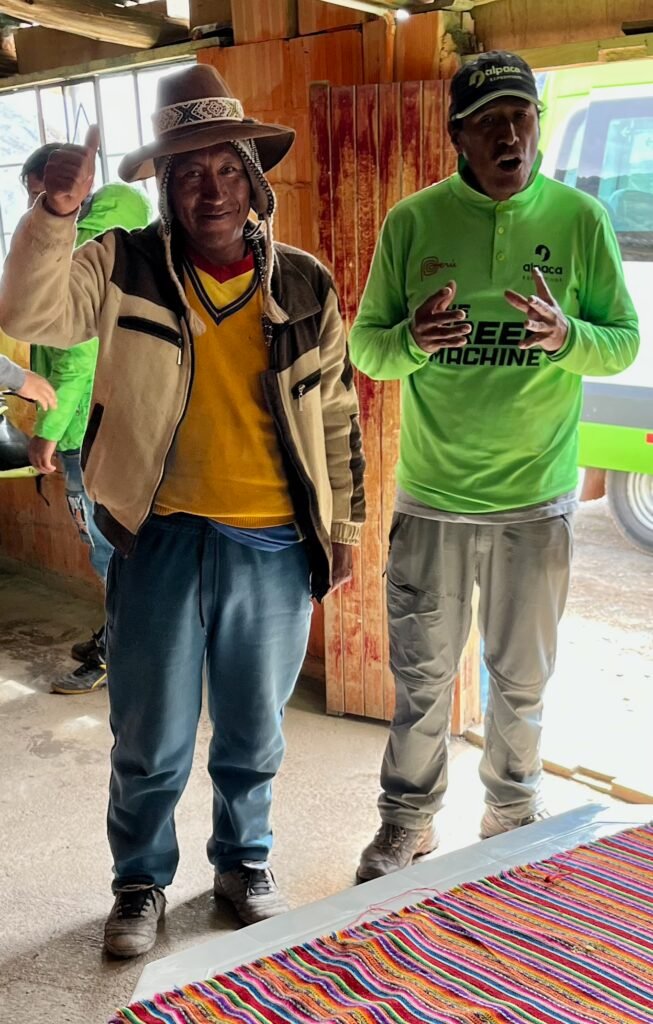
Now, while having breakfast at one of the small community centers, Ruben introduced the community leader and he thanked us for our help. They would be bringing in someone to show the villagers how to use everything properly.
A nice way to start the day.
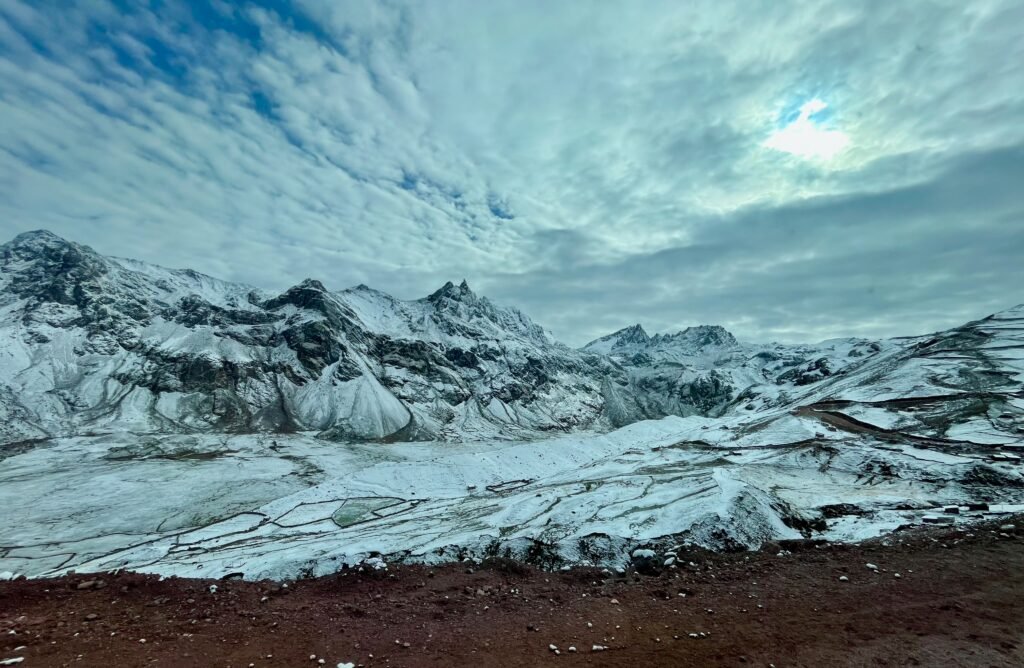
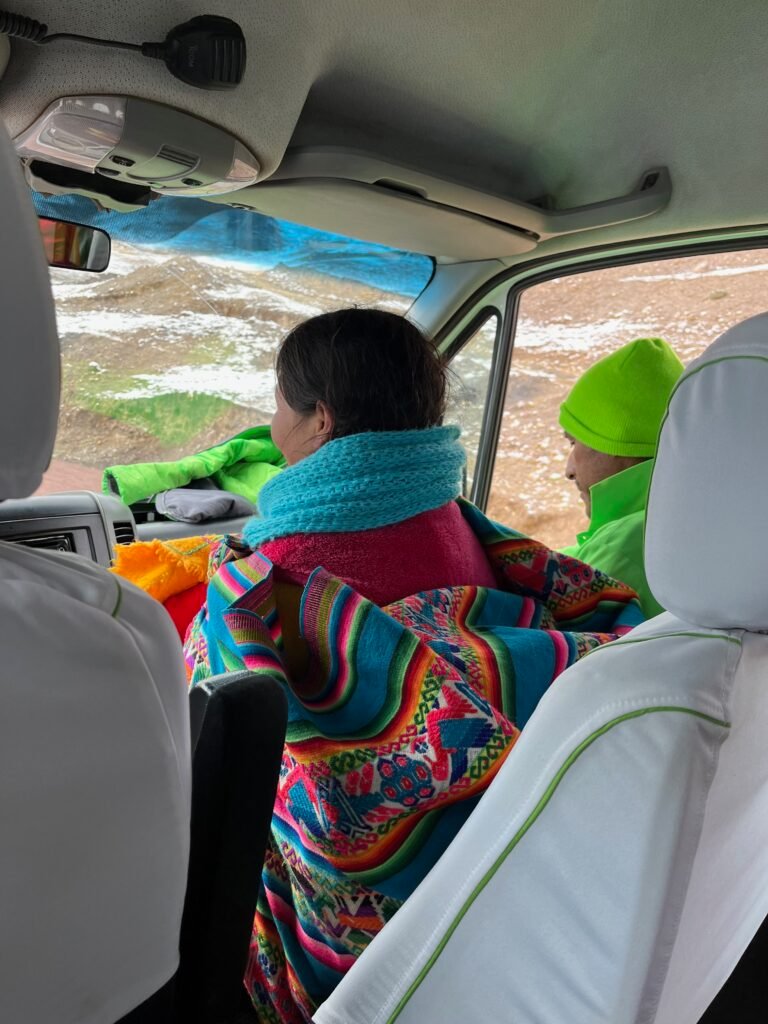
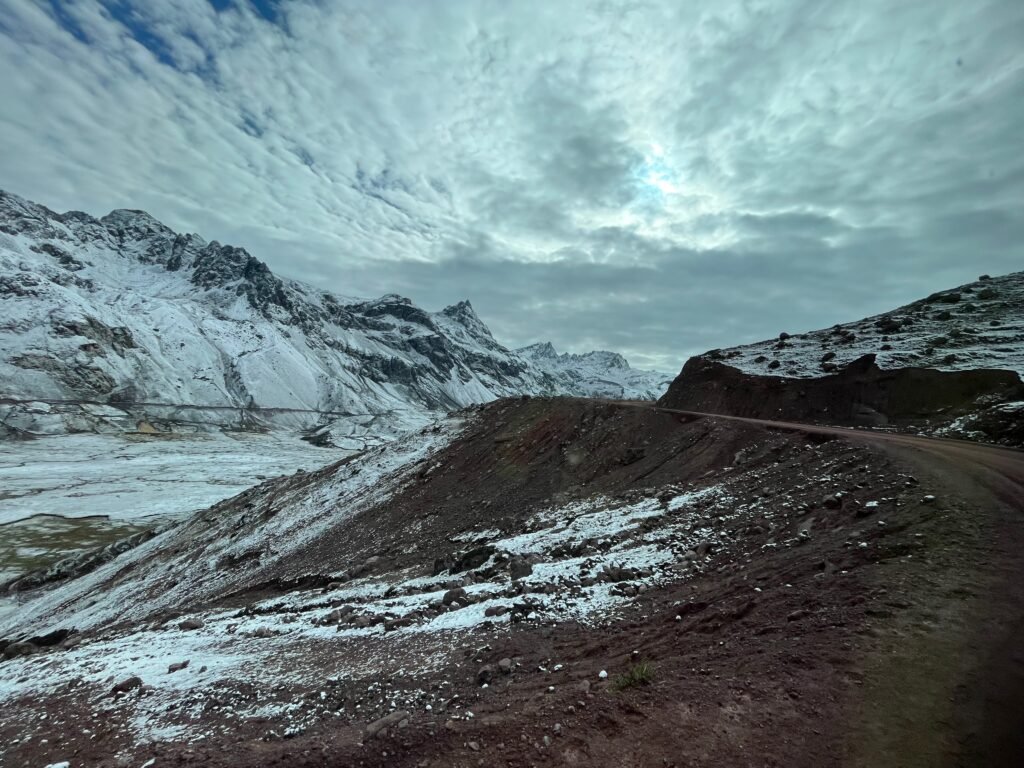
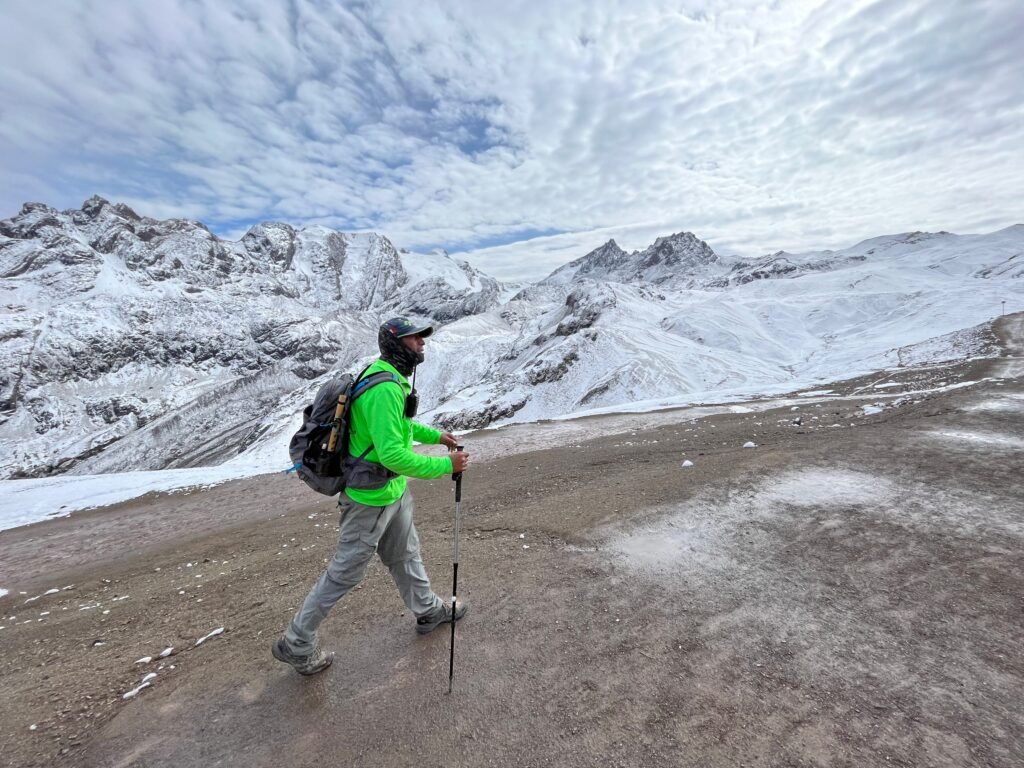
The mountain drive to the upper parking lot was bare dirt but nicely maintained and graded. No guard rails here! As we rolled up through the fog and clouds, we popped out under a winter sky. It had snowed during the night above 15,000 feet and the scenery was simply breathtaking.
The picture is linked to a short video pan of the valley below Rainbow Mountain.
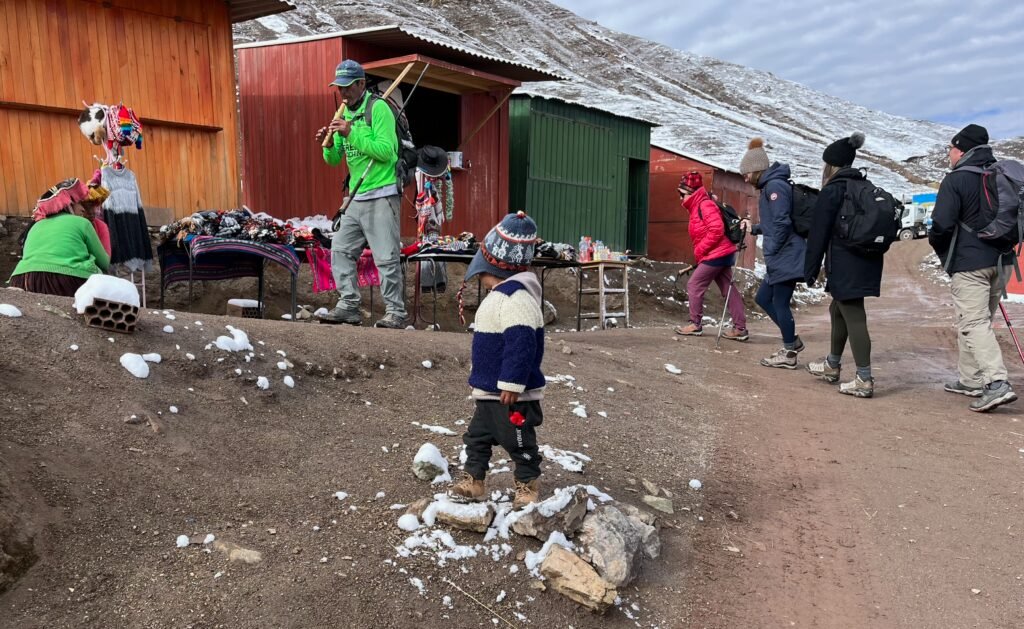
It was a cold morning but many of the locals were wearing sandals.
Apparently, the terracing is natural due to the water freeze/thaw cycles.Always room for a hitchhiker!
We were able to reunite with a Utah family that we met for the Short Inca Trail. And we’d probably follow our Pied Piper Ruben anywhere.
In fact, David had met Ruben about five years ago and had requested him for their guide on this trip! I mentioned how great he has been for us and how he completely changed our expectations.
“Oh, so you know Ruben?” David asked me.
“Oh yeah, Ruben and I go way back,” I replied.
“Really? How far back?”
“Saturday.”
We both laughed, but it certainly seemed like a long time now. And according to him, we were his Champion Team!
Oh the sky, the sky.
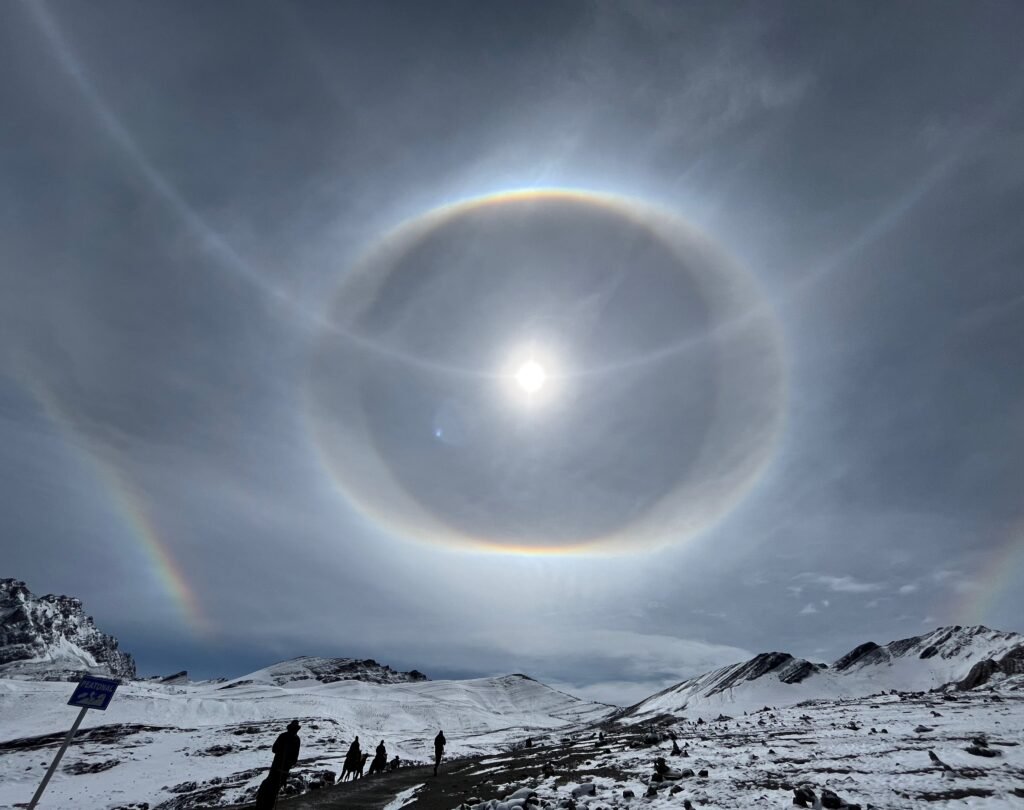
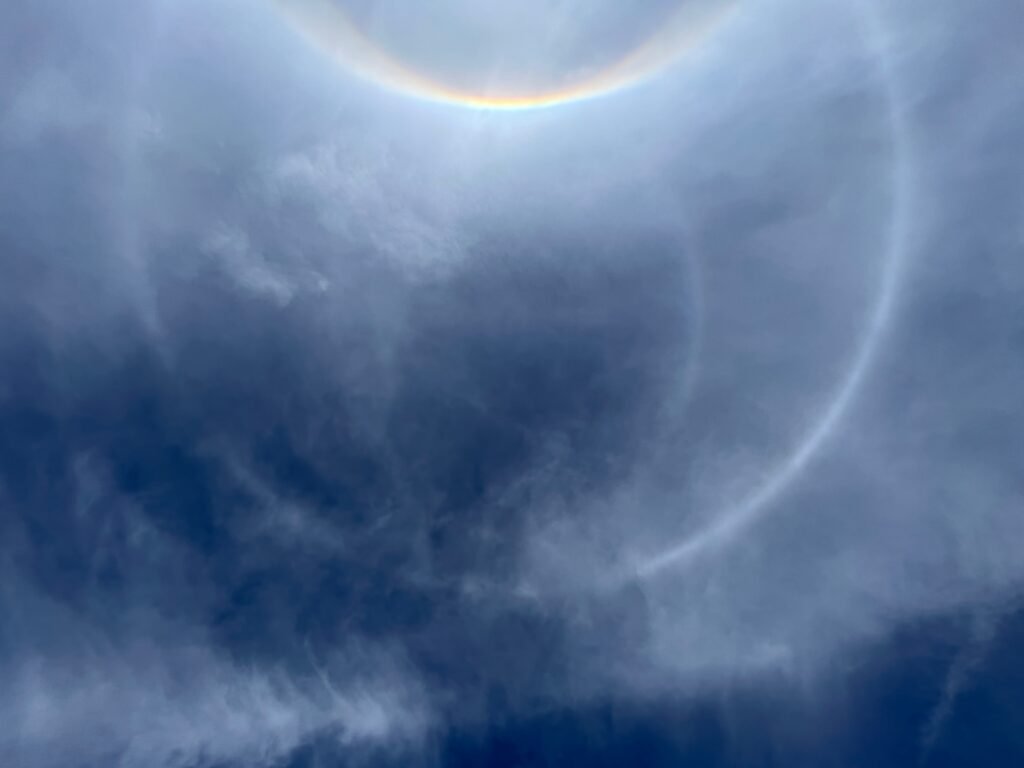
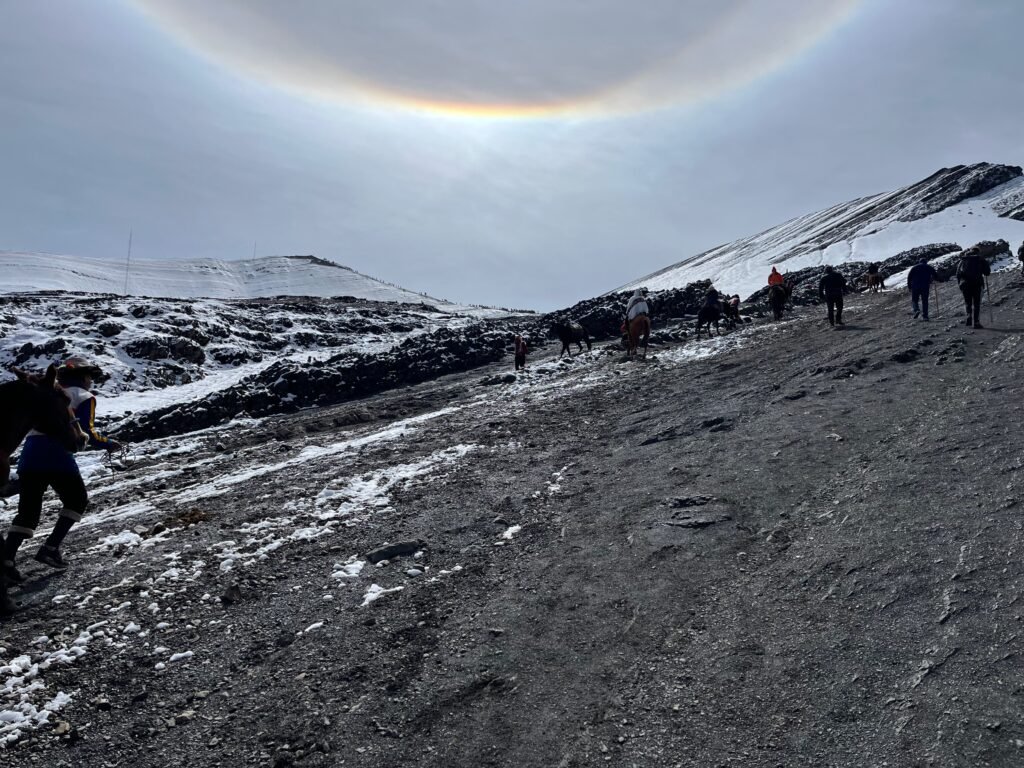
The morning sky and mountain snow were blinding without sunglasses. And the high ice crystals refracted the sunlight into an unbelievable display. I’ve seen ice halos before, but never like this! And it was changing quickly.
The Sun is sitting at the center of two halos. The circular one is a 22-degree halo. But the flattened one around it is called a circumscribed halo and it is tangent to the first at the top and bottom. The big arc that passes through the Sun is a parhelic circle. If you ever see the bright spots that are on either side of the Sun on a wintry day, they’re called Sun Dogs because they dog the Sun. They would be at the intersection of the parhelic arc and the 22-degree halo in the picture.
But there are two more that I’ve never seen. The rainbow arcs in the lower corners of the picture are called infralateral halos, and I think are pretty rare due to the meteorologic conditions required. These two were bright enough to reveal rainbow colors, and arced away from the Sun. So Rainbow Mountain has rainbows all over it!
And even higher in the sky, it looks like I could see the entirety of the parhelic circle, something I’ve never seen.
Now, there’s another arc, called the circumzenithal arc, that forms around the zenith, the point straight above you in the sky. I’ve only seen the little piece of that arc where it touches the 22-degree halo.
But here, I see the hint of the entire circle, which is very cool.
Heading for the Top!
It’s a little over 2 miles and 1,000 feet of climbing to the top. Patricia has almost recovered from her illness, but the altitude is a real deal. I don’t know how many travelers that I’ve talked to that have been surprised with its affect.
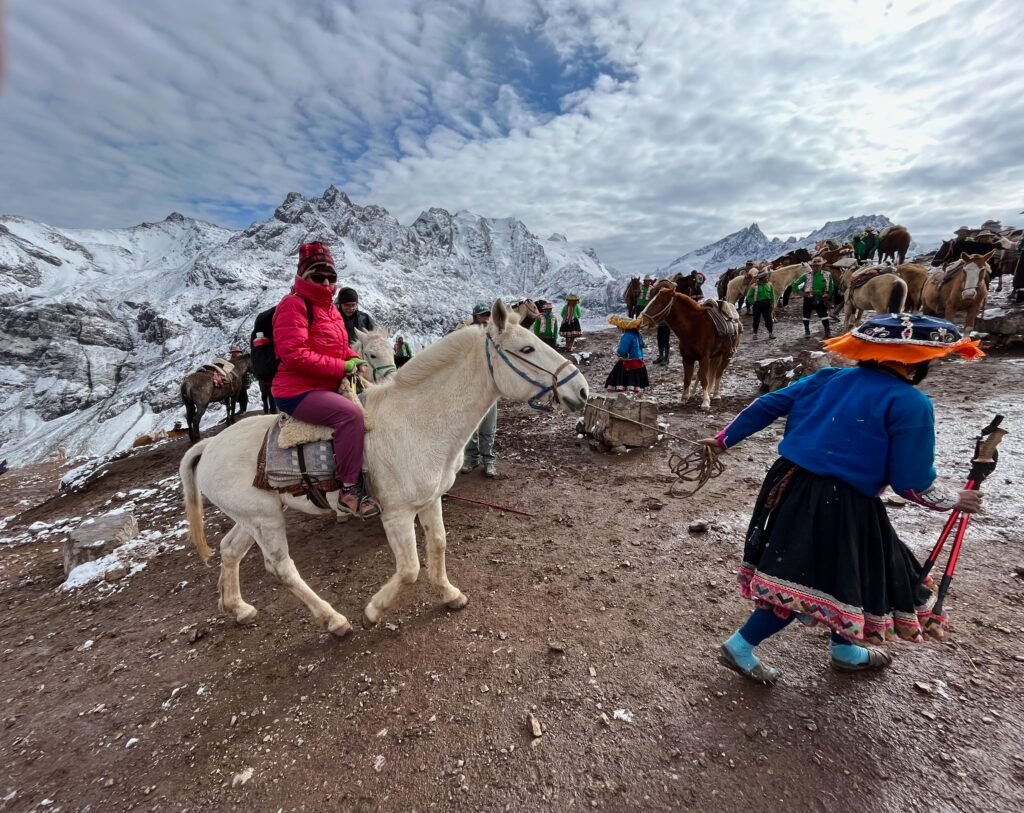
So she decided to take the ‘taxi’ to the base of the mountain and then do the remaining 1/2 mile to the top.
Which, of course, is the steepest part!
Once again, it all seems to be in our favor! The beauty of the morning snow is melting away, and it’s just a gorgeous day.
Patricia started the climb before I caught up to her. The local ladies operating the taxis can hustle along!
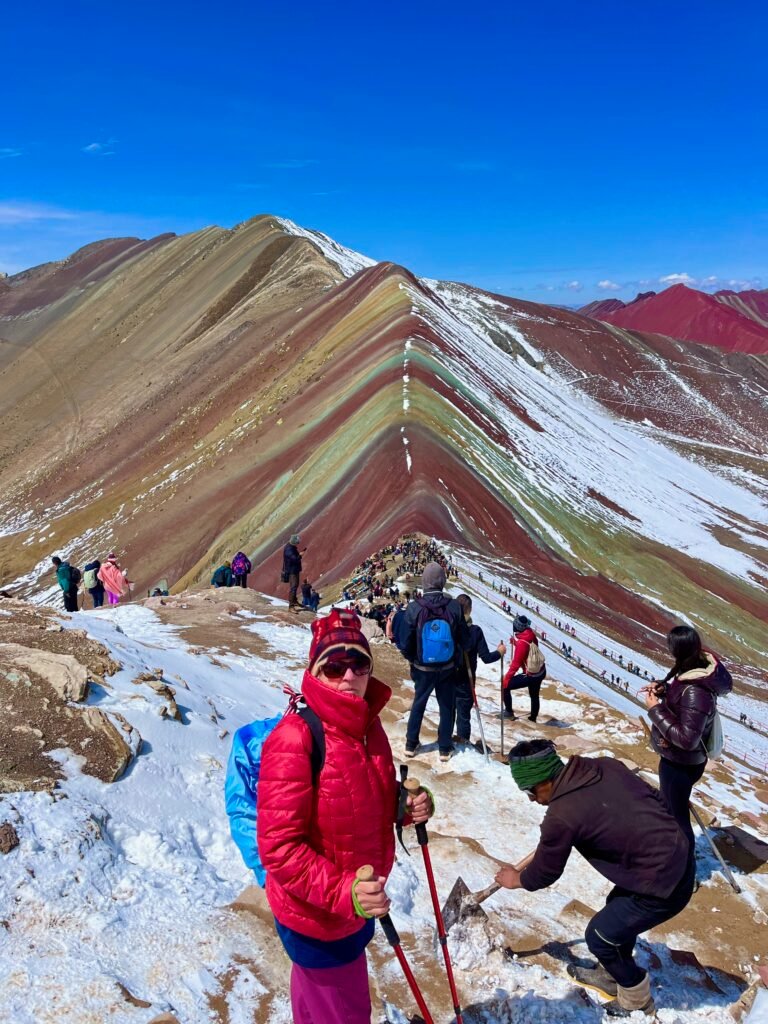
I watched the red jacket working its way up the steep slope with the crowd. Even though the snow was melting, we were all packing it into ice and it was getting a bit treacherous! Several workers were attempting to clean off the path.
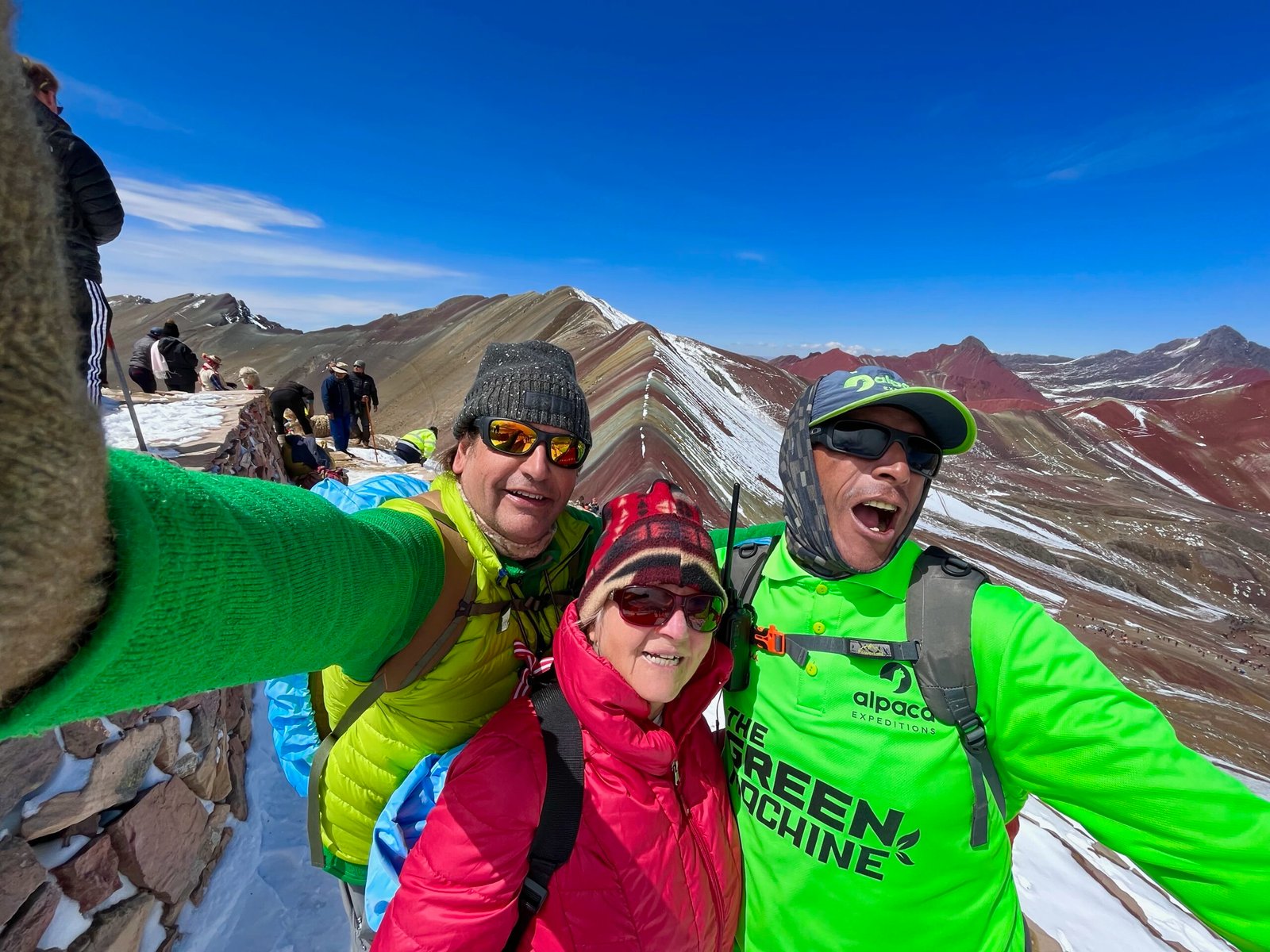
It was a special moment at the top when we came back together. The literal high point of our trip and just a glorious day. And it marks a turning point in our odyssey. It’s been pretty challenging here in the Andes and we’ve had to work hard, adapting to the situations as they come.
Ah, the mountain energy! Can you feel it?
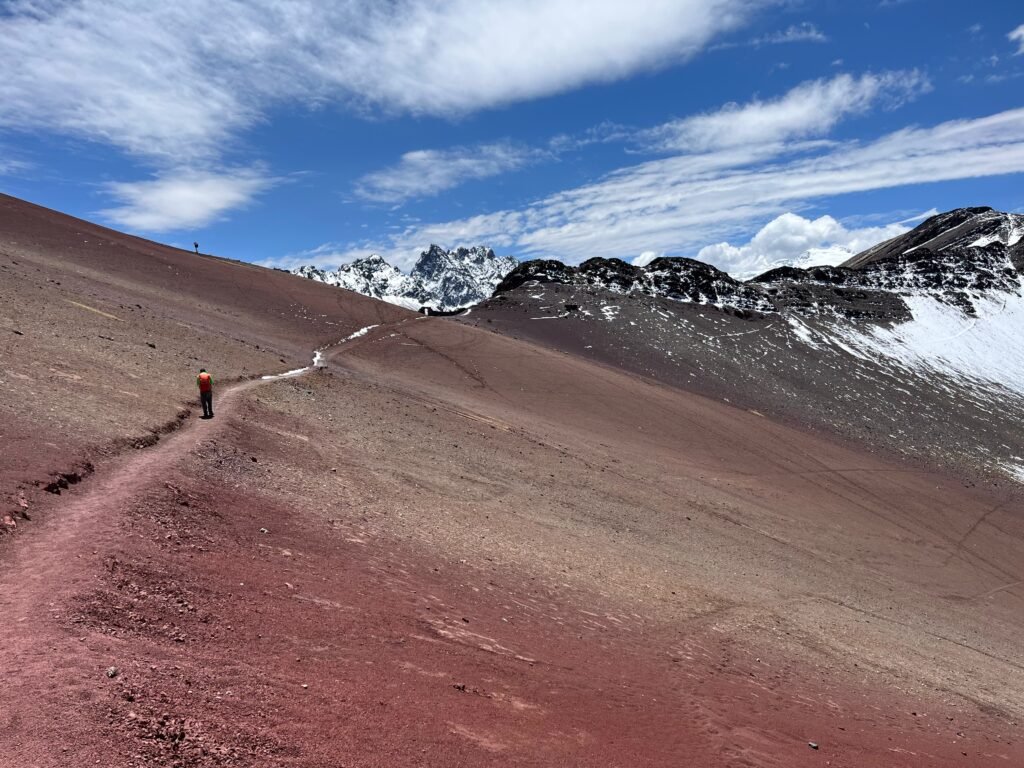
We made our way down to the trail junction to Red Valley. This was another option included in our odyssey that most don’t do, I think partly because of the effort required for the Rainbow peak. I’m feeling pretty great though, and Patricia decided to take the ‘taxi’ down close to the buses while Ruben and I and a young man from New York chose to go see it.
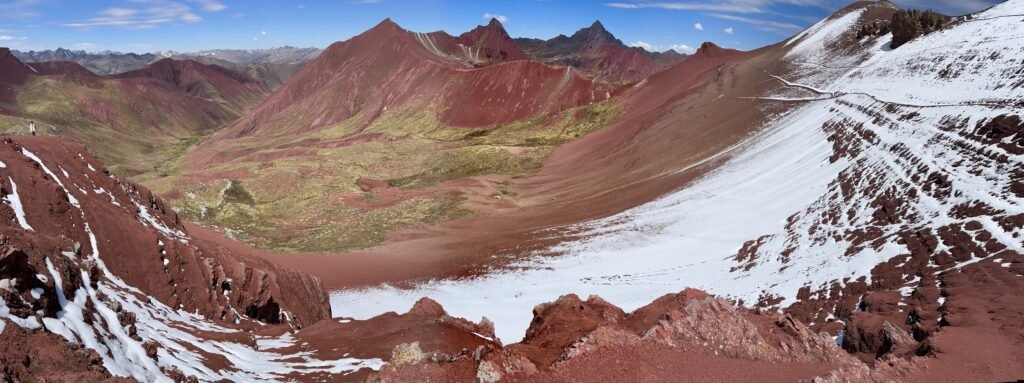
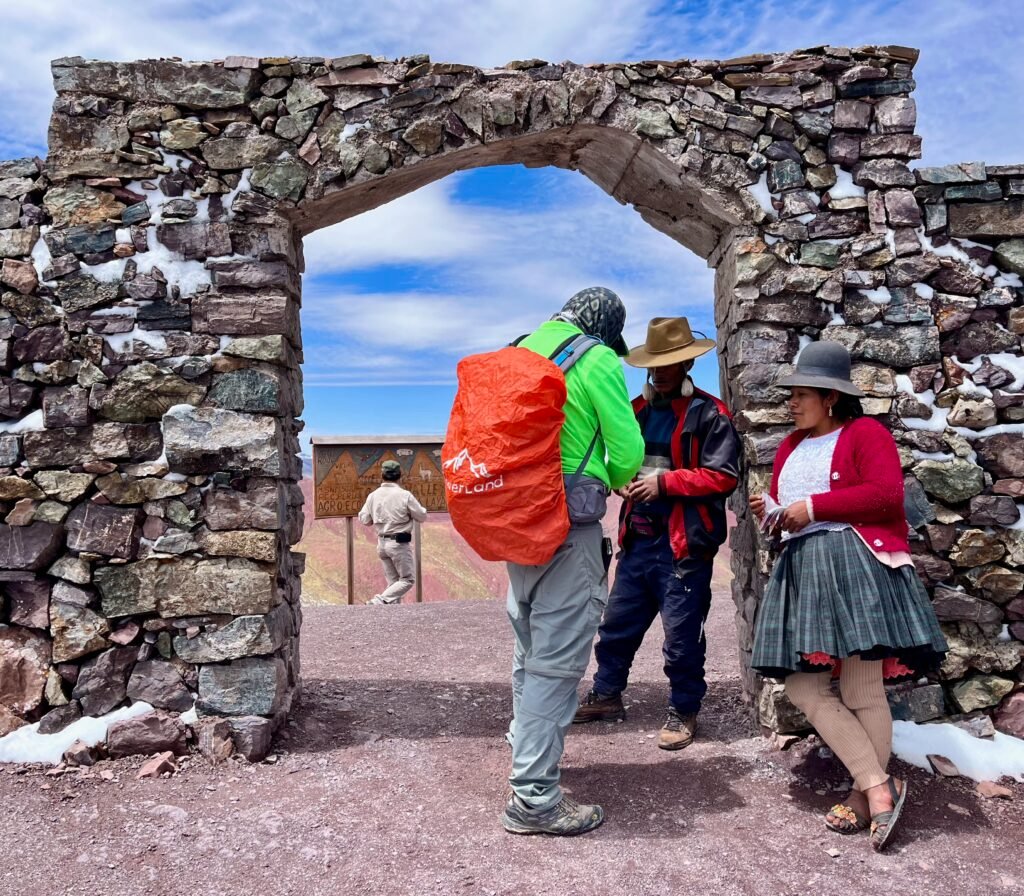
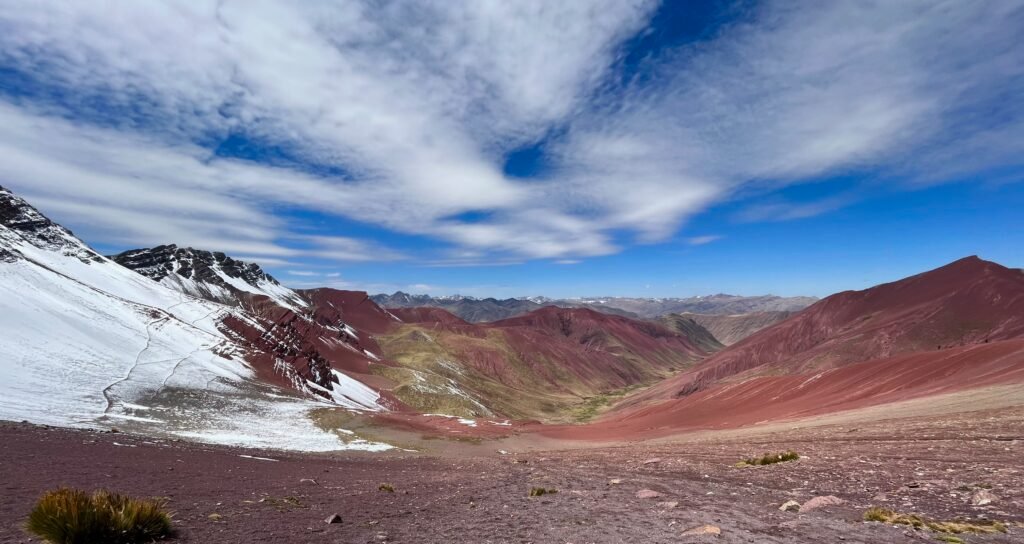
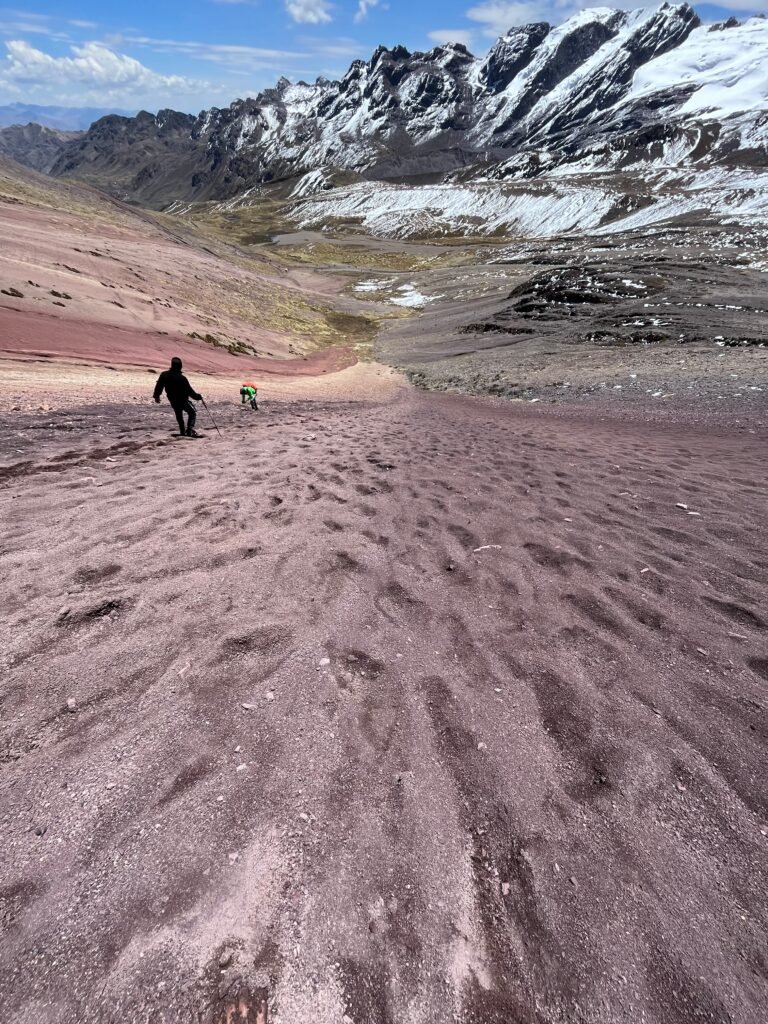
It was less than a mile along the mountain side to Red Valley, not a bad grade at all. There was a stone gate at the ridge where the locals were collecting tickets. As we crossed the ridge, I’ll have to say, the Red Valley was pretty stunning in the remaining snow.
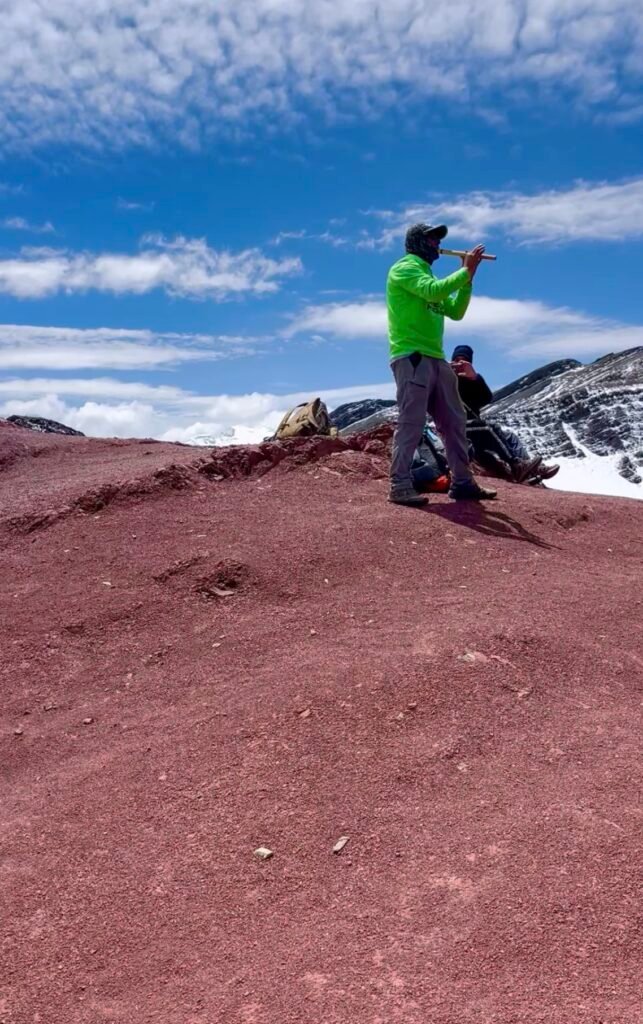
As always, the Pied Piper had his flute. The picture is linked to a video pan of Red Valley, with Ruben’s flute accompianment.
This spot overlooking Red Valley was a special place to him, and we all gave thanks using the coca leaf tradition we had learned this week.
A great way to reflect on our blessings and melt into the mountains.
Every part of the day seemed to be eventful, and the ride out was no different. While it’s impossible to describe the high mountain roads, the picture is linked to a short video that might give an idea.
There’s a treat at the end…
Yet another stellar day among an unending stream of stellar days! Tomorrow we become legitimate tourists, hopping on the bus for an 10-hour ride to Puno on the banks of Lake Titicaca.